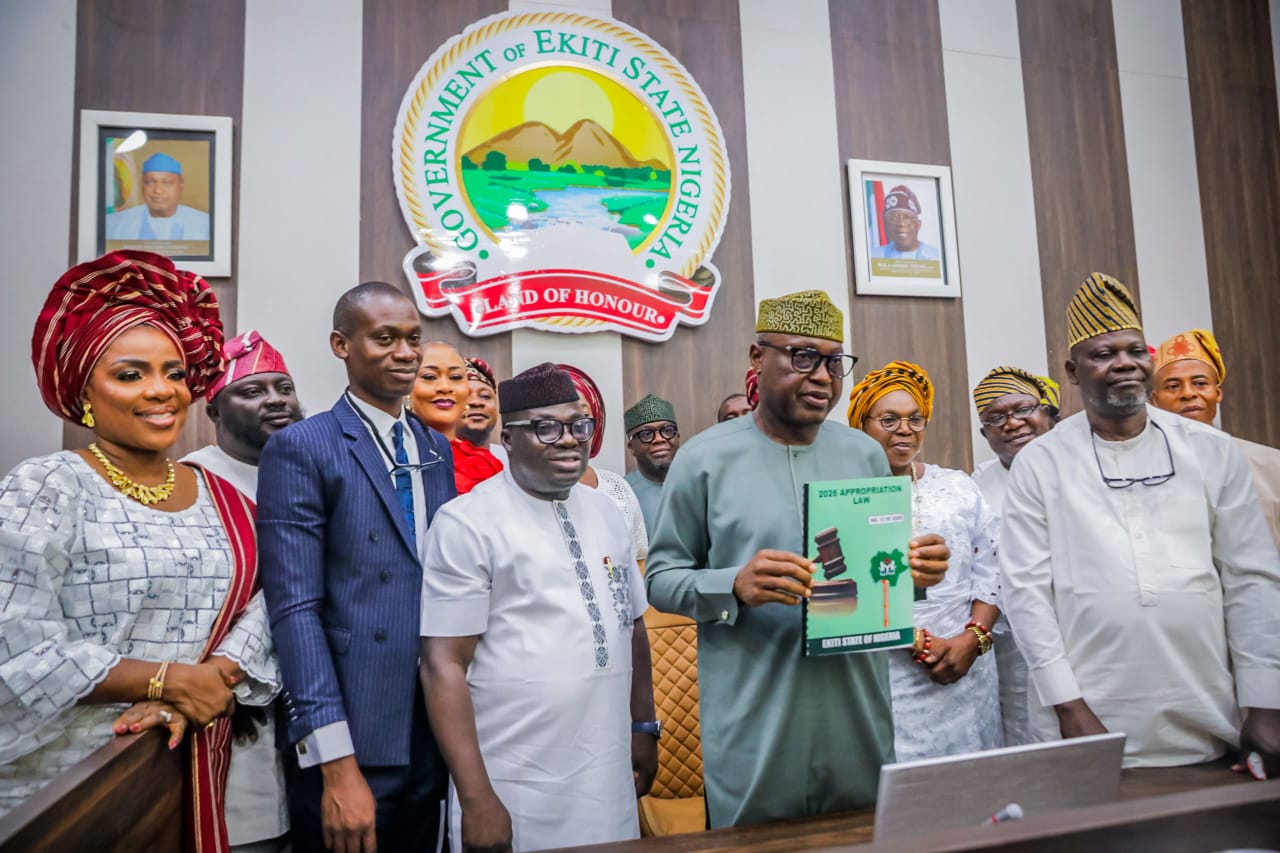
Ekiti State Governor, Biodun Oyebanji, has signed the 2026 Appropriation Law of ₦415,572,070,139.44 into law, pledging to complete all ongoing capital projects across the state.
The budget, tagged “Budget of Sustainable Governance,” was assented to on Tuesday at the Executive Council Chamber of the Governor’s Office in Ado-Ekiti.
Governor Oyebanji said the 2026 fiscal plan prioritises the completion of ongoing projects, while also focusing on food security, wealth creation and infrastructure development.
“As next year marks the end of our first term in office, this budget will enable us to consolidate on the achievements recorded since the inception of our administration on October 16, 2022,” he said.

The governor commended the Ekiti State House of Assembly for the prompt passage of the budget, which he presented on October 10, 2025, noting that it would help revive the state’s economy and advance his administration’s shared prosperity agenda.
Read Also: Tax laws: Atiku reveals areas altered, seeks suspension, probe
Under the approved budget, ₦221.87 billion (53 per cent) is allocated to recurrent expenditure, while ₦193.70 billion (46 per cent) is earmarked for capital projects. This represents an 11 per cent increase over the 2025 budget and is aimed at promoting sustainable growth through fiscal discipline.
Oyebanji also signed into law the Ekiti State Revenue Administration Law, 2025, and the Ekiti State College of Technology, Ijero-Ekiti Law, 2025.
He said the early presentation and passage of the appropriation bill were in line with the 1999 Constitution and designed to maintain the January–December fiscal cycle, while aligning with the Fiscal Sustainability Plan. According to him, this approach allowed lawmakers adequate time to scrutinise the budget and engage relevant stakeholders.

Describing the budget as a product of extensive consultations with residents and prepared in line with global best practices, the governor said its programmes and projects align with the six pillars of his administration, which are derived from the Ekiti State Development Plan (2021–2050).
“In the 2026 fiscal year, we shall strive to meet our revenue targets to ensure the completion of all ongoing projects and initiate a few critical but strategic ones,” he said.
“We will also strengthen our partnership with development partners to support the implementation of specific, non-discretionary projects in the state.”
Oyebanji said details of the budget breakdown would be presented to the public by the Commissioner for Budget and Economic Planning in the coming days.
He expressed appreciation to the Speaker of the House of Assembly, Rt. Hon. Stephen Adeoye Aribasoye, principal officers and other lawmakers for their support and commitment to the state’s development.
“I am extremely grateful for your dedication. I am confident that history will be kind to you,” he said.
Earlier, Speaker Adeoye Aribasoye described the budget as a reflection of the state’s commitment to the wellbeing of Ekiti residents, stressing that the assembly prioritised transparency, accountability and strict adherence to fiscal frameworks throughout the process.
He said the capital expenditure was strategically spread across the economic, law and justice, social and administrative sectors to balance government operations with infrastructure development, social investment and institutional efficiency.
“These laws collectively address revenue integrity, educational advancement and effective resource allocation—the core of sustainable governance which this administration strongly believes in,” the speaker said.