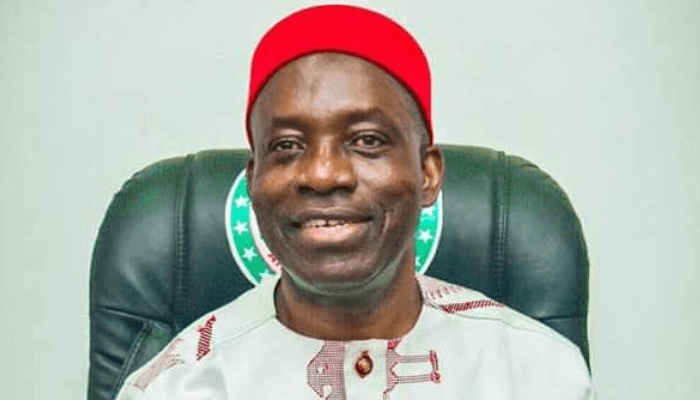
Sometimes in August, I called to remind a caterer of my petty contract with her, which was getting belated. She replied that my job was delayed because she was engaged with ‘ọsọ-Soludo’. Since I did not understand her immediately, I sought clarification, and she told me that she was removing her stocks and other removables from her shop because bulldozers from government contractors were clearing the way for the proposed dualisation of the Ekwulobia-Nnobi road, which would pass through Nkwo-Igbo! People were notified to retrieve all retrievers from their shops before the bulldozers did their duty. People actually felt it would take a long time to come until the machines started ‘active service’ from Ekwulobia and got to Isuofia, Soludo’s hometown. That was when people knew that it was a serious affair. Oso-Soludo literally means fleeing from Soludo, but in this context, it means fleeing from the bulldozers as they start preliminary work on the Ekwulobia-Nnobi highway. Soludo is involved because his government awarded the contract.
Nd’Igbo as a people have engaged in ‘OSO’ twice, when they left their places of sustenance hurriedly and unprepared for ‘home’. But for the people of Igbo-Ukwu, this is the 4th oso in the history of the town. The first OSO was around 1929 when our forebearers protested against the highhandedness of the imposed warrant chief, and the Whiteman, with a troop composed mostly of Black men, came to restore order and, as they usually said, pacified Igbo-Ukwu. It was our fellow Blacks who did us in! Igbo-Ukwu people, mostly the males, fled into the bushes, valleys and mountains in neighbouring towns, and that marked the end of the short-lived rebellion. The second OSO was the Oso-Biafra, which occurred when the rest of the country ganged up against Nd’Igbo, which initially included everybody from Makurdi downwards. It started from the pogrom in Kano and the entire north, and then the ‘police action’ in 1967 and the unequally yoked war, in which most of the world, led by the UK-backed Nigeria, subdued my people. The oso started from the north and then from all parts of the country down to the east, and then from some parts of the east to other parts of the east. My family was luckily not involved in the oso but I remember that some of my father friends from Abba ( in Njikoka LGA)occupied our house at Igbo-Ukwu while several families from Onitsha axis occupied our classrooms at St Anthony’s Primary School Osumenyi, where my father was a an institution as a revered headmaster. All these ended in January 1970, followed by Gowon’s fake declaration of ‘No victor, no vanquished’ and the mouthed policy of 3Rs, which was implemented more in breach.
“The transporters, who were also Igbos, exploited the desperation of the fleeing horde, most of whom sold their household items for less than peanuts at the various motor parks.”
We then had OSO-Abiola, when Nd’Igbo fled from all over the country down east, following the June 12 imbroglio. The transporters, who were also Igbos, exploited the desperation of the fleeing horde, most of whom sold their household items for less than peanuts at the various motor parks. I was so pissed off that I wrote an article, ‘Igbos, when will this stop?’, asking why we should flee even when two cocks were fighting over a hen! And now we have this Oso-Soludo, which is refreshingly quite different from all the previous ‘osos’ that our people have experienced. Even the electric poles fled, as they were being relocated to make way for the road.

The theory of ‘creative destruction’ enunciated by Joseph Schumpeter in 1942 simply states that the old should be creatively and deliberately destroyed for the new to emerge. By a stroke of fate, a Jewish, a Canadian and a ‘Frenchist’ (professors at US, French and British universities) jointly won the 2025 Nobel Prize for Economics, and they wrote of creative destruction. If you don’t like the word ‘Frenchist’, go to court!
Oso Soludo is a positive oso, as the old roads and all that are associated with them are being destroyed to give way to the new road for the good of the people. The oso is not just for Nd’IgboUkwu. Towns from Amawbia to Ekwulobia, Agulu to Nnewi, and Nnewi to Okija, and inhabitants of Okpoko also ran! We know that nothing good comes easy and that any change comes with its own wahala. I mean genuine change, not the Buharian Change.
If OSO-Soludo is the only type of OSO, let us keep on fleeing!

Ik Muo, PhD, Department of Business Admin, OOU, Ago-Iwoye. 08033026625