In 2024, Nigeria’s paint makers reported a 45 percent rise in production costs, as rising expenses hit their bottom-lines.
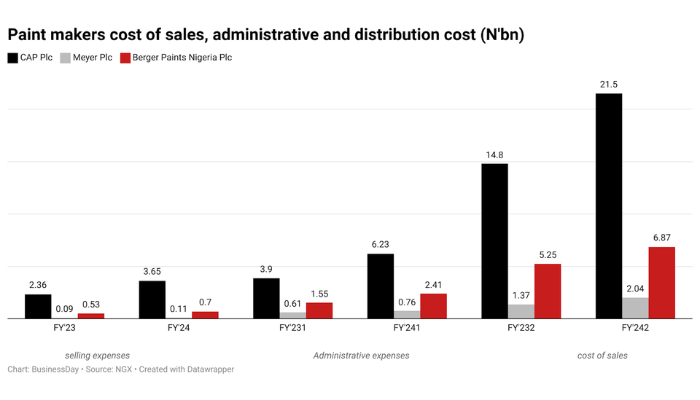
Data compiled by BusinessDay show the total cost of production (cost of sales plus administrative and distribution expenses) of Berger Paints, Chemical and Allied Products (CAP) Plc and Meyer Plc hit N44.2 billion in 2024, which is 88 percent of their combined revenue of N50.21 billion.
That means shareholders are missing out in terms of higher dividends and profits that would have added impetus to their portfolios of returns.
The situation can be attributed to the increase in cost of production due to naira devaluation, which makes it hard for companies to pass on rising costs to already beleaguered consumers in the form of higher prices.

The Nigerian economy has been facing persistent inflationary pressures, with the inflation rate at a 28-year high of 34.8 percent as of December, the latest report by the National Bureau of Statistics (NBS) said. This has had a direct impact on the costs of key raw materials used in paint production, many of which are imported due to limited local alternatives.
“The continued depreciation of the naira has intensified challenges for businesses reliant on dollar-denominated inputs, particularly in the manufacturing sector. A key concern is the volatility of the exchange rate, which complicates financial planning and cost management,” a Lagos-based analyst said.
“Additionally, rising energy costs have placed further pressure on operating margins, making it increasingly difficult for firms to maintain profitability and stability in the current economic climate.”
Read also: Three Nigerian paintmakers’ profit margin falls to 12% in first half
The financial results from CAP Plc revealed that the company’s cost of sales surged by over 45 percent in 2024, with similar trends observed in other listed firms Berger Paints and Meyer production costs amounting to N6.87 billion and N2.04 billion, respectively.

The industry’s reliance on imported inputs such as titanium dioxide, resins, and pigments has left these paintmakers vulnerable to foreign exchange fluctuations. As a result, production costs have escalated, forcing some companies to increase product prices to remain viable.
These companies, despite the harsh economic pressure, reported an increase in sales which amounted to their profit margin rising to 10.9 percent for CAP Plc, 10.4 for Meyer and 5.75 percent for Berger Plc during the period.
Despite the hurdles, Nigeria’s paint sector remains optimistic about the long-term potential as the ongoing infrastructure development and real estate boom continue to drive demand for paints and coatings, offering growth opportunities for firms that can navigate the economic turbulence.
According to the NESG-Stanbic IBТС Business Confidence Monitor for January 2025, the Nigeria service sector continues to grapple with challenges in January 2025 bringing its BCM Index at -1.40 points.
“While this represents a slight improvement from -3.46 points in December 2024, it still signals a subdued business environment characterised by persistent operational difficulties and heightened uncertainty.”
However, real estate, a key service sector, grew to 18.67 percentage points, reflecting the usual seasonal uptick in business activities within the services sector.