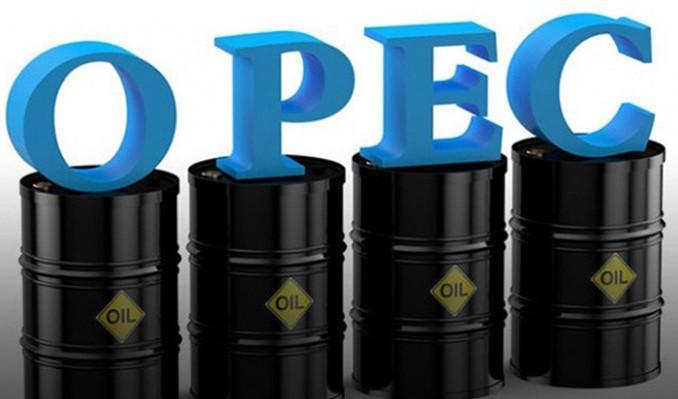
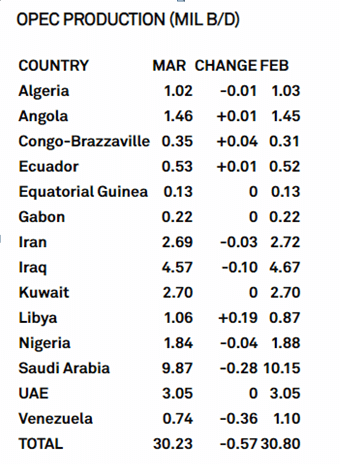
The 14-country oil producers cartel, the Organisation of Petroleum Exporting Countries (OPEC) in March cut 570,000 barrels per day from its February output level, the most in four years as Saudi-let cuts and outages from Venezuela’s weighed on supply.
A survey by S&P Global Platts survey found pumped 30.23 million b/d in the month, the lowest in more than four years, with crisis-hit Venezuela contributing most to the decline

Once OPEC’s third-largest crude producer years ago and still with world’s biggest reserves, Venezuela in March plummeted to 10th, with production falling to 740,000 b/d. That is the lowest in more than 16 years, when a crippling industry strike caused output to fall to 650,000 b/d in January 2003 said Platts.
The country experienced at least 10 days of widespread power blackouts, shutting down its extra heavy crude upgraders, and state oil company PDVSA also exhausted its reserves of naphtha diluent by mid-month, according to status reports seen by Platts.
While Venezuela was able to maintain relatively steady crude exports in the month by drawing from storage, survey participants said they see little reason for optimism.

Many of the upgraders are expected to remain offline, the April 28 US sanctions deadline for non-US entities to wind down their transactions with PDVSA is rapidly approaching, and the continued deterioration in the country’s infrastructure has likely led to some permanent loss of production capacity, analysts said.
Saudi Arabia, OPEC’s largest producer by far, dropped its production by 280,000 b/d in March to 9.87 million b/d, the survey found. That is the kingdom’s lowest since February 2017.
Saudi energy minister Khalid al-Falih has said the country aims to “lead by example” on OPEC’s production cut agreement, which is aimed at draining global oil inventories and bolstering the market, despite pressure from US President Donald Trump to keep prices low.
OPEC and 10 non-OPEC allies agreed in December to cut a collective 1.2 million b/d in supplies through June, and Falih has said he would like to see the deal extended when the coalition meets June 25-26 in Vienna to maintain bullish momentum in the market.
Oil prices have risen almost 30% since the beginning of the year, briefly surpassing $70/b on Thursday, largely due to the OPEC/non-OPEC production cuts. The agreement exempts Venezuela, Iran and Libya, and the 11 OPEC members with quotas under the deal achieved 124% compliance in March, up from 79% in February, primarily thanks to Saudi Arabia?s overcompliance.
The kingdom’s March production level was 440,000 b/d below its quota of 10.31 million b/d.
Iraq, OPEC’s second largest producer, moved closer to compliance with its output cap, as rough weather shut in some production and some voluntary cuts were made, according to the survey. Iraq pumped 4.57 million b/d in the month, a 100,000 b/d decline from February, though still above its quota of 4.51 million b/d.
Iran, which has been under US sanctions since November, produced 2.69 million b/d in March, the survey found. Its output has held relatively steady the last few months, as sanctions waivers the US granted to eight countries to continue purchasing Iranian oil have staved off declines.
The waivers are set to expire in early May, and the US has not announced whether it will renew them.
Libya was the most significant gainer in March, according to the survey, with the restart of the Sharara field pushing the country’s crude output up to 1.06 million b/d.