JP Morgan was touting Nigeria’s local debt as one of its top trades in frontier markets just a week ago. Now, it’s pulling the plug, at a loss.
In a striking reversal, the American banking giant is advising investors to exit Nigerian T-bills and OMO bills, citing a worsening global backdrop, plummeting oil prices, and rising fears of foreign capital flight.
It closed its latest trade with an FX-adjusted loss and warned that if oil remained below $60 per barrel, Nigeria’s fragile current account surplus could flip back into deficit.
“Although the Nigeria carry trade has been one of our highest conviction trades in frontier local markets over the past year, we close our newest iteration of the trade at a loss,” Ayomide Mejabi, head of frontier markets strategy wrote in a note titled “Frontier Local Market Strategy: Reducing Risk Further.”
The OMO bill position (maturing 03/03/26) was entered at a 24.6 percent yield with an FX rate of N1,538/USD. JP Morgan exited at a yield of 28 percent and an FX rate of N1,590, a reflection of both rising risk premiums and the naira’s steady weakening amid dollar shortages.

Nigeria had been a bright spot for frontier investors, with reforms and FX gains powering a rare $6.8 billion balance of payment surplus in 2024, following deficits of $3.34 billion in 2023 and $3.32 billion in 2022.
But as global oil prices slump and the naira weakens, the carry trade is cracking under global pressure.
Oil was on course for a second weekly slump, Friday, after days of wild volatility as the world’s two largest economies escalated a trade war.
Brent steadied near $63 a barrel as at noon after China raised its tariffs on all US goods to 125 percent, but said it will pay no attention to further hikes from Washington. Prices were still headed for a loss of more than 3 percent this week.
The bank’s move underscores growing concern that Nigeria’s economic resurgence may not be resilient to a global slowdown.
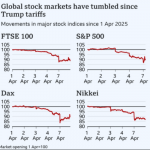
A combination of U.S. trade tariffs and escalating recession fears has flipped sentiment across emerging and frontier markets, and Nigeria is no exception.
“Oil prices below Nigeria’s $60 break-even, if sustained, would drag the current account into deficit. Under such a scenario, we had previously estimated that USD/NGN could move above N1700,” Mejabi noted.

Still, JP Morgan acknowledged the Central Bank of Nigeria’s proactive efforts to stabilise the currency in the wake of the Trump tariff onslaught.
The apex bank sold roughly $550 million to the market last week, more than half its March total, to prevent a disorderly devaluation.
The naira has somewhat benefitted from these interventions, given that it has not weakened anywhere near peer frontier/emerging market currencies.
“When compared to its peers as well as more liquid markets, the naira’s -3.6 percent move against USD over the past week has been reasonable, in our view (it’s been as much as 6.5 per cent weaker at some points),” the bank noted.
Yet the pressure is mounting. Foreign portfolio holdings in local debt are still estimated at $10 billion, and outflows are expected to pick up. Market liquidity, especially in short-term bills, has struggled to match investor exit demand.
“We expect rates to continue moving higher, above 30% in yield terms, as higher premiums are needed for such low oil prices,” JP Morgan said.
While short-term volatility has prompted the tactical retreat, the firm remains “constructive” on Nigeria’s medium-term prospects. It pointed to recent reforms such as the subsidy removal, FX liberalisation, and oil sector restructuring as bright spots that set Nigeria on the right path.
“As we wrote last week before the tariff carnage, we believe Nigeria will stay the course on its reform journey, especially after implementing the more politically difficult measures of eliminating fuel subsidies and allowing the exchange rate to depreciate, as well as become more flexible over the last 18 months.
“We think the changes at the state oil company, NNPC, would bear fruit in the medium term, as oil proceeds should now flow more freely into the fiscal accounts, via the central bank,” Mejabi said in a note to clients.