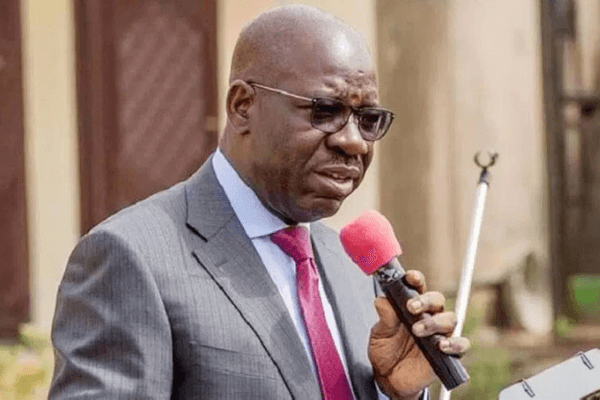
Edo State governor, Godwin Obaseki, has assured of his administration’s commitment to attain Universal Health Coverage with ongoing reforms in the health sector geared towards providing access to responsive, affordable, efficient health services, especially at the primary healthcare centres across the state.
The governor stated this in commemoration of the World Health Day, celebrated every April 7, to mark the founding of the World Health Organisation (WHO).
According to Obaseki, “As we mark the founding of WHO, we are emboldened to press on with our mission to provide access to qualitative, responsive and efficient healthcare services, at the primary healthcare to all Edo residents. We have begun by gradually overhauling the primary healthcare system, a move that brings us closer to attaining Universal Health Coverage in Edo.”
The governor explained that the state government’s healthcare reforms are holistic and far-reaching, and got a boost recently with the right institutional framework, to be driven by the 17-member Edo State Primary Healthcare Board. He noted that the board was inaugurated with a mandate to ensure revamp of the state’s primary healthcare system to be responsive, efficient and effective, in delivering affordable and accessible healthcare.
The governor added that part of his administration’s commitment to providing access to quality healthcare to Edo people and residents is expressed in the payment of counterpart funding for the Basic Health Care Provision Fund (BHCPF), “which will enable Edo State fully benefit from the implementation of the BHCPF, a fundamental funding provision under the National Health Act signed in 2014.”
“In Edo State, we are revamping our Primary Healthcare system which is being built on several pillars, including human capacity, provision of technology and data, quality assurance, financing and infrastructure of the healthcare system to provide a well-package preventive, curative and rehabilitative healthcare services to our citizens,” he said.
In a statement to mark the 2019 World Health Day, in Geneva, Director-General, WHO, Tedros Adhanom, said in 2019 it is simply unacceptable that “half the world’s population cannot access essential health services.
“Millions of women give birth without help from a skilled attendant; millions of children miss out on vaccinations against killer diseases, and millions suffer and die because they can’t get treatment for HIV, TB, and malaria.”
Meanwhile, local government areas in the state have been urged to ensure that their budget timelines are in harmony with that of the state government so as to ensure that development efforts are well aligned to guarantee maximum benefit for the people.
The submission was made at the Medium-Term Expenditure Framework (MTEF) and Budget Process for Local Government Officers across the state, organised by Edo State Ministry of Budget and Economic Planning, in Government House, Benin City, the Edo state capital.
The emphasis of the workshop was on realistic budget preparation using MTEF and National Chart of Accounts (NCOA), and to formulate development plans and work plan that aligns local councils’ plans with that of the state.
One of the organisers of the workshop, Ebuwa Odeh said a major objective of the session was to cascade the state budget processes to the local council level, noting, “The lapses were differences in budget preparation calendar i.e. different timelines between state and local government.”
She said facilitators at the workshop emphasized the need to adopt the National Charts of Account (NCOA) in preparing budgets at the local government level.
She said, “The workshop intends to promote efficiency in the budget preparation using National Charts of Accounts at the local government level which results in realistic budgeting. Also, as the state domesticates national plans and policies, we want local government councils to domesticate state plans.”
The permanent secretary of the ministry of budget and economic planning, Vera Obadan, said that the workshop would boost the capacity of the councils in preparing their annual budgets in line with global best practices.
Obadan told journalists that “gone are the days when different projects are captured in the budget and at the end, they are not implemented. We want to ensure that LGAs’ budgets are activity-based.”