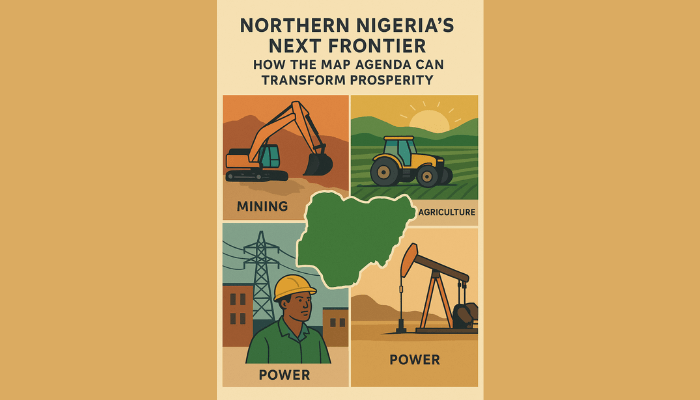
The Northern region of Nigeria is back, or at least, it wants to be. Once the country’s industrial hub in the 1970s, home to thriving textile factories, groundnut pyramids, and bustling trade routes, the region is now making a bold attempt to reclaim that legacy.
- From potential to plan: The logic of the MAP agenda
- The financing question: Turning vision into investable projects
- Governance and coordination: From conference to commitment
- Powering the Transformation: Energy as the Missing Link
- Human capital and security: Building peace through production
- Avoiding old mistakes: What must be done differently
- The window of opportunity
- From promise to proof
Decades of neglect, insecurity, and policy drift left its economy adrift. But a new strategy known as the Mining, Agriculture, and Power (MAP) Agenda is reviving conversations about Northern industrialisation, this time backed by data, investment plans, and regional coordination.
“The North has the minerals, the land, and the sunlight. What it needs now is will.”
Born from the recent Northern Nigeria Investment and Industrialisation Summit, the MAP vision positions the North as the next frontier of national prosperity, a zone capable of driving Nigeria’s diversification, creating millions of jobs, and retaining billions in domestic value. Yet ambition alone is not strategy. The real test lies in turning this vision into a bankable reality.

Read also: How Nigeria can turn painful reforms to prosperity
From potential to plan: The logic of the MAP agenda
Few regions in Africa possess the endowments of Northern Nigeria. Beneath its soil lie vast deposits of lithium, gold, zinc, and iron ore, inputs that fuel the world’s electric vehicle and energy transition industries. Its landmass, over 70 million hectares of arable land, represents nearly 80 percent of Nigeria’s cultivable area. It also holds some of the country’s highest solar irradiance levels, capable of producing over 30 GW of renewable energy if fully harnessed.
Yet despite these natural advantages, the region contributes less than 25 percent of Nigeria’s industrial GDP. The MAP Agenda seeks to correct this imbalance by linking mining, agriculture, and power in one integrated ecosystem, where mined resources feed industrial parks, power fuels processing, and agriculture provides both export earnings and food security.
Its goal is clear: to create five million jobs, raise regional GDP by at least ₦75 trillion by 2035, and turn the North into Nigeria’s industrial heartland. To do so, it proposes a Northern Industrial Development Fund (NIDF) to pool domestic and foreign investment, an interstate coordination council to prevent policy fragmentation, and a Joint Implementation and Monitoring Taskforce (JIMT) to track progress and enforce accountability.
The financing question: Turning vision into investable projects
No vision sustains itself without financing architecture. Nigeria’s past development blueprints, from Vision 2010 to 2020, faltered not from lack of ideas, but from lack of funding discipline and project bankability. The MAP strategy seeks to avoid this trap by proposing a blended finance structure that combines:

- Seed capital from Northern states and sovereign entities to establish credibility.
- Development finance and concessional lending through Afreximbank, AFC, and BOI for catalytic infrastructure.
- Commercial investment tranches targeting private equity and diaspora capital.
- Outcome-linked sovereign guarantees to derisk early investors.
But these instruments will only attract capital if there are bankable projects, not just policy statements. The first test of seriousness will be to identify three anchor projects by mid-2026.
One could be a solar-powered agro-industrial hub in Kaduna, combining irrigation, food processing, and rural electrification. Another modular lithium beneficiation plant in Nasarawa, leveraging global demand for energy minerals. The third could be a hydro-solar hybrid park in Niger State, providing 200 MW of energy to support industrial corridors across the North-Central zone.
Each project must have detailed feasibility studies, transparent procurement, and realistic return models, not just political goodwill. Investors no longer respond to patriotic appeals; they respond to credible numbers.
Governance and coordination: From conference to commitment
Perhaps the MAP Agenda’s biggest challenge lies not in funding, but in governance. Nigeria’s interstate cooperation has often collapsed under political rivalry and changing administrations. To avoid becoming another forgotten communiqué, MAP must be institutionalised through legally binding instruments, enforceable memoranda of understanding among participating states, with measurable targets and joint ownership.
The creation of the Joint Implementation and Monitoring Taskforce (JIMT) is therefore a step in the right direction. But it must go beyond bureaucratic reporting. It should publish quarterly performance dashboards, disclose fund disbursements, and engage independent auditors and civil society monitors. Only radical transparency can build the trust needed for continuity.
A Northern Data Intelligence Hub could further support evidence-based policymaking, aggregating data on investment flows, employment, and production to track outcomes, not intentions.
Read also: How Nigeria can turn painful reforms into long-term gains
Powering the Transformation: Energy as the Missing Link
If mining and agriculture are the engines of the MAP Agenda, then power is its fuel. Nigeria’s chronic electricity deficit, with 13,000 MW installed but less than 5,000 MW available, makes industrialisation impossible without reform. The ₦4 trillion electricity sector refinancing plan recently approved by the Federal Government offers a lifeline. But for the North to truly industrialise, at least 5 GW of new capacity must be dedicated to industrial clusters by 2030.
Renewables must play a central role. Solar farms across Sokoto, Katsina, and Yobe could power agro-processing and small industries, reducing diesel dependence. Mini-grids could electrify rural mining communities and cold-chain systems. Energy must no longer be treated as an infrastructure problem; it is the foundation of productivity and inclusion.
Human capital and security: Building peace through production
Critics often argue that insecurity makes the North untenable. The counterargument is simple: economic exclusion fuels the insecurity itself. By formalising artisanal mining, training youths in new agro-industrial skills, and ensuring host communities benefit through royalties and jobs, MAP can turn extractive zones into productive peace zones.
The plan’s proposal for a Regional Skills Acceleration Programme linked to polytechnics and universities should be fast-tracked. Training 500,000 youths in mining safety, mechanised agriculture, and renewable energy maintenance by 2030 is not just a social policy; it is a security strategy.
Avoiding old mistakes: What must be done differently
Northern Nigeria has seen reform plans before, the Sokoto River Basin scheme, the Anchor Borrowers Programme, and various agricultural initiatives. Most failed because they treated development as a state charity, not an economic enterprise. MAP must learn from this.
To stay credible, three guardrails are critical:
- Transparency and anti-corruption enforcement: Procurement must be digital, public, and open to scrutiny.
- Private-sector discipline: States should co-invest with private partners, not dominate them.
- Conflict-sensitive planning: Land, environmental, and communal grievances must be addressed before construction begins.
Only then can the North transform natural endowments into lasting prosperity.
The window of opportunity
Global capital is now shifting toward critical minerals, green energy, and food security, exactly the assets Northern Nigeria possesses. If the MAP Agenda can align these with sound governance, it could attract billions in foreign investment and reposition Nigeria as a key supplier in global value chains.
But time is short. Investors have choices. Without early wins, enthusiasm will fade. The first ₦10 billion contribution to the Northern Industrial Development Fund by Q2 2026 must not be another promise; it must happen. That single act will test whether the North’s leaders mean business, literally.
Read also: Naira rises to most competitive currency as reforms pay off
From promise to proof
Nigeria has reached the point where potential no longer impresses; only proof does. The MAP Agenda presents a blueprint to turn Northern Nigeria’s abundance into shared prosperity. Yet its success will depend on execution discipline, data transparency, and inclusive governance.
If implemented faithfully, the North could move from subsidy dependency to productivity and from resource extraction to industrial transformation. But if it remains trapped in PowerPoint projections and political cycles, it will join the long list of Nigerian reforms that died on the tarmac of good intentions.
Northern Nigeria has waited decades to reclaim its role as an engine of growth. The world is watching. The question now is not whether the MAP Agenda is visionary; it is whether it will finally be real.