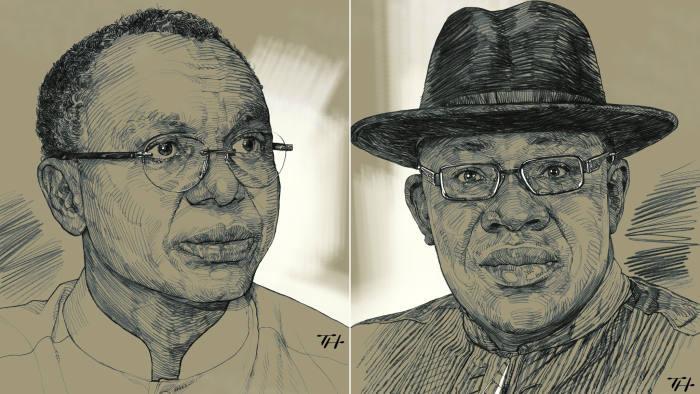
As Nigeria prepares for next year’s elections, the Financial Times spoke to two sitting governors about the challenges facing their states and the country. Technocrat Nasir El-Rufai has run northern Kaduna state since 2015. He is a close ally of President Muhammadu Buhari in the ruling party, the All Progressives Congress. One Lagos-based businessman close to him calls Mr Rufai the enfant terrible of Nigerian politics — an accidental politician who is criticised for being divisive. Kaduna, the third most populous state, is a core constituency for the presidency and has a history of communal violence. Clashes last month left dozens dead and parts of the state under curfew.
Former police officer and lawyer Henry Seriake Dickson has governed Bayelsa state, in the oil-rich Niger Delta, since 2012. The governor is a member of the opposition People’s Democratic Party, in one of its regional strongholds. Bayelsa is one of Nigeria’s top crude producers, and oil is at the centre of its economy — and its security challenges, when militancy flares up in the delta. These interviews have been condensed and edited for maximum clarity.
What are the biggest challenges facing Kaduna state?
The challenges that we face in Kaduna are in many ways the same challenges that face all of Nigeria — we have a young population. They can be a source of opportunity for the country; they can also be a source of peril. It all depends on how aggressively we are able to invest in their education, in their health and in the creation of opportunities to empower them to unleash their entrepreneurial and other talents. This is our biggest challenge, our demographics, and the fact that it is a largely agricultural [economy] . . . so we are trying to aggressively pursue agro-industry.

The other set of challenges has to do with security. We inherited a cattle rustling problem in Kaduna, which more or less decimated the livestock sector. Kaduna was the leading producer of milk until rustling largely destroyed livestock in the state. We worked with other states to fight cattle rustling, and worked with the federal government . . . but a new phenomenon emerged: kidnapping. The cattle rustlers have started rustling humans. In Kaduna, we have an ethnic intolerance problem because whenever there is a dispute between groups from different ethnic groups, they tend to fall into communal crisis. The final one in my view is the fact that Kaduna, like many states of the federation, is dependent on the federal government for survival . . . The danger of federation account dependency is when oil prices collapse you wake up overnight and find yourself distressed, and many states found themselves in that situation in 2015.
What are the biggest opportunities for Kaduna?
Because of the size of our state and the fact that we’re a transport state into northern Nigeria . . . many consumer good producers have a heavy presence in Kaduna, from where they feed the northern states. Services is the second biggest component of gross domestic product and that is all around goods production and distribution. Another big untapped resource is mining — Kaduna has large deposits of gold. The other area [where] we have comparative advantage is education — we have the largest concentration of tertiary education institutions of any northern state. So private education is another area of opportunity to serve northern states.
What do you make of your party’s chances in February?
I’m optimistic. I have not seen any candidate yet from any party who can defeat President Buhari. Some people have expressed concern about the conduct of the elections and likelihood of violence, and I am not that worried . . . All the loopholes that gave rise to manipulation of elections and rigging of elections that ultimately are the triggers for violence have been taken care of [by the Independent National Election Commission]. And based on everything I know — including polls we’ve done — President Buhari will emerge victorious. It’s going to be hotly contested, but we are going to win because the other parties just don’t have the footprint we have across the country, and don’t have the kind of [pull among the people] that President Buhari has as a candidate.

What are the biggest challenges facing Bayelsa state?
We’re at the peak of the Atlantic Ocean . . . that means that our terrain is quite challenging. The entire state is below sea level, making . . . the task of developing even roads and bridges and typical infrastructure very expensive. The cost is almost 15 to 20 times more than you have in drier areas. The challenge of social stability [has been] caused by a combination of factors: insufficient investment in education over the years and then the work of the oil companies and the destruction it has caused in the social lives of our people; the militancy that came because of some of that. It makes Bayelsa wholly dependent on the federal government. When the recession came, our revenues plummeted, and for a young state [that was difficult]. But even the oil companies have no presence here other than working in creeks. Their offices aren’t here so they don’t pay tax here — by law they pay tax to the big cities where they’ve been working for years, not in Bayelsa.
What are the state’s biggest opportunities?
Education, which is very, very serious, it’s almost the number one priority of my government.
We made a declaration of emergency while I was taking my oath of office . . . there was a lot of feeling that it was political empty talk as usual, but almost seven years down the line everyone has seen we meant business when we said education was going to be free and compulsory. Our thinking is that if you get education, if you spread education and opportunity and you invest in that area, then a number of the other challenges will naturally take care of themselves. But Bayelsa is a land of opportunity. It’s a state that is one of the fastest growing, fastest developing. We’ve been working to create the potential infrastructure to promote growth, to promote economic opportunity that can be the basis for an inclusive growth.
How do you view the PDP’s chances in February’s elections?
My party is in a good position and, of course, I wish my party the best and to win . . . Every election is a referendum on the incumbent. But let’s see how it goes. [As the ruling party], they have a lot of power, the capacity to influence negative outcomes.
But the president’s party ran on three key fronts: they ran on the economy. They said they were going to make the economy work, make it better. Right in their first year, the economy collapsed. We can debate several reasons why Nigeria went into recession . . . but one of the theories is that that collapse could have been dealt with by proactive policies. The president also ran on anti-corruption . . . but [that] seems to be ineffectual and merely political. And they ran on national security. They say they defeated Boko Haram, but they are still alive and kicking. [Then there is] a pogrom going on in the middle belt, and I don’t think it’s tenable for the ruling party to claim that they have advanced the cause of national security. It’s difficult for them to claim that it is safer today than it was in 2015.