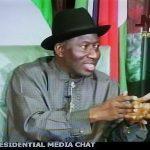
President Goodluck Jonathan yesterday said the Federal Government had no plan to change the pump price of premium motor spirit (PMS), popularly known as petrol, allaying fears and speculations that the government had discreetly increased the price as some filling stations were reportedly selling above the approved price of N97 per litre.
President Jonathan also spoke on the employment target by the SURE-P, the World Economic Forum on Africa (WEF) holding in Abuja this week, the insecurity situation in the country, efforts of government at rescuing the abducted school girls in Borno, among other issues.
In his reaction to a question regarding manipulations of petrol pump price at some filling stations in the country during the presidential media chat last night, Jonathan said he would set up a machinery to look into the situation, adding that it is a criminal offence for any marketer to manipulate the pump price to extort Nigerians.
“I can’t increase the pump price through the back door. Nobody just wakes up and changes pump price. If I want to change the price, I will do it openly and announce to Nigerians before doing it. But I have no plans now to change pump price,” the president said.

Noting that the Department of Petroleum Resources (DPR), the governmental agency charged with the responsibility of regulation and supervision of all the operations being carried out under licenses and leases in the oil and gas industry, must do its work, Jonathan stated that from Monday (today) the agency would verify if the manipulation of the pump price is happening.
Commenting on the power supply situation in the country, the president said the privatisation of the power sector would leave the country in a better situation.
“With the steps we have taken, we can’t go back to the time in the past when we were generating 2,000 megawatts,” he said, adding that the progress was slow because of challenges including gas supply and funding by the new investors, which he said were being addressed.
“The situation will surely improve. We are looking for ways to get funds to invest in the gas sector.”
Speaking on the alleged missing oil revenue leveled against the Nigerian National Petroleum Corporation (NNPC), the president stated that a forensic audit was ongoing, adding that the Senate had told a consultant to look into the matter.
“If anybody or group of persons steal $20 billion, this country will know,” he added.
On the probe of the minister of Petroleum Resources over the alleged N10 billion spent on chattered aircraft, reportedly stalled by court order, Jonathan said he was not aware that the oil minister had gone to court to stop the investigation.
The president said the government was working very hard despite challenges, to improve the environment to propel job creation in the country by the private sector. “The greatest problem we have is stabilising power (electricity). By the time we stabilise power, the private enterprises that will create more jobs will spring up. We are trying to reduce the number of people that government pays salaries so that we can invest in infrastructure that will enable the private sector create more jobs.”
Commenting on the World Economic Forum (WEF) on Africa, scheduled to hold from May 7 to 9 in Abuja, the president said it would be a viable forum for Nigeria to showcase the opportunities in the country and attract foreign investments.

“A lot of the people that will come for the WEF are coming for the first time and they are global business people who have indicated interest to come to Nigeria for one business or the other. For our local players, it gives them the opportunity to know where they can access fund. We need to encourage the private sector,” said Jonathan.
Urging citizens, particularly, residents of the Federal Capital territory, to make sacrifices during the period of the event, the President said the restriction of movements was to ensure the success of the occasion. He noted that other countries make similar sacrifices during big events in their domains.
Noting that source of funds and infrastructure are part of the greatest problems of the private sector, according to the World Bank, the president said the government was addressing the power situation as well as constructing major road networks.
On employment generation in the country, he said the Subsidy Re-Investment and Empowerment Programme (SURE-P) set the target of employing 350, 000 young Nigerians nationwide under its community service initiative.
He said government cannot do it alone, further adding that the onus lies on the Organised Private Sector (OPS) to create more employment opportunities for the citizenry.
According to him, the federal government is working assidously to create a conspducive regulatory andoperatng emvironment for businesses to thrive. “At the level of the SURE-P, we set up something called community service and our target was to employ 10, 000 Nigerians in every state.”
He pointed out that the Small Medium Enterprises (SMEs) sector is critical to driving economic development and job creation, stating that the Nigerian government can only create 35 percent of jobs in the country.
“There is nowhere in the world government employs everybody. It is the private sector that should create jobs”. Jonathan enjoined the OPS to increase the level of participation in the agricultural sector, but revealed that spate of insecurity in north is jeopardising the implementation of country’s agricultural policy.
A number of foreign multinationals and companies have indicated interest to set up production plants and factories in Nigeria, Africa’s largest economy, according to him, which re-emphasises the need to speedily resolve Nigeria’s power crisis. “We are working very hard even with the challenges in power.
“We are trying to stabilise power. By the time we achieve that, the private businesses that would spring up will create jobs”. “What people want to hear is that the civil service commission has employed 1.5 million people”, he explained. Jonathan called on foreign governments, especially developed nations of the world to work with the Nigerian government to fight the insurgency in the country. He however bemoaned the lack of support from the United States (US) government. “Sometimes the US government is reluctant to assist, citing issues of human rights violation. Without superior intelligence, you cannot tackle terrorism”, added Jonathan.
The President, who said he never said Boko Haram had infiltrated his cabinet, explained that when he made the statement, he used the word “government”.
“I never said that Boko Haram has infiltrated my cabinet. Cabinet is made up of the President, vice president and the ministers. But government is made up of three arms- the executive, the legislature and the judiciary. You’ll remember that a senator was prosecuted; we are still investigating some in connection with their alleged roles in Boko Haram activities,” the President said.
President Jonathan, who extensively dwelt on the sad incident of abduction of school children in Chibok, Borno State, urged the cooperation of parents and guardians of the victims to enable government determine the appropriate approach to solving the riddle.
He also explained that government was in advanced talks with the United States of America and other nations who have indicated interest to assist Nigeria in the fight against terror, expressing optimism that in no time at all, positive results will be achieved.
Debunking the insinuation that the abducted children may have disappeared for ever, Jonathan said: “These girls are not another Malaysian plane that disappeared without any trace. There are even rumours that some of the girls have been married out; married out to where?”
President Jonathan, who faulted the attempts in some quarters to dress the Boko Haram sect in the same garb with the Niger Delta militants, and also shut the door of negotiation with the Islamist sect, said: “You cannot negotiate with somebody you don’t know; nobody has even claimed responsibility for the abduction of the school girls… It is a mistake for people to say the Boko Haram sect is doing the same thing as the Niger Delta militants. I tell you that the Niger Delta militants are different from Boko Haram. I am not trying to defend them because I come from that area. The Niger Delta militants had reason for their agitation, and when you call them for a meeting, they’ll tell you the reason for their agitation. The approach and mentality are different. The Niger Delta militants did not go to parks and begin to kill innocent people. Terrorist activities of the Boko Haram are different from Niger Delta militants’ approach.”
The President also refuted the allegation that some helicopters were dropping materials for Boko Haram members in Borno State. He said: “People are just making frivolous claims that are not verifiable. Nobody has shown us a clip of the helicopter dropping supplies or the particular point where it happened.”
Jonathan, who also refused to believe that the scale of insecurity had increased, pointed out that government had been able to curtail the insurgents to certain extent.
“If people are saying that things are getting worse, it may not be true because there was a time when the bombs were going off every Sunday. But we have been able to curtail that. If they are saying so because of the Nyanya it is understood. Let me once again say to Nigerians that we appreciate their pain and feelings, but I want to reassure everyone that we’ll surely get over these trying moments.”
Zebulon Agomuo, Ben Uzor Jr and Femi Asu