Nigeria’s lost a total $467 million in July due to shut-in of production from leaking pipelines carrying crude oil from wells to flow stations in the Niger Delta, where more than 90 percent of the country’s crude are explored.
The loss comes from 6.29 million barrels of crude oil that the Nigerian National Petroleum Corporation (NNPC) said in its August monthly report that it could not take to the market due to shut-in of pipelines in July.
Further analysis into previous monthly reports of NNPC showed inconsistency in the records of pipeline vandalism as there was no detailed records of pipeline vandalism in the month of January, February and March and while the records given in the month of April, February and July given were not well explained.
Petroleum and associated products are transported through extensive network of pipelines in Niger Delta. They are usually susceptible to sabotage from militants who usually break the pipelines to illegally tap crude oil. But sources in the oil and gas industry also admit that most of the pipelines are old and hence easily susceptible to damage and leakages.
The August monthly report of the NNPC show that in July alone pipelines leading to five leading terminals for crude exports suffered major leakages costing the country several millions of dollars in lost revenue. The $467 million (N168 bn at US$/N360) is more than the N128 billion transferred by the NNPC into the federation account in July. This represent significant loss of revenues to both the federation and state governments, who are already struggling with significant revenue shortfalls, forcing them to resort to raising debt to finance their governance obligations.
READ ALSO: Investors bet on Nigeria with N800bn sealed deals in Jan 2013
The $467 million loss to pipeline leakages also compares with just $450 million Nigeria received as export earnings in August, an indication that that receipts from export earnings could be twice higher, if leakages can be eliminated.
Sources in the oil and gas industry have told BusinessDay that the country’s pipelines are not only old but are poorly secured, thereby making them easy targets of repetitive attacks by vandals.
The NNPC August monthly report shows the five terminals that had major shut-in as a result of leakages connecting them to major oil wells include; Bonny Terminal, Forcados Terminal, Erha Terminal, Usan Terminal and the Agbami terminal.
“Bonga, Yoho and Odudu terminals were also shut down for varying days for Christmas-tree change-out, Scrubber leak repairs and Rig movement respectively,” according to the NNPC August performance report.
Combined production shut-in from all the five terminals in July was 6.29 million barrels worth, with a total value of US$467 million, using the average price of the International Brent crude, the benchmark for Nigeria crude oil which sold for an average price of $74.4 in July.
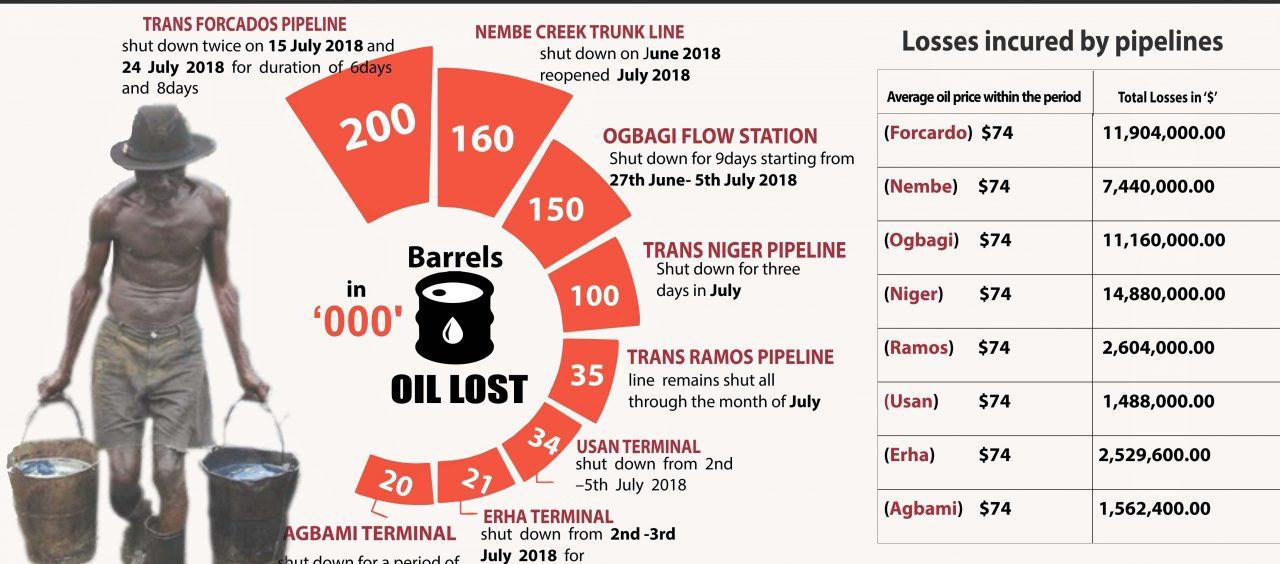
A breakdown of the various shut-ins showed that 160,000 bpd worth $11 million was lost when the Nembe Creek Trunk Line (NCTL) was shut down on June 8, 2018 “due to leaks at San Barth, Owangai and Elem Kalabari” The pipeline was reopened in July 2018.
Another 100,000 bpd worth $7.4 million was lost when the Trans Niger Pipeline (TNP) leading into Bonny was shut down due to leaks at Rumukrushi area for three days in July while the Ogbagi Flow Station was also shut down for maintenance for a period of nine days starting from June 27 to July 5, 2018 causing a shut-in of about 150,000bpd.
Similarly, the Trans Forcados Pipeline (TFP) was shut down twice on 15 July 2018 and 24 July 2018 for duration of six days and eight days respectively due to observed leaks in the Otegele and Batan areas leading to a production shut-in of about 200,000bpd worth $14 million. The pipelines only came back on stream July 31, 2018.

Also the Trans Ramos Pipeline was shut down in April 2018 due to leaks in a creek crossing around Odimodi area with a loss of approximately 35,000bpd worth $2million as production into Forcados Terminal remained shut all through the month of July.
Oil production in the Erha Terminal was shut down from July 2 to 3 2018 for maintenance with production shut-in of 32,000 bpd worth $2.0 million and again on July 19 to manage the tank top with cut back of 20,000 bpd worth another $1.4 million.
Usan Terminal was shut down from July 2-5, 2018 to manage the Top tank resulting to shut-in of 34,000 bpd worth $2.5million while the Agbami, Terminal Production loss of 21,000 bpd worth $1.5million due to plant emergency shut down for a period of 4 days with effect from July 1, 2018.
NNPC admitted that Payments into the Federation Account were affected after adjusting crude and product losses and pipeline repairs and management cost incurred during the period.
NNPC pipelines suffered a total of 1,828 vandalized points in the 12 months between August 2017 and August 2018 fuelled mainly by crude oil theft and vandalism, with the corporation admitting that this incessant vandalism has put it at disadvantaged competitive position. The corporation said it spent N1.4 billion for pipeline repairs and management in July alone.
Speaking to BusinessDay on the challenges the NNPC looks to be having with its leaking pipelines, Ademola Henry team leader at the Facility for Oil Sector Transformation (FOSTER) questioned why government is still operating pipelines when it is such a high cost centre.
“Anytime NNPC cannot find anywhere to hide expenses that they have incurred, they just recorded them as loses under pipeline repairs, which is very sad,” Henry said by phone.
He advised that the federal government should “deregulate the sector and commercialize the pipelines and allow it operate on a tariff model which will further block leakages.”
“The allegation in the industry now is that the biggest beneficiaries of pipeline vandalism are the Military’s Joint Task force, which is very sad,” Henry concluded.
Ayodele Oni, energy partner at Bloomfield law practice said the problem of pipeline vandalism is broad. “When you have problem surrounding unemployment, corruption, poverty, neglect and lack of social infrastructure this is what you get.”
“Government needs to give the locals a sense of belongings like job opportunities, education, and infrastructure and stop giving money to local chiefs,” Oni told BusinessDay.
The energy partner at Bloomfield Law practice said Nigeria is too dependent on pipeline and needs to develop an alternative transport system for easy movement of crude oil like the opportunity offered by a functional rail system which is what other countries are doing.
DIPO OLADEHINDE