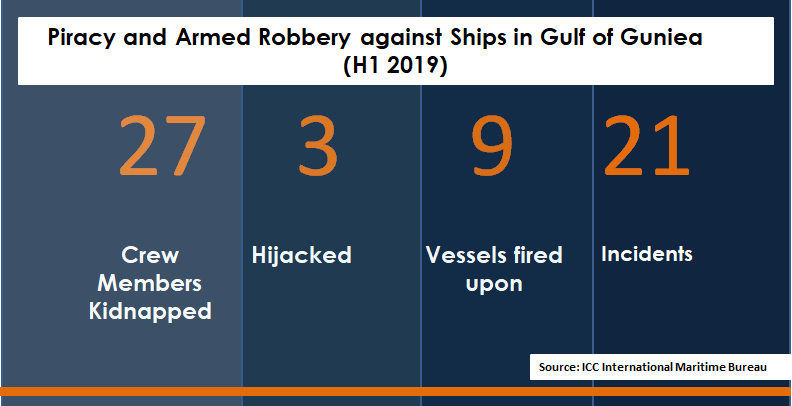
The Gulf of Guinea (GoG), which houses West African waterways including Nigerian territorial waters, has remained the world’s most dangerous spot for pirate attacks, sea robbery, terrorism, unregulated fishing, oil theft and other forms of illegalities.
The development, no doubt, has posed serious economic concern to the nation’s shipping community following the high level of sabotage on international trade as oceangoing vessels do business in Nigerian ports now have to impose war risk insurance on cargoes coming to Nigeria.
BusinessDay findings show that in shipping business, safety is very critical. However, due to piracy, shipping business in countries within the GoG region has been surrounded with tension such that some shipping companies are now forced to rent security officials, pay them millions of dollars to secure the cargo on transit.
Boss Mustapha, the Secretary to the Government of the Federation (SGF), confirmed recently in a forum held in Lagos that the situation compels some foreign shipping companies to request for government’s approval to enter Nigeria’s territorial waters with armed security personnel onboard.

This, he said, was why Nigerian government has not taken the issue of safety and security in the maritime sector lightly because maritime domain must be protected to attract foreign investors and also preserve Nigeria‘s territorial integrity.
“The treasures for our future growth and development lie in an improved shipping environment where safety and security of goods, services, seafarers and the shipping community is guaranteed,” he said.
To deal with maritime insecurity, which is an organised crime, Mustapha pointed to the need for the Federal Government to collaborate with other countries to develop an integrated maritime security strategy in addressing the challenges of insecurity.
Maritime domain is vulnerable and ensuring its security is certainly beyond the capacity of one country, thus, the need for countries in the region to come together under one umbrella to developed a lasting solution to maritime insecurity.
In line with this suggestion, the Nigerian Maritime Administration and Safety Agency (NIMASA) has perfected plans to bring countries in the region together under the Global Maritime Security Conference (GMSC) 2019, a high-level Maritime Security Conference to be hosted by Nigeria.

The 3-day conference, which aims to build an understanding of the challenges of maritime security in the region, also hopes to develop tailored solutions as well as coordinate efforts at strengthening regional and international collaborations to extinguish maritime threats in the region.
NIMASA listed the objectives of the conference to include defining the precise nature and scope of coordinated regional responses to maritime insecurity vis-à-vis intervention supports from external actors/partners.
It will evaluate the relevance and impacts of the various interventions initiated already to tackle maritime insecurity in the region with a view to revising and adapting them to address the current challenges.
In addition to tackling threats to maritime security, strategising alternative approach to prevent cyber security attack and other forms of emerging maritime security threats, is also the aim of the conference. It will also advocate for deeper global commitment to deployment of resources for ending maritime insecurity within the region.
The event is expected to have 11 panel sessions as well as intensive and interactive sessions designed to expand, address and deliver a workable framework to tackle key issues around the safety and of the waterways.
The Conference will be held at the International Conference Centre, Abuja, from the 7th – 9th of October 2019 while President Muhammadu Buhari will present the keynote address. Personalities such as ECOWAS President, ECCAS President, chairperson of African Union Commission and secretary general of the International Maritime Organisation (IMO) are expected to grace the event.
Pundits believed that the conference would help to promote sustainable shipping in the region, if strategic collaboration and partnerships are built among countries in the region.
Dakuku Peterside, director general of NIMASA, who pointed out that the Gulf of Guinea plays importance role to food security, stated that the region must be properly secured to avert illegal activities that may hamper food supply.
He said that the region, which is a major shipping route, must be properly guarded if the countries in the region are to properly harness the blue economy for economic growth. “We must do everything to safeguard the region from illegal fishing, piracy and other activities that may affect the food chain.”
He further said that NIMASA knows the importance of the region to the African continent and that was the major reason the Agency has continuously championed collaborations among member states to develop the continent’s blue economy through sustainable shipping.
Recall that in Nigeria, NIMASA has entered into a contract with Home Land Security International (HLSI), an Israeli firm to build an Integrated National Security and Water Protection Infrastructure in Nigeria under the Deep Blue Project.
This project entails the provision of security infrastructure and training of personnel for the protection of Nigeria’s maritime domain. It is envisaged that this project will comprehensively address the emerging cases of insecurity in the maritime industry and restore investor confidence.
It also involves the acquisition of new platforms and other logistics required to enable the Agency perform its statutory functions of securing the Nigerian waters in conjunction with the Nigerian Navy.