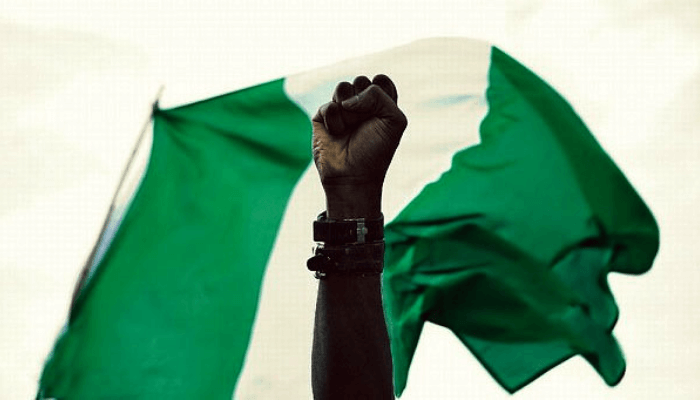
The metaphor of mkpọkọrọ ikwe ne ẹkwụ reburu ọnụ – literally, ‘pounding rotten palm nuts in a broken mortar’ – is no longer a quaint proverb from rural folklore. It is now the most fitting lens through which to read Nigeria’s democratic experiment, now twenty-six years old and counting. The imagery is vivid: a weary woman, pestle in hand, sweating under the tropical sun, labouring to extract oil from a pile of rotten palm nuts in a cracked mortar. Every strike splashes futility – no oil, only mush and frustration. That, in essence, is Nigeria’s “unbroken democracy” – loud in ritual, hollow in result; a ceaseless pounding that yields neither oil nor nourishment.
In the first part of this series, we traced democracy’s philosophical origins – from Hobbes’s Leviathan through Locke’s natural rights, Rousseau’s social contract, and Montesquieu’s separation of powers – to its redefinition in the Nigerian context, where elite consensus masquerades as popular sovereignty. In the second, we met Musa, the archetypal gate man, whose post by the gate has become a front-row seat to Nigeria’s democratic absurdities. Watching politicians defect, decamp, and re-decamp with the same flourish as a masquerade changing masks, Musa could only mutter, “Nothing wey no go see for gate.” Now, in this concluding piece, we return to the broken mortar and the rotten nuts – to the smell of decay, the grinding sound of futility – to ask whether Nigeria’s democracy can ever yield oil again.
Democracy in Nigeria has been effectively privatised. What began in 1999 as a promise of civilian governance has mutated into an enterprise of state capture. The political class operates like a cartel, using democratic institutions as cover for plunder. Elections are not contests of ideas but auctions of loyalty. Public office is not service but spoils. Transparency International’s 2023 Corruption Perception Index ranked Nigeria 145th out of 180 countries, scoring a paltry 25/100—an indictment of a democracy in which corruption has become a political language. The logic of prebendalism, long described by Richard Joseph, has become normalized: every official views public office as an entitlement to personal wealth.
Nigeria boasts over 90 registered political parties, yet few possess any ideological distinction. The same political actors oscillate between them, driven not by conviction but by convenience. Politics has become an industry of mobility, not morality. This ideological emptiness fuels voter apathy. From a 69% turnout in 2003, participation plunged to 43% in 2019 and 27% in 2023. Afrobarometer’s 2023 survey shows that 77% of Nigerians “believe democracy works only for the rich.” The people, whose will should animate democracy, have been reduced to spectators, useful only for validating power, never directing it. In metaphorical terms, they are the rotten palm nuts: once fertile, now decayed, unable to yield oil. The political system, the broken mortar, cannot hold the pounding of their aspirations. Each election cycle grinds them further into pulp. Musa, our gate man, becomes their allegorical spokesman. Watching convoys of defectors speed past his gate, he shrugs: “Nothing wey no go see for gate.” It is a fatalistic wisdom; democracy without ideology is noise without rhythm, pounding without purpose.

At the annual Accra Dialogue on Democratic hosted by the Goodluck Jonathan Foundation (GJF) focusing on the theme ‘Why Democracies Die,’ (September, 2025), discussions centred on the structural drivers of democratic decline in West Africa and throughout the continent. Key participants identified weak democratic institutions, corruption, and elite capture as major causes of democratic failure, thus underscoring the need for a ‘governance reset’ and holding leaders accountable. About the same time, Vanguard newspaper’s investigative report – ‘Bumpy Road to 2027: Politicians plot to rig, INEC ‘infiltrated…’ – alluded to the structural drivers of democracy failures prominent among of which is 2027 elections rigging architecture – penetrating INEC, manipulating the judiciary, and weaponizing insecurity to suppress turnout.
If this revelation holds true, Nigeria’s road to 2027 may well be another journey into futility, a continuation of the pounding ritual in a broken mortar. The judiciary, once the last hope of the common man, has itself become a pawn. Justice now appears purchasable, echoing the Sultan of Sokoto’s lament at the 2024 NBA conference in Enugu that “justice in Nigeria has become a commodity for sale to the highest bidder.” A democracy without justice and the people is a body without a soul. It breathes but does not live.
The grim verdict is unmistakable. Democracy in Nigeria is being played without the people. Their will is gagged, their votes neutered, their voices silenced. A general election unfolds under the watch of the electoral umpire, who delivers results often contentious, disputed, and, in the eyes of millions, unjust. Aggrieved candidates turn to the judiciary, first the Election Tribunal, then the Court of Appeal, and finally the Supreme Court, the so-called final bastion of justice. There, within the sanctified walls of the Temple of Justice, sit a select few, no more than thirty, sworn to uphold equity and defend the blindfolded goddess who knows no name, tribe, creed, or colour. She is meant to be impartial, unmoved by personal predilections, indifferent to whose ox is gored.
Yet, time and again, these purportedly infallible arbiters – ex-terrestrial beings, as one might imagine – deliver judgments that rubbish the articulated will of millions of Nigerians. At every stage – Tribunal, Appeal, Supreme – the voices of the many are trampled under the gavel of the few. Democracy, the hallowed “government of the people, by the people, and for the people,” becomes a cruel irony. The collective choice of the electorate is upended by a handful of individuals vested with the power of life and death over the nation’s democratic expression, wielded with an authority that often seems capricious, inscrutable, and almost metaphysical in its finality.
In this system, the people – the true custodians of sovereignty – are reduced to spectators and ceremonial actors. They exist only to validate power, only to breathe life into the machinery of elections, only to be counted when it suits the narrative of the powerful. Once the political spoils are secured, they are cast aside, forgotten, abandoned, as if democracy itself has rendered them forlorn orphans of the Nigerian state. Is this democracy, or something darker masquerading under the same banner? Fela Anikulapo Kuti, the legendary maverick of music and social critique, captured it best when he coined the term “demoncrazy” – a demonstration of madness masquerading as democracy. It is a political theatre in which ritual participation replaces meaningful engagement, where the instruments of governance are wielded not in service of the people but at their expense, and where the very notion of popular sovereignty is turned on its head.

Indeed, Nigeria’s democracy today is a theatre of paradoxes: the people are sovereign in theory, but powerless in practice; they are visible at polling units, but invisible in policy; they are counted in elections, but disregarded in governance. In essence, the citizens exist as the hollowed heart of a system that consumes their voices and discards their agency, a system where the promise of democracy becomes a hollow echo, ringing endlessly without substance.
And so, we stand again at a fork in Nigeria’s democratic journey. The recent appointment of Prof Joash Ojo Amupitan (SAN) as the new INEC Chairman has been greeted with cautious optimism. A respected legal scholar and advocate of electoral integrity, his emergence could, in theory, herald a new dawn. But as experience has shown, personality changes without systemic reform amount to replacing a pestle while the mortar remains broken. Will Amupitan’s tenure turn the corner without comprehensive reforms, such as constitutionally guaranteeing INEC’s independence, mandating direct electronic transmission of votes from polling units to the IReV portal, and ensuring that the appointment of the INEC Chair is made by an independent body rather than the President? Without these, even the noblest intentions will sink into the same quicksand that swallowed his predecessors.
From all indications, the grim verdict is that democracy in Nigeria has become a theatre of absurdities, played without the people. Their will is gagged, their votes neutered, their voices silenced. The electoral umpire declares; the judiciary affirms; the executive reigns. The people, stripped of agency, exist only as orphans of sovereignty, summoned at elections, discarded afterward. Yet, even in the darkness of futility, metaphors offer a glimmer of renewal. The ‘broken mortar’ need not remain broken. It can be re-forged. The ‘rotten palm nuts’ can be replaced with fresh harvests. Democracy can still yield oil, if only the pounding is guided by sincerity, accountability, and institutional reform.
As Nigeria marches toward 2027, the choice is stark: continue pounding futility in a broken mortar, or rebuild the vessel of statehood and fill it with integrity. Only time will tell if Professor Amupitan’s INEC will become the forge that remolds the mortar or yet another pestle in the endless pounding of rotten nuts. This piece was finally screeching to a conclusive end when the trial of democracy, like Maazi Nnamdi Kanu, intensified as its travails oscillated between broken mortar and barrack drums. Even the broken mortar now trembles. From the sudden cancellation of the October 1 Independence Day parade at Eagle Square, to the arrest and detention of senior military officers, and the sweeping shake-up that replaced nearly all service chiefs except the Chief of Army Staff, now redeployed as Chief of Defence Staff, Nigeria’s fragile democracy quivers under a gathering storm.
Rumours of a coup, once whispered in corners, now echo in the public square, fertilized by discontent, insecurity, hunger, and a people’s deepening despair. Add to this the recent allegations of “Christian genocide” and ethnic cleansing in parts of the North Central, and the cauldron boils over. The warning signs are familiar to students of history. Where governance fails, rumour thrives; where justice is mocked, rebellion festers; where the people’s will is ignored, the barracks begin to murmur. But it bears restating: the surest safeguard against the rumble of boots is the firm hum of good governance. Nigeria’s democracy, twenty-six years “unbroken,” stands today at its most vulnerable point since 1999, not because of the strength of soldiers, but because of the weakness of statesmen. The mortar is cracked not by coups, but by corruption; not by military ambition, but by civilian impunity. When the social contract – the covenant between the rulers and the ruled – is continually broken, democracy itself becomes an empty shell, an exhausted ritual performed on borrowed legitimacy.
The coup rumours are not the disease; they are a symptom – a symptom of a democracy that has lost its moral compass and its civic confidence. The cure lies not in nostalgia for the jackboot, but in a rebirth of governance rooted in accountability, equity, and justice. For in truth, the most enduring defence against the drums of the barracks is not the strength of the constitution or the loyalty of the generals; it is the trust of the governed. When citizens believe that their voices count, their votes matter, and their rights are protected, the military instinct retreats to the background, where it belongs.
The metaphor of the broken mortar and rotten nuts is not just diagnosis but prophecy. Unless Nigeria confronts the futility of its democratic rituals, it will continue to expend energy without nourishment, until despair curdles into collapse. The unfinished task, therefore, is to restore faith in the social contract, rebuild the mortar of statehood, and replace the rotten nuts of corruption and impunity with the fresh kernels of justice and service. This implies reimagining democracy – building institutions that can hold, cultivating leaders who can yield oil, and empowering citizens whose pounding will finally feed the nation. Only then can Nigeria escape the paradox of futility and taste the oil of genuine democratic dividends.
.Prof Agbedo writes from the University of Nigeria Nsukka (UNN)