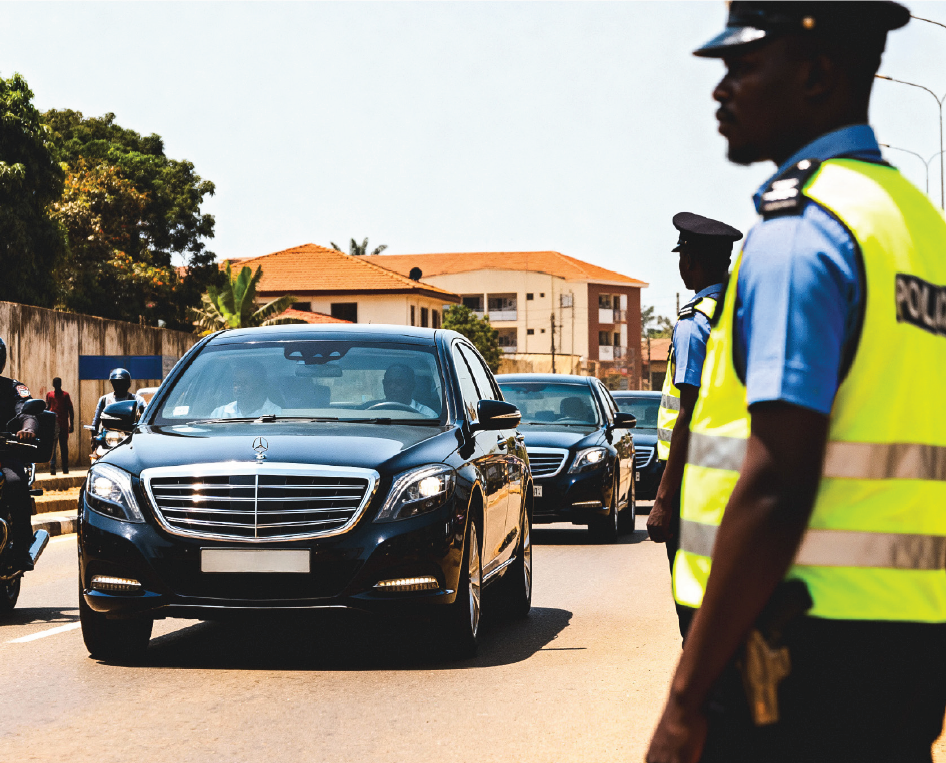
The directive by President Tinubu that police officers be withdrawn from Very Important Persons (VIPs) has reignited one of Nigeria’s most enduring debates: the paradox of a country that is chronically under-policed yet persistently diverts scarce officers to guard the privileged few. The President has ordered that officers currently assigned to VIPs be redeployed to their core duties. VIPs who still desire escorts must now request personnel from the Nigeria Security and Civil Defence Corps.
The symbolism of this directive is powerful. It challenges the entrenched culture of privilege that has long defined Nigeria’s security architecture. Yet history tempers optimism. Every new Inspector General of Police in recent memory has made similar pronouncements, only for the practice to quietly revert to the status quo within weeks. Even now, some VIPs are already protesting that withdrawal will expose them to kidnappers and bandits.
The structural deficiency of Nigeria Police is not a secret as everyone knows Nigeria’s policing system is underpowered, underfunded, and underwhelming in its reach.
Nigeria today has an estimated 371,800 police officers serving a population of about 236.7 million. That translates to roughly one officer for every 650 citizens. The United Nations recommends a benchmark of one officer for every 460 citizens. By that measure, Nigeria is short by nearly 190,000 officers. The gap is even more glaring when one considers that over 100,000 officers are reportedly tied up in VIP protection duties, leaving ordinary citizens in rural and urban communities exposed to insecurity.
Comparisons with other African countries underscore the scale of Nigeria’s challenge. Algeria, with a population of 45 million, has about 160,000 police officers, giving it a ratio of 396 officers per 100,000 citizens. South Africa, with 60 million people, maintains about 150,000 officers, or 280 per 100,000 citizens. Globally, the median is around 300 officers per 100,000 citizens. Nigeria, by contrast, has only 157 officers per 100,000 citizens — barely half the global median. In practical terms, this means that while other nations can afford to deploy officers visibly in communities, Nigeria struggles to maintain even a skeletal presence.
The President’s directive therefore raises a fundamental question: why provide for VIPs when the country is under-policed? The answer lies in Nigeria’s political culture, where public office holders, business elites, and even religious leaders often insist on armed escorts as a symbol of status and security. Even musicians and known fraudsters (Or Yahoo Yahoo boys) are provided with police escorts. Some have escorts in military uniform. Yet this practice drains manpower from the very communities that need policing most.
Calls for reform have grown louder in recent years, with many advocating for the creation of state police. Proponents argue that decentralising the force would improve accountability, responsiveness, and community trust. They point to the success of regional security outfits such as Amotekun in the South-West, which, though limited in scope, have demonstrated the value of locally rooted policing. Opponents, however, warn of the dangers of political misuse. Governors, they argue, could deploy state police against opponents or minorities, exacerbating Nigeria’s fragile federal balance. Funding is another concern: many states already struggle to pay salaries, and adding a police force could deepen fiscal strain.
Still, the manpower crisis makes decentralization increasingly attractive. With the federal government unable to bridge the gap quickly, state police could provide a complementary layer of security. Tinubu’s directive, if sustained, may be a step toward forcing the conversation into practical action.
Solving Nigeria’s policing problem requires more than redeployment. Mass recruitment is essential. The President has approved the hiring of 30,000 officers, but this is a drop in the ocean compared to the 190,000 needed to meet UN standards. Recruitment must also be accompanied by improved welfare. Recent protests by rank-and-file officers highlighted poor pay, inadequate housing, and lack of insurance as major grievances. A demoralized force cannot deliver effective policing.
Technology and training are equally critical. Modern policing relies on surveillance systems, forensic tools, and data-driven intelligence. Nigeria’s force remains largely analogue, with limited capacity for cybercrime investigation or forensic analysis. Investment in these areas would not only improve crime detection but also reduce reliance on brute manpower. Community policing, long touted but poorly implemented, must also be revived. Building trust between officers and citizens is vital for intelligence gathering, especially in tackling insurgency and banditry.
The question of cost looms large. Recruiting 190,000 officers at even ₦1 million per officer annually would require ₦190 billion each year in salaries alone. Add training, equipment, housing, and logistics, and the figure rises significantly. Yet the cost of insecurity—lost investments, disrupted businesses, and human lives—far outweighs the expense of reform. Nigeria’s economy bleeds billions annually due to insecurity in the North-East, North-West, and Middle Belt. A well-funded police force is not just a security imperative; it is an economic necessity.
Who will shoulder this burden? The federal government remains the primary actor, but state governments must also play a role, whether through funding joint security initiatives or lobbying for constitutional amendments to establish state police. International partners may provide technical assistance, but the bulk of the responsibility lies within Nigeria.
Tinubu’s directive is therefore both symbolic and practical. Symbolic, because it challenges the entrenched culture of VIP privilege. Practical, because it could free up thousands of officers for frontline duties. But history suggests caution. Unless backed by sustained recruitment, improved welfare, and systemic reform, the directive risks becoming yet another pronouncement that fades into irrelevance. Hopefully, the President’s police recruitment order under the new state of emergency on security can offer some hope.
Nigeria’s policing crisis is not merely about numbers; it is about priorities. Redirecting officers from VIPs to communities is a start, but without addressing the structural deficiencies of the force, the country will remain under-policed. The President’s move has opened a window for reform. Whether Nigeria seizes it will determine not just the safety of its citizens, but the stability of its democracy and the health of its economy.