Africa’s most populous country has fewer than 1,000 cold trucks, far below the 25,000 needed to transport over 11 million metric tonnes of perishable goods annually, according to a recent U.S. International Trade Administration (ITA) report.
This significant shortfall presents a major investment opportunity in the country’s growing cold chain sector, valued at N160 billion in 2023.
From developing solutions that provide automated storage facilities to the manufacturing of plastic crates to transport fresh produce to the markets, and investing in cold storage trucks from transporting perishable goods, presents opportunities for investors to tap into.
“The opportunities in the country’s cold chain industry are huge and massive,” says Alexander Isong, president of the Organisation for Technology Advancement of Cold Chain in West Africa (OTACCWA)

“We just started scratching the surface,” he noted, adding that the country’s cold storage facility is next to zero. “We have very small, minute cold rooms that don’t scratch the surface,” he says.
Michael Akintese, co-founder of Ecotutu, a cold-chain storage and logistics company, says the country is operating with less than fourpercent of its cold chain capacity.
“That gap costs farmers and agribusinesses up to N3.5 trillion each year,” Akintese said.
With rising demand for temperature-controlled logistics, the sector is drawing attention from local and international investors.
Experts say it’s becoming a vital, yet still underdeveloped, pillar in Nigeria’s push for food security and sustainable agriculture.

Daniel Onwude, CEO of Coldtivate, a digital cold-chain company, notes the huge potential in the cold chain sector, despite its challenges.
“There’s a goldmine of opportunity waiting to be tapped,” he says.
Key investment areas include developing solar-powered cold storage and transport solutions to address power unreliability, expanding cold storage facilities, and increasing refrigerated trucks and last-mile delivery tricycles, particularly in rural regions, to improve accessibility and efficiency.
Onwude also stresses the need for embracing smart technologies like IoT, RFID, AI, blockchain, and digital twins to enhance monitoring and control.
“Leveraging government incentives, like free trade zones, for infrastructure development, and building local expertise in cold chain logistics are critical steps for driving innovation and sustainable growth in the sector,” he said.
Akintese highlighted the financial impact of cold storage, noting that small businesses saw an average profit increase of 23.47 percent after gaining access to cold-chain solutions.
According to the U.S. ITA, Nigeria’s cold chain sector faces a major skills gap in cold tech design, installation, and maintenance, creating both a challenge and a training opportunity for local investors entering the space.
The hidden cost of food waste
Each year, Nigeria loses around 40 percent of its total food production to post-harvest spoilage, according to the African Post-Harvest Loss Information System (APHLIS).
Perishable produce—particularly fruits and vegetables—are hit the hardest, with losses reaching as high as 70 percent, according to the report.
These losses take a human toll that is visible at every market stall. Fatima, a tomato vendor at Lagos’s Mile 12 market, experiences it firsthand.
“We bring them from Kano, only for half to rot before anyone buys them,” she laments. “Sometimes I lose up to 50 percent of my profits—just like that.”
Haliru Abdulsalam, a fruit and vegetable trader in Lagos, also voiced similar concerns.“If my goods are kept for more than two or three days without proper preservation, they start to spoil,” he said. “It’s a race against time—and we’re losing,” he added.
Global outlook
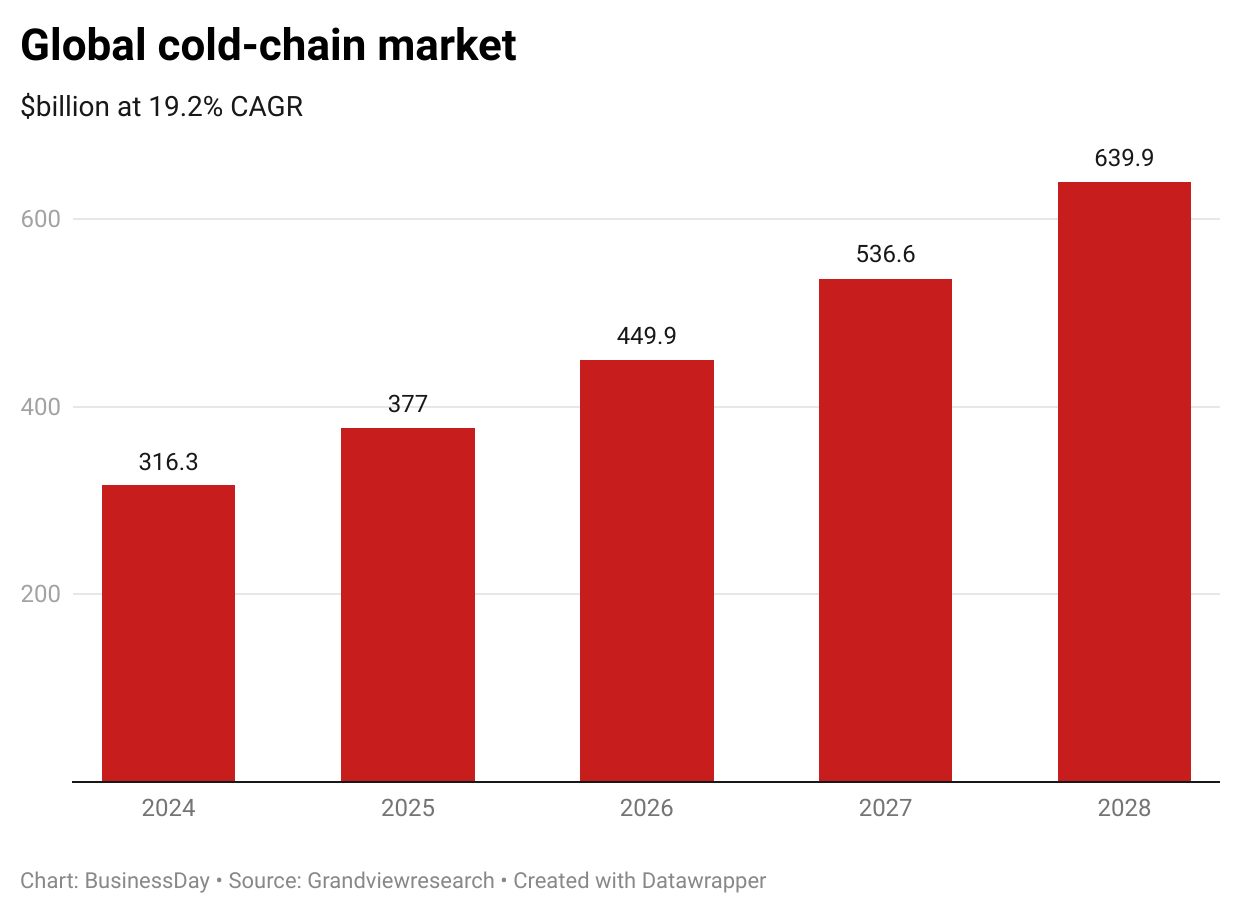
Globally, the cold chain market was valued at $316.34 billion in 2024 and is projected to grow at a compound annual growth rate (CAGR) of 19.2 percent from 2025 to 2030, according to Grand View Research.
The United States and China are leading countries in the cold-chain sector in terms of revenue generated, according to Grandview Research.
The African Cold Chain Market is projected to grow from approximately USD 20 billion in 2025 to around USD 30 billion by 2031 according to 6Wresearch.
Challenges
Onwude, highlights the realities holding the industry back. “Despite immense opportunities, the industry is not devoid of bottlenecks,” Onwude told BusinessDay.
“The cold chain market plays a critical role in tackling food insecurity,” he said
However, weak infrastructure and economic constraints continue to hold the sector back, he adds.
“Setting up a cold room is super expensive. Between high operational costs, diesel dependency, import duties, and currency fluctuations, the financial hurdles are steep,” he says.
He also pointed to inadequate infrastructure, unreliable electricity, poor road networks, and a lack of cold storage and transport facilities as major roadblocks.
“We also lack skilled professionals in this space, which forces reliance on foreign expertise,” he added.“Regulatory red tape, inconsistent policies, and bureaucratic delays only worsen the situation,” he explained.
Akintese also noted some inefficiencies in the sector.
“In 2024, we’re operating with just 4 percent of the cold chain capacity we need,” he says. “That gap costs farmers and agribusinesses up to ₦3.5 trillion each year,” he stated.
He also added that the problem extends beyond production.“There’s a value chain disconnect,” he explained. “Cold storage, transport logistics, and processing equipment need to be accessible right from the point of harvest.
“A well-functioning supply chain that ensures every stakeholder—farmer to consumer—gets fair value is critical,” he says.
The way forward: systems, not just solutions
Akintese believes reducing food waste must go hand in hand with policies that strengthen the supply chain.
“Achieving food security means fixing broken systems. And nothing screams ‘broken’ more than our fragmented, uncoordinated food supply chains,” he said.
He argues that the solution isn’t only financial or technological—it’s philosophical.
“Fixing this isn’t just about throwing money at the problem or building shiny new tech,” Akintese says. “It’s about rethinking how we value food and how we distribute it. It’s about systems that prioritize people and the planet, not just profit.”
He calls for empowerment of smallholder farmers, investments in local food networks, and holding large corporations accountable for their role in enabling food waste.
Local innovation, real impact
Dada shared with BusinessDay an inspiring example from Jos, Plateau State, where a young agritech entrepreneur is rewriting the food waste narrative.
“He buys ‘ugly’ but perfectly edible tomatoes directly from farmers at fair prices and processes them into tomato paste using solar dryers—no preservatives, no waste, just smart innovation,” Dada states.
The small factory now employs 12 women and supplies preservative-free paste to restaurants in Abuja. “This isn’t just about food, it’s about value. It’s also about proving that with the right mindset and modest investment, local solutions can drive real change,” he says.