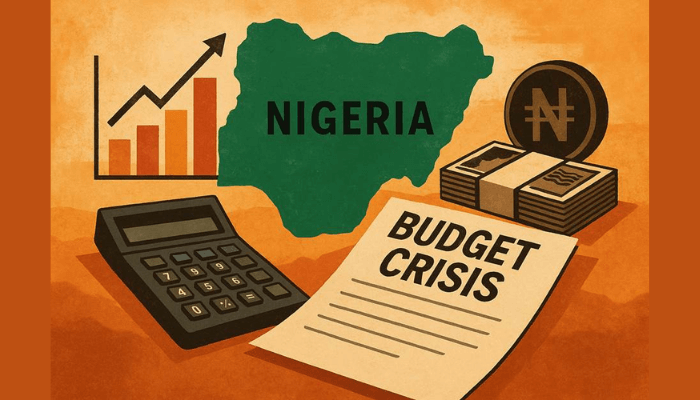
Nigeria is heading into another fiscal year with its public finances in a state of organised confusion. As 2025 draws to a close, the country is still wrestling with overlapping budgets, delayed reports, shifting numbers and a missing medium-term plan.
Senators now openly warn that the overlap of the 2024 and 2025 budgets has cast doubt on when – or even whether – a 2026 Appropriation Bill will be presented in good time. What should be a predictable annual ritual – medium-term plan, budget proposal, legislative scrutiny, implementation, reporting – has become a muddle of extensions, amendments and after-the-fact explanations. For an economy of over 200 million people, this is more than an accounting irritant; it is a recipe for weak growth, wasted money and eroding trust.
One country, many budgets
In theory, Nigeria operates a January–December budget cycle. In practice, recent years have normalised running multiple budgets at once. The 2023 Appropriation Act, worth about N21.8 trillion, and the N2.17 trillion 2023 supplementary budget did not die with the calendar year. They were first extended to March 31, 2024, then again to June 30, 2024, and finally to 31 December 2024, ostensibly to prevent projects from being abandoned.

Alongside them, the 2024 ‘Budget of Renewed Hope,’ initially put at about N28.7 trillion (later restated in some documents nearer N27.5 trillion), began its own life cycle. Analysts have pointed out that, at various points in 2024, four separate budget instruments – the 2023 main and supplementary budgets, the 2024 main budget and a 2024 supplementary – were all in force.
The habit did not stop there. The capital component of the 2024 budget, which should have lapsed in December 2024, was first extended to 30 June 2025, and then extended again to 31 December 2025. As Premium Times put it in October, Nigeria is currently running two budgets simultaneously: the extended 2024 capital budget and the 2025 budget of about N54.2 trillion. That is not a sign of clever flexibility; it is a symptom of a system that cannot complete what it starts.
Budget numbers that won’t sit still
The story of the 2025 budget illustrates the drift. On 18 December 2024, President Bola Tinubu presented a N49.7 trillion 2025 budget proposal to the National Assembly. As the plan moved through the legislative process, the envelope was revised upward to around N54.2 trillion. Lawmakers then added their own adjustments and, on 13 February 2025, passed a record N54.99 trillion Appropriation Act – with a deficit of N13.08 trillion, or about 3.9 percent of projected GDP.
It did not end there. In November 2025, the National Assembly approved an additional N1.15 trillion in domestic borrowing to close the gap between the deficit initially proposed by the executive and the larger deficit it had itself approved. The total 2025 budget now stands at N59.99 trillion. On paper, then, Nigeria is promising more spending than ever before. In reality, the problem is not the headline size; it is the capacity to implement.
Implementation that never quite starts

Under Nigeria’s Fiscal Responsibility Act (FRA), the Budget Office must publish a quarterly budget implementation report within 30 days of the end of each quarter. These Budget Implementation Reports (BIRs) are supposed to tell citizens and investors what has actually happened to the trillions appropriated in Abuja. In the last year, that legal discipline has broken down.
Civic-tech group BudgIT noted in August 2025 that the government had failed to publish any BIRs for nearly a year, in breach of the FRA. The Budget Office later confirmed that the reports had been delayed by lengthy verification and reconciliation exercises – and by the confusion created by overlapping budget cycles. When the full-year 2024 budget performance report finally appeared in October 2025, investigative work by FIJ showed that only 32.28 percent of the 2024 capital budget had been disbursed as of June 2025 – six months after the budget was meant to have run its course.
In other words, less than one-third of capital spending had moved, even as the government was asking Parliament to extend the life of the budget and to approve still more borrowing. The 2025 capital budget is faring little better. While some releases have been made, capital implementation has been heavily delayed, with lawmakers themselves warning that the extended 2024 projects are crowding out the start-up of 2025 projects. Contractors complain of unpaid certificates across two budget years, and banks are watching project-linked loans with growing unease. A budget that lives mostly on paper is no budget at all.
A missing medium-term compass
Behind the annual drama is a deeper institutional failure: the erosion of medium-term fiscal planning. The FRA requires the federal government to prepare a rolling Medium-Term Expenditure Framework (MTEF) and Fiscal Strategy Paper covering the next three years, and to lay it before the National Assembly at least four months before the start of the new financial year.
The annual budget is supposed to be derived from this framework. In 2025, that sequence has come apart. As of October, the Senate was complaining that overlap between the 2024 and 2025 budgets had cast doubt on “the viability of the presentation of the 2026 Appropriation Bill… anytime soon,” and no 2026–2028 (or 2026–2029) MTEF had been transmitted for scrutiny. States, meanwhile, are already tabling their own 2026 budgets, in some cases without a clear federal benchmark to work with. A ship without a chart can still move. It just struggles to arrive where it said it was going.
Debt: the comforting story and the awkward numbers
On one level, the debt story looks reassuring. The World Bank’s October 2025 update notes that Nigeria’s public debt-to-GDP ratio has fallen to 39.8 percent, its first decline in more than a decade, helped by higher nominal GDP and exchange-rate effects. Yet the way the 2025 budget is being financed tells a different tale. After pushing total spending to nearly N60 trillion, the federal government has leaned harder on both domestic and external borrowing.
In early November, Nigeria sold $2.35 billion in Eurobonds, split between a long 10-year and a long 20-year tranche, at yields of about 8.625 percent and 9.125 percent. The Debt Management Office (DMO) makes no secret of the purpose: the proceeds will be used to finance the 2025 fiscal deficit and other government financing needs. Taken together with the additional N1.15 trillion in domestic borrowing approved in November, this means that Nigeria is paying some of the highest interest rates in its history to fund budgets whose capital components are only partially implemented and poorly reported.
No visible dividend for citizens
For ordinary Nigerians, these fiscal contortions would be tolerable if they delivered visible improvements in daily life. They have not. The World Bank estimates that over 46 percent of Nigerians now live below the national poverty line, with food inflation hitting the poorest hardest, as they spend up to 70 percent of their income on food. Another recent report puts the number of Nigerians living in poverty at about 139 million in 2025, up sharply from 2018.
The Bank notes that the cost of a basic food basket has risen roughly fivefold since 2019, a brutal ‘tax’ on households that see little of the supposed benefits of macroeconomic reform. While headline inflation is projected to ease somewhat in 2025, it remains high by historical standards, and food prices continue to erode real wages and savings. Against this backdrop, talk of record budgets and ‘transformation’ rings hollow. Nigerians do not experience budgets as PDFs on government websites; they experience them as roads, power, schools, hospitals and jobs. On that test, the current system is failing.
How to fix a drifting system
None of this is inevitable. Nigeria’s budget mess is the product of choices – and it can be reversed by different choices. At minimum, five reforms are urgent:
1. Restore the calendar and stop serial extensions.
One budget per year should be more than a slogan. Extensions of capital implementation should be rare, tightly justified and project-specific, not routine blanket rollovers that normalise running two budgets at once.
2. Treat fiscal rules as binding law.
The timelines in the Fiscal Responsibility Act – for MTEF preparation, budget submission and quarterly implementation reports – should be enforced by Parliament and, if necessary, the courts. A rule that can be ignored is no rule at all.
3. Publish implementation data on time and in usable form.
Returning BIRs to their statutory schedule, and publishing project-level data in machine-readable formats, would greatly strengthen public oversight and investor confidence. The 2024 experience – a full-year report appearing ten months late – should be an exception that is never repeated.
4. Align borrowing with a transparent fiscal strategy.
Extra borrowing approvals should be framed within a clear, medium-term debt strategy – including explicit limits on interest-to-revenue ratios – rather than justified piecemeal each time a gap appears.
5. Rebuild executive–legislative coordination.
The Presidency and the National Assembly need a shared, public budget timetable: date for MTEF submission, date for budget presentation, deadline for passage. Political contestation is healthy, but procedural chaos is not.
A budget is more than an annual spectacle in the National Assembly. It is the country’s most important economic contract. Until Nigeria returns to a single, timely, well-implemented and honestly reported budget each year, anchored in a credible medium-term plan, the country will continue to live with what it has now: rising numbers on paper, rising debt in practice, and too little change in the lives of the people all this is supposedly for.
Dr Adeosun is BusinessDay’s chief economist