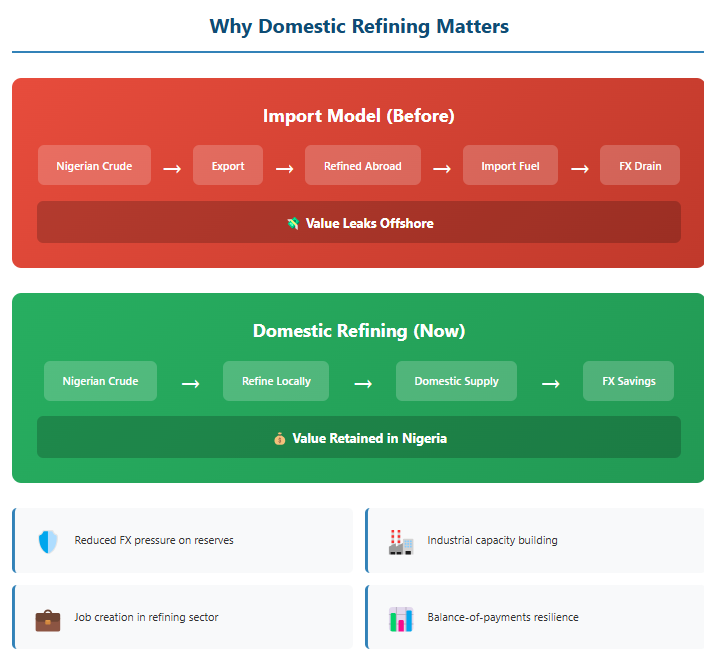
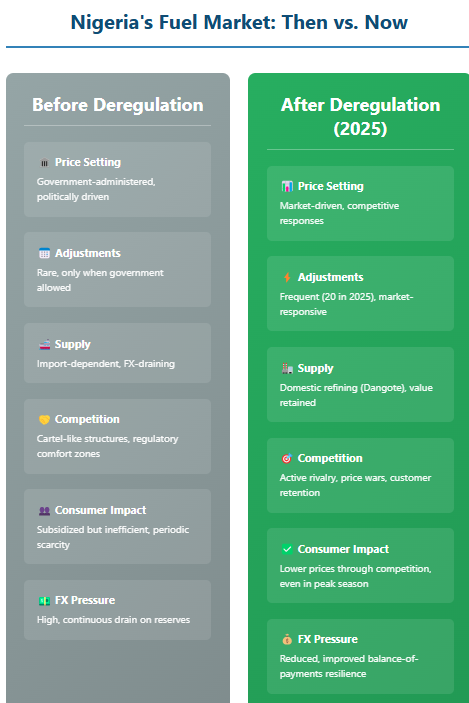
For decades, Nigeria’s petrol market presented a paradox. Despite being Africa’s largest oil producer, the country relied almost entirely on imported refined fuel, often administered through state-mandated price controls and opaque subsidy arrangements. These policies insulated firms from competition, dulled incentives to invest in domestic refining, and periodically created severe shortages. Prices rarely reflected true cost structures; they rose only when policymakers deemed it politically necessary. During this period, cartel-like behaviour emerged, as dominant players coordinated implicitly or explicitly to maintain margins under the cover of regulation. Ordinary Nigerians bore the brunt of this system, facing high and erratic fuel prices, long queues at pumps, and limited alternatives. Subsidies, while intended to protect consumers, encouraged waste and inefficiency, drained fiscal resources, and distorted market signals. In effect, the state replaced market mechanisms, rewarding entrenched inefficiency while leaving households and businesses exposed to supply disruptions and inflationary shocks, reinforcing dependency on imported refined petroleum.
Read also: Reforms fuel N4.4trn insurance market as enforcement boosts confidence
The Dawn of Market-Driven Pricing

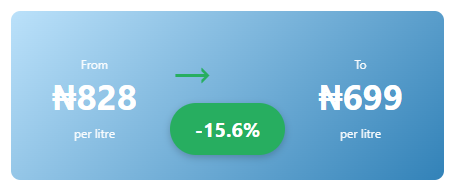
This entrenched equilibrium began to shift as Nigeria gradually dismantled its subsidy regime and allowed market forces to dictate pricing. Deregulation has been politically controversial and economically sensitive, as prices surged sharply upon removal of subsidies, prompting public outcry and inflationary pressure. Yet the principle was clear: allow firms to compete, restore price signals, and incentivize efficiency in refining, distribution, and retail. The recent actions of the Dangote Petroleum Refinery illustrate this new reality. In mid-December 2025, the refinery cut its ex-depot petrol price from ₦828 per litre to ₦699 per litre, marking a more than 15 percent reduction in a single adjustment. Remarkably, this represents the refinery’s twentieth price review in 2025, highlighting how a deregulated market forces firms to respond rapidly to supply, demand, and competitive pressures. The old model, where prices were frozen or adjusted sporadically by state fiat, is giving way to a dynamic system where market behavior determines outcomes, signaling a profound structural change in Nigeria’s downstream sector.
Competition Emerges as the Arbiter
Dangote Refinery’s pricing has compelled competitors, including NNPC Limited and independent marketers, to react in near real time, adjusting ex-depot and pump prices in response to rival moves. Across Abuja, Lagos, and other urban centers, pump prices have softened even in December, a month traditionally associated with seasonal demand spikes and rising costs. The market, once held hostage by administrative control, is now governed by competitive forces. Firms cannot rely on regulatory protection or informal cartels; they must attract customers through pricing, service quality, and operational efficiency. Consumers, for the first time in years, see tangible benefits: lower transport costs, reduced household expenses, and greater choice. Even incremental adjustments now transmit quickly through the supply chain. This emergence of competition demonstrates the efficacy of liberalization: price signals reflect market fundamentals rather than political expediency, and firms are held accountable by rivals rather than regulators alone. It is a shift from passive compliance to active market engagement.

Broader Economic Implications
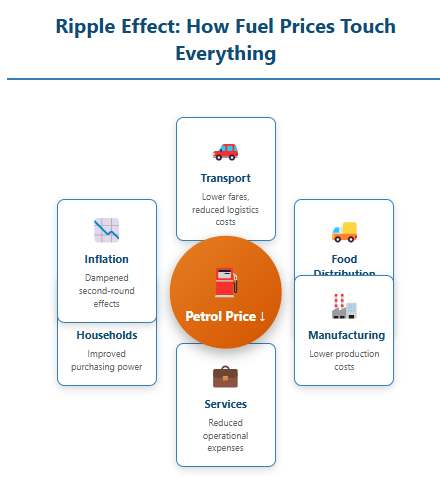
The implications extend beyond fuel prices at the pump. Petrol is a foundational input in transport, logistics, manufacturing, and services. Lower and more responsive prices alleviate cost pressures across the economy, temper inflation, and increase household purchasing power. The transmission effect, particularly in a highly oil-dependent economy like Nigeria’s, can influence production costs, food distribution, and wage negotiations. Furthermore, domestic refining strengthens macroeconomic resilience. Local refineries retain value within the economy, reduce foreign exchange dependence, and cushion the balance of payments from crude price shocks. With Dangote Refinery sourcing local crude and producing refined products domestically, Nigeria captures a previously lost portion of the value chain. In addition, the competitive pressure it exerts compels innovation, better logistics, and efficiency across the downstream ecosystem. While these benefits are early and uneven, they signal that deregulation is not merely a policy abstraction; it is a mechanism for structural transformation with measurable economic effects.
Read also: IPMAN rejects fuel imports as Dangote Refinery denies supply disruption claims

Challenges of Transitioning Markets
The path to a fully liberalized market is not without frictions. Independent marketers face margin compression and heightened operational risk as prices fluctuate in response to rivals. Infrastructure bottlenecks, uneven regional distribution, and occasional delays in product supply still complicate retail pricing. There is also a risk that dominant firms could consolidate market power if smaller competitors cannot adapt quickly, potentially undermining the benefits of competition. Policymakers therefore face a delicate task: allow market dynamics to function, but ensure transparency, fair access, and regulatory oversight to prevent abuse. Nevertheless, these challenges are inherent in any transition from a heavily regulated system to a competitive one. Unlike the stagnation of previous decades, today’s market incentivizes adaptation, efficiency, and responsiveness. Firms that innovate, manage costs, and prioritize consumer experience are rewarded, while inefficiency is penalized — the very logic of a functioning market.

A Glimpse of Hope
For ordinary Nigerians, these developments are more than technicalities. They represent the early fruits of a long-sought dream: a market where competition, not political convenience or administrative fiat, determines outcomes. The recent series of price cuts in 2025, culminating in Dangote Refinery’s December reduction, provides tangible proof that deregulation can deliver. Households are beginning to feel relief, and businesses experience the ripple effects through reduced transport and production costs. If this trajectory continues into 2026, the country may remember 2025 as the year the fuel market finally started to act like a true market. While imperfections and risks remain, the signal is unmistakable: when competition replaces cartel comfort zones, efficiency rises, innovation is rewarded, and citizens benefit. Deregulation, cautiously managed, is transforming Nigeria’s oil sector from a system of scarcity and political shielding into a dynamic engine of consumer welfare and economic resilience.