While some have attributed Nigeria’s 2024 GDP growth of 3.4 percent to the painful reforms initiated by this administration in 2023, its long-term sustainability remains uncertain if regional marginalisation is not addressed. History has repeatedly shown that economic growth which fails to promote inclusivity across all regions and social groups is ultimately unsustainable.
Take the Soviet Union, for instance. Despite its reputation for rapid economic expansion between 1928 and 1960, it faltered in the 1970s under the weight of an extractive rather than an inclusive economic model. Even the most respected economists of the time failed to foresee its collapse. Paul Samuelson, a Nobel Laureate and the author of the world’s most widely used university economics textbook, once predicted that the Soviet Union’s national income could overtake that of the United States by 1984, or at the latest, 1997. As reality unfolded, his estimates were revised to 2002, then 2012. The Soviet economy, despite its initial spectacular growth, could not sustain itself because its model did not prioritise inclusive development.
Nigeria today faces a similar risk. The country is divided into six geo-political zones: North West, North East, North Central, South West, South East, and South South. However, instead of ensuring that each region thrives based on its comparative advantage, economic policies have disproportionately favoured certain areas while neglecting others. A bird may have two wings, but it will never fly with just one.
A maritime system skewed towards Lagos

Nigeria has six major seaports managed by the Nigerian Ports Authority (NPA) alongside smaller and privately operated ports. These include the Lagos Port Complex (Apapa), the busiest and largest seaport in Nigeria. Tin Can Island Port (TCIP) – responsible for a significant portion of Nigeria’s cargo traffic. Onne Port (Rivers State) – designated for oil and gas logistics. Rivers Port (Port Harcourt) – one of Nigeria’s oldest seaports. Warri Port (Delta State) – supporting petroleum and general cargo trade. And lastly, Calabar Port (Cross River State) – Nigeria’s first deep seaport, now severely underutilised due to shallow waters.
Olumati Festus, the Manager of Calabar Port, confirmed in 2024 that not a single container vessel has docked there in the past 25 years. It is a stunning failure for what was once a vital gateway for trade. The primary obstacles include the shallow channel and the dilapidated access road, making it unappealing for cargo operators.
Kelvin Emmanuel, an economist on Arise TV, extensively highlighted the bureaucratic delays that have stalled the port’s rehabilitation. “In 2006, a contract was awarded to a Dutch company to rehabilitate Calabar Port and deepen the channel draft. However, contractual disputes with the government led to protracted delays, and the case ended up in court. Although the matter was settled out of court in 2022, the promised rehabilitation never materialised. Calabar Port remains largely inactive, handling barely one vessel per week compared to the relentless traffic in Lagos,” He explained.
Similarly, Onne Port, despite its strategic location, is uncompetitive due to its oil and gas-only designation. Emmanuel notes, “If you’re importing goods unrelated to oil and gas, the charges at Onne Port are significantly higher than in Lagos. It makes no economic sense for importers to pay a premium when they can use the cheaper Lagos alternative.”
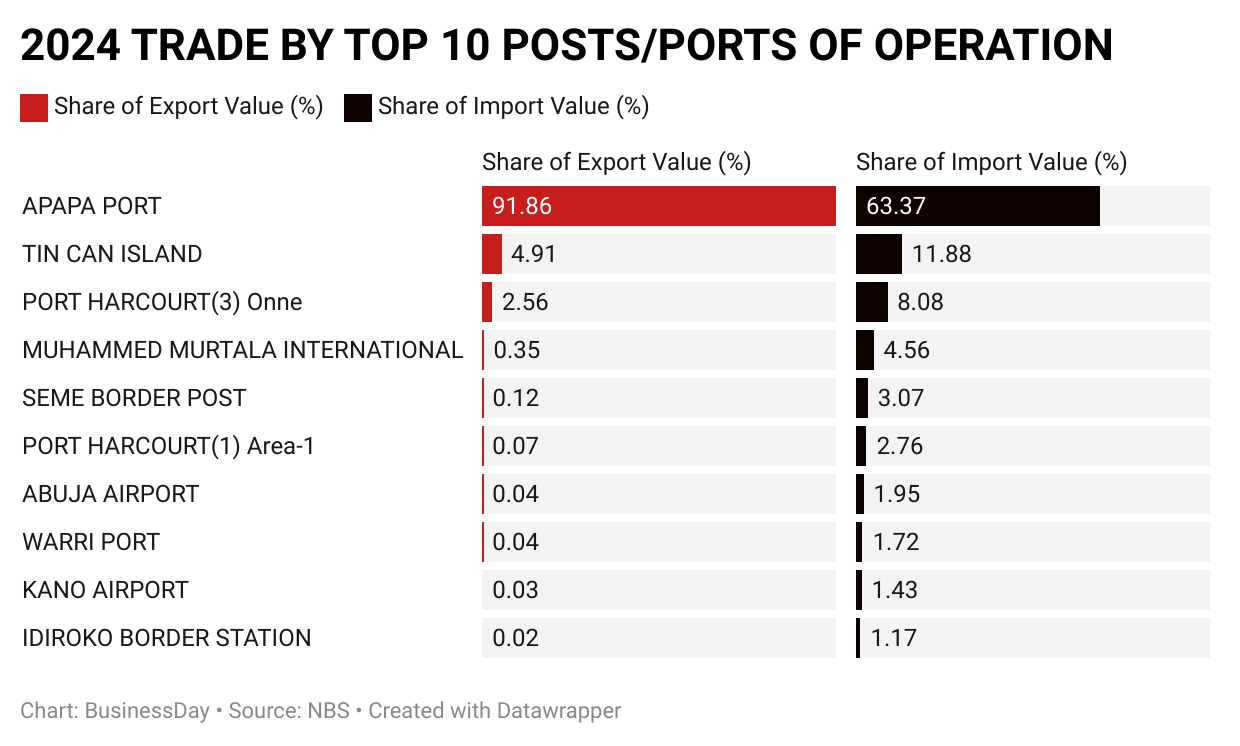
The result? Almost all trade is funnelled through Lagos. The latest data from the National Bureau of Statistics (NBS) reveals that in 2024, 91.86 percent of Nigeria’s total exports passed through Apapa Port alone, while Tin Can handled 4.91 percent, leaving the remaining ports with just 3.23 percent. Imports followed a similar pattern: 63.37 percent through Apapa, 11.88 percent via Tin Can, with the rest accounting for 24.75 percent.


A maritime economy unbalanced by policy
This Lagos-centric model distorts trade and logistics. The National Inland Waterways Authority (NIWA) disclosed in 2022 that over 65 percent of cargo arriving in Lagos ultimately ends up in Onitsha and Aba—both in the South East. Yet, the region lacks a fully operational seaport, forcing businesses to absorb astronomical transport costs. A 40-foot container from Guangzhou (China) to Lagos is cheaper to import than trucking the same container from Lagos to Aba.
Emmanuel puts it bluntly: “No nation has built sustained economic growth this way. How do you build an economy when the smallest state by landmass—with the highest per capita income and the highest population—has the only fully functioning seaport in Nigeria?”
The case of Ibom Deep Seaport in Akwa Ibom is even more revealing. Despite full regulatory approval from the Infrastructure Concession Regulatory Commission (ICRC), the federal government has refused to act. Emmanuel asks, “Why is the federal government not pushing Ibom Deep Seaport with the same urgency it gave to Lekki Deep Seaport?”
Despite having the shortest distance to deep-sea routes of any Nigerian port, Ibom Deep Seaport remains stalled. Businesspeople in North Central will tell you that they prefer the Eastern Maritime Corridor over Lagos, as it offers a shorter and more efficient route for their operations.
A paradox in pipeline infrastructure
This pattern of regional neglect is not limited to ports. The Southeast is the only region in Nigeria without a high-pressure gas transmission pipeline, despite Abia State being rich in natural gas reserves. Instead of investing in local industrialisation, the federal government prioritises gas exports to the North and Europe through some projects. The projects are Ajaokuta-Kaduna-Kano (AKK) Gas Pipeline – transporting gas from Kogi to Kano, strengthening industries in the North, and the Trans-Saharan Gas Pipeline (TSGP) – designed to export gas to Europe via Niger and Algeria. Kelvin Emmanuel questions this approach: “The government is expanding gas pipelines to Algeria and Kano, yet nothing runs through the Southeast. Why?”
A stark contrast is found in Canada’s Trans Mountain Pipeline Expansion (TMX), which Kaase Gbakon, a Senior Forestry Economist at the Government of Saskatchewan, has analysed extensively. TMX has allowed Alberta’s oil industry to expand exports beyond the U.S., increasing revenues and economic resilience.
Nigeria, however, has failed to apply the same logic domestically. Instead of using infrastructure to unlock regional growth, it continues to entrench economic disparity.
Nigeria cannot fly with one wing
If the presidency is serious about sustaining economic growth, it must tackle regional marginalisation head-on. Nigeria cannot continue to operate a maritime and energy system rigged in favour of one region while ignoring others.
To achieve truly sustainable growth, Nigeria must revive and decentralise seaports, beginning with Ibom Deep Seaport and Calabar Port. Also, it must develop a high-pressure gas pipeline for the Southeast, linking it to industrial hubs. Lastly, it must ensure that economic policies reflect regional equity, not just political convenience.
The time to tweak politics for all regions is now. A nation cannot soar if only one wing is allowed to function.