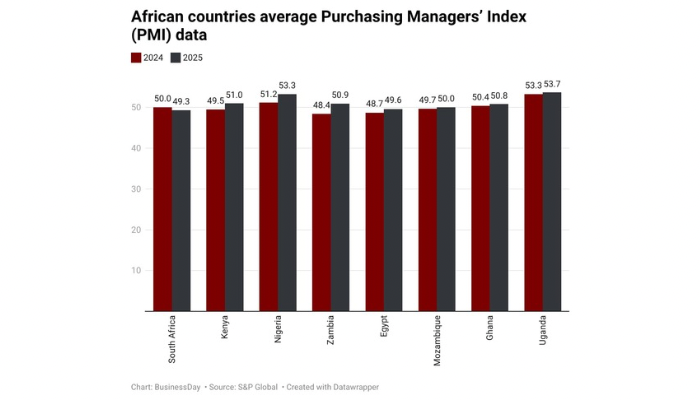
Nigeria’s economic activities have maintained steady growth for 11 consecutive months, as the composite Purchasing Managers Index (PMI) for October 2025 stood at 55.4 points, according to a new report released by the Central Bank of Nigeria (CBN) on Wednesday.
This reflects continued expansion across key sectors of the economy, underscoring growing business confidence and improved output performance nationwide.
The October 2025 PMI figure of 55.4 points represents an increase from 54.0 points recorded in September 2025, signifying a stronger and broad-based expansion in aggregate economic activity. The CBN report highlighted that out of the 36 subsectors surveyed, 25 recorded expansion during the review period, marking the eleventh consecutive month of economic growth.
In the industrial sector, the PMI rose to 54.2 index points in October from 51.4 points in September, reflecting a notable improvement in industrial performance and sustained growth momentum. Further analysis revealed that 9 of the 17 subsectors surveyed within the industry group reported an increase in activity, confirming the sector’s continued recovery and contribution to overall economic expansion.

Read also: Nigeria’s economic mirage: Inflating GDP with illicit activities
The services sector, which has been a major driver of Nigeria’s non-oil growth, maintained its upward trajectory with a PMI of 55.6 points in October, indicating sustained expansion for the ninth consecutive month. Out of the fourteen subsectors surveyed, eleven recorded growth in business activity, demonstrating the broad-based nature of the sector’s resilience and performance.
Agriculture, a key pillar of Nigeria’s economy, recorded a PMI of 55.7 index points in October 2025, marking its fifteenth consecutive month of expansion, the longest among the three composite sectors. All five sub-sectors within agriculture recorded growth during the month, reaffirming the sector’s pivotal role in supporting the broader economic recovery. The agriculture sector also recorded the widest gap between input and output prices at 8.4 index points, suggesting increased production costs relative to output prices. In contrast, the services sector recorded the narrowest gap at 0.6 index points, indicating improved price stability.
The report showed that the composite PMI, alongside the three major sectoral indices of Industry, Services, and Agriculture, all recorded expansion, collectively signalling an improvement in overall economic activity. The Output Index (57.2 points), New Orders (56.0 points), and Employment Index (53.8 points) all posted gains during the review period, underscoring sustained growth momentum across key components of the composite PMI.
Read also: IMF raises Nigeria’s growth projection to 3.9%

Similarly, the Composite Stock of Raw Materials Index indicated growth at 53.6 points, while the Suppliers’ Delivery Time Index improved to 54.8 points, showing better delivery efficiency and faster supplier response times in October 2025.
A breakdown of the 36 sub-sectors across the three major sectors revealed that 25 sub-sectors experienced expansion during the month, with the Educational Services subsector recording the strongest growth. Only 11 sub-sectors reported mild contractions, led by Petroleum and Coal Products, though their overall impact was insufficient to offset the broad-based expansion observed across the economy.
Overall, the sustained expansions across Industry, Services, and Agriculture reflect continued strengthening of Nigeria’s growth fundamentals. The consistent PMI improvement provides strong evidence of a broad-based economic momentum, underpinning a positive outlook for the fourth quarter of 2025.
“The PMI report provides the views of the respondents and does not in any way represent the view of the Central Bank of Nigeria. As such, the CBN cannot be held liable for any action taken based on the responses provided in this survey,” the apex bank said.