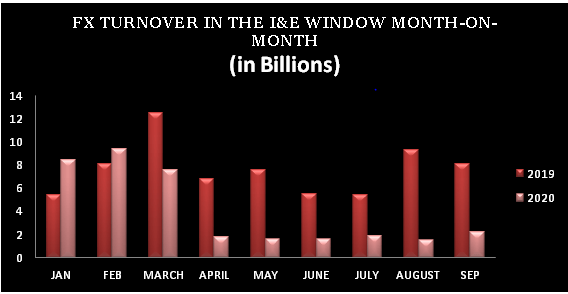
Dollar transactions at Nigeria’s Investors and Exporters (I&E) window slumped 47 percent to $36 billion between January to September 2020, from $68.8 billion a year ago, according to market data, in a sign of Nigeria’s bruising dollar crunch.
Dollar inflows into Nigeria have ebbed this year on the back of lower oil prices and the COVID 19-induced global economic slowdown. The reduced dollar inflows has taken a toll on an economy that’s heavily reliant on the greenback for key imports from food to manufacturing inputs.
Despite the activities of the Central Bank of Nigeria (CBN) to beat the dollar crunch in the past few months, the low turnover in the I&E window shows that it has yielded little gains.
Though FX turnover month-on-month did appreciate 47 percent to N2.26bn in September compared t0 N1.53bn recorded in August 2020, which is a sign of improvement, it is still a far cry from the N8.1 billion traded in the same period last year, as trade volumes remain very low due to tightened liquidity.

The decline in oil prices and foreign investor apathy led to dollar shortages in the FX market and that has seen the naira depreciate significantly.
The CBN has devalued the Naira twice this year alone. The official naira has weakened by 24 percent to N380 per US dollar from N306 per dollar at the beginning of the year.
The CBN was also ordered by the Federal Government to stop providing foreign exchange for food and fertilizer import to conserve scarce dollars and boost local productions.
The dollar demand management strategy of the CBN do not seem to be attracting dollar inflows as investors are still staying clear of the foreign exchange market while others have their cash trapped in the country as they have remained on the queue for dollars.
Turnover rate in the I&E window has been on a steady decline since March 2020 but the picture looks bleaker when compared with the previous year.

In September 2020, FX turnover stood at $2.26 billion, a 72.11% decline compared to the N8.1bn recorded in September 2019.
Compared to August 2019, turnover plunged by 85% to N1.5bn in August 2020, from N9.3bn recorded in the same period last year.
FX turnover declined 78%, 71% and 64% in May, June and July 2020 compared to the same periods in 2019.
Many businesses and manufacturers that rely heavily on dollars have been struggling as the lack of access to foreign exchange is hampering their ability to import vital raw materials, machines and spares that are not available locally.
According to data obtained from the Manufacturers Association of Nigeria, manufacturer’s outstanding dollar demand is around $1 billion.
The foreign exchange scarcity and a heap of other challenges have continued to cripple the performance of the Purchasing Managers’ Index, a gauge of how businesses are faring.
The Manufacturing Purchasing Managers’ Index (PMI) witnessed a contraction for the fifth consecutive month in September, as it stood at 46.9 index points, down from the 48.5 index points recorded in August 2020, according to the CBN PMI report.
The PMI is a leading indicator to assess the health of an economy and also predict growth. This signals that the index still in a contraction is dangerous for the economy hurtling towards a second recession in four years.
The Nigerian economy contracted 6.1% in the second quarter of this year as the oil price crash and the pandemic shrunk economic activities.
According to the National Bureau of Statistics (NBS), the Unemployment rate in Nigeria is at 27%, the highest in a decade while the inflation rate for August accelerated to 13.22% as food prices surged. This gives a grim outlook to investors.
Total investments into Nigeria in Q2’20, including portfolio investments, foreign direct investment and equity investments, plunged to $1.29 billion, a 77.88 per cent decline from the $5.85 billion inflows recorded in Q1’20.
Although Covid-19 fears are relaxing and companies have resumed operations, if manufacturing companies are not producing as a result of the dollar crisis it could hamper the recovery of Africa’s biggest economy in the coming days.