Corruption remains a persistent challenge in Nigeria, shaping governance, public trust, and inclusive development. The 2023 report, the third in the series of Nigeria Corruption Survey published jointly by the United Nations Office on Drugs and Crimes (UNODC) and the National Bureau of Statistics (NBS), offers a unique lens into evolving patterns and trends, capturing the nation’s ongoing struggle against this endemic issue. While some metrics indicate progress—such as a decline in inflation-adjusted bribe values and reduced assertiveness in bribe demands—other areas reveal enduring challenges, including widespread bribery across public and private sectors and the predominance of cash or money transfer as a channel.
The report also underscores a growing public resistance to corruption, with an increasing number of Nigerians refusing bribe requests and fewer experiencing repercussions for such refusals.
“Yet, with public confidence in government anti-corruption efforts waning across all regions, the findings call for renewed urgency and innovative strategies to bridge the gap between policy and public expectation.”
Encouragingly, societal attitudes toward bribery are shifting, with fewer citizens justifying corrupt practices to expedite services. Yet, with public confidence in government anti-corruption efforts waning across all regions, the findings call for renewed urgency and innovative strategies to bridge the gap between policy and public expectation.
This year’s data is both a wake-up call and a beacon of hope, signalling that change is possible when systemic reforms meet grassroots determination. As Nigeria continues its fight against corruption, it must leverage these insights to create a more transparent and accountable society. The report is not just a reflection of where the nation stands but a roadmap for where it must go.

Below are the key extracts of the report.
More than half of Nigerians have had contact with public officials
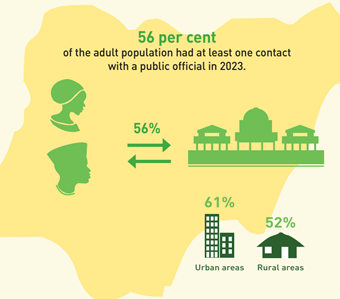
In 2023, about 56 percent of Nigerians reported contact with public officials within the previous 12 months, a decrease from 63 percent in 2019. Urban residents had higher interaction rates (61%) than rural residents (52%). Despite this decline in contact rates, the frequency of bribe payments remained stable, with bribe-payers averaging 5.1 bribes annually, slightly down from 5.4 in 2019. An estimated 87 million bribes were paid in 2023, compared to 117 million in 2019, equating to roughly 0.8 bribes per adult.
Prevalence of bribery payment is relatively stable, but concern remains

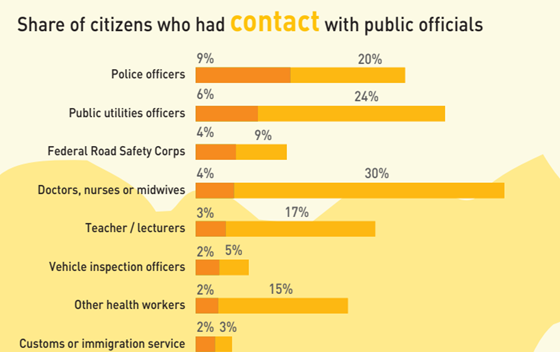
Bribe frequency was higher in rural areas, with an average of 5.8 bribes per payer, compared to 4.5 in urban areas. The most common interactions involved healthcare professionals (30% of respondents) and public utilities officers (24%), followed by police officers at 20 percent. These trends highlight persistent challenges in governance and the distribution of public services across Nigeria.
Bribery prevalence in Nigeria has seen a slight but notable decline, with 27 percent of citizens who interacted with public officials in 2023 reporting they paid a bribe, compared to 29 percent in 2019. When including cases where bribes were requested but refused, bribery featured in 34 percent of interactions in 2023. Encouragingly, a growing number of Nigerians resist corruption—70 percent of those asked to pay bribes refused at least once, with the highest refusal rate (76%) recorded in the North-West. All regions reported refusal rates above 60 percent, highlighting an encouraging trend of increased citizen empowerment.
Read also: Bad governance, corruption, ethnic distrust must be addressed to grow
Public reception to paying bribes waning
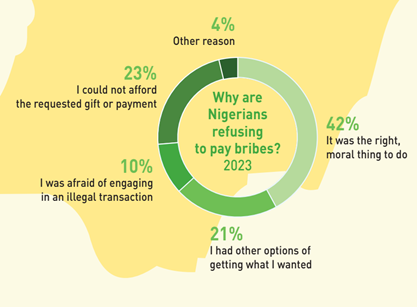
Public attitudes toward bribery are also shifting, with 70 percent of the population refusing to pay on at least one occasion in 2023. Acceptance of bribery to expedite procedures has dropped from 29 percent in 2019 to 23 percent in 2023, reflecting a growing intolerance for corruption. Fewer individuals report suffering repercussions for refusing bribes (38% in 2023, down from 49% in 2019). Reasons for refusal include moral convictions (42%), cost-of-living concerns (23%), and access to alternative options (21%), signalling a societal move toward accountability and transparency. This cultural shift demonstrates progress in the fight against corruption, driven by increased awareness and resilience among Nigerians.
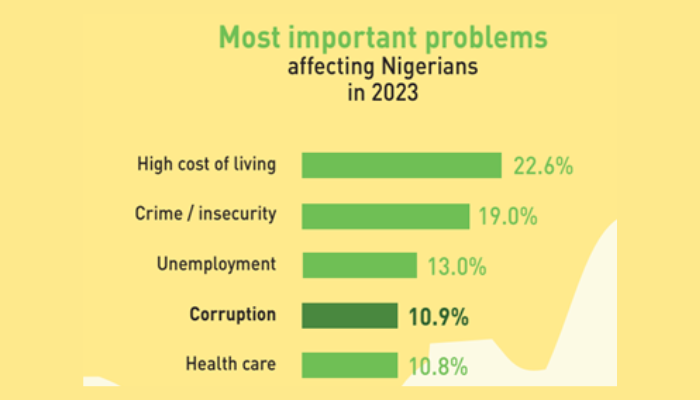
Corruption continues to rank among the most important problems affecting Nigerians.
In 2023, Nigerians ranked corruption as the fourth most pressing national issue, following the cost of living, insecurity, and unemployment.
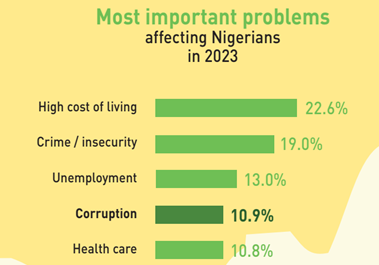
This reflects consistently high levels of concern about corruption, surpassing other issues such as education and housing. However, public confidence in the government’s efforts to combat corruption has significantly declined. While over half of Nigerians believed the government was effective in tackling corruption in 2019, this confidence dropped to less than one-third by 2023.
This trend is evident across all regions, with each of the six geopolitical zones recording declines of more than 10 percentage points in citizen trust between 2019 and 2023. These findings highlight the growing gap between public expectations and perceived government performance in addressing corruption.
Private sector bribery is increasing but continues to be less prevalent than in the public sector.
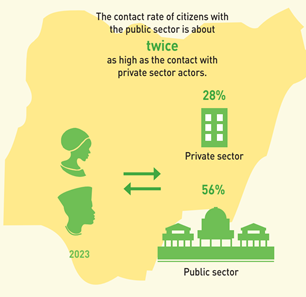
The prevalence of bribery involving private sector actors, such as doctors in private hospitals and employees of private companies, rose significantly from 6 percent in 2019 to 14 percent in 2023. This increase was observed across all regions and various categories of private sector employees. Despite this growth, bribery within the public sector remains about twice as prevalent as in the private sector.
Additionally, citizens are twice as likely to interact with public sector officials (56%) compared to private sector actors (28%), emphasising the continued dominance of public sector engagement in overall bribery incidents.
Read also: Nigeria’s economy shows resilience as GDP up 3.46% on services
Who collects bribes?
Public officials vary widely in their involvement in bribery, with distinct patterns tied to their frequency of citizen interactions. Officials such as doctors, nurses, and teachers, who often engage with the public, report relatively lower bribery rates in their interactions. In contrast, officials like prosecutors or land registry officers, who have less frequent contact with citizens, exhibit significantly higher rates of bribery in their dealings. These variations highlight disparities in corruption risks across different public service sectors, suggesting the need for targeted anti-corruption measures tailored to specific roles and frequencies of engagement.
Bribery in Nigeria can occur through direct or indirect means, with notable shifts observed in 2023. Direct requests from public officials accounted for 52 percent of bribery cases, down from 60 percent in 2019, while indirect requests made up 23 percent. Spontaneous payments to expedite services constituted 9 percent, and 8 percent of bribes were offered unsolicited as tokens of appreciation.
Notably, the timing of bribe payments has also changed. In 2023, 58 percent of bribes were paid before receiving a service, a decrease from 67 percent in 2019. Conversely, post-service bribe payments increased to 22 percent, up from 15 percent in 2019. This trend, combined with the reduction in direct bribe requests, suggests that public officials may be less assertive in demanding bribes, signalling a potential shift in the balance of power in favour of citizens. This evolving dynamic could indicate a gradual reduction in coercive corruption practices.
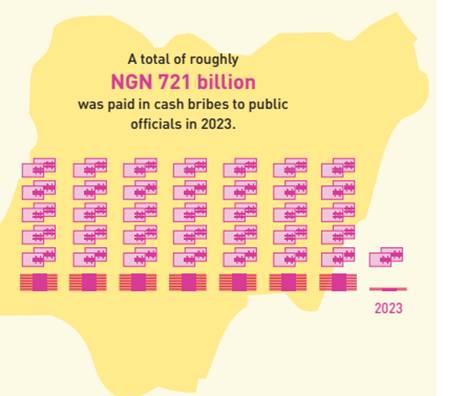
In a similar vein, 2023 saw the average cash bribe paid to public officials in Nigeria at ₦8,284, marking an increase from ₦5,754 in 2019. However, when adjusted for inflation, the real value of bribes decreased by 29 percent, reflecting a decline in purchasing power. An estimated total of ₦721 billion (approximately $1.26 billion) was paid in bribes during the year, representing 0.35 percent of Nigeria’s Gross Domestic Product (GDP). These figures underscore the significant economic impact of bribery, even as its inflation-adjusted value declines, highlighting the persistent challenge of corruption in Nigeria’s public sector.
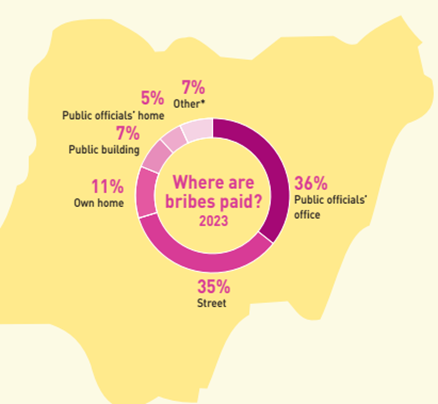
In 2023, bribes were most commonly paid either in a public official’s office (35%) or on the street (36%), reflecting the prominence of these locations in citizen interactions with officials. Additionally, 11 percent of bribes were paid in the respondents’ homes, and 7 percent occurred in other public venues such as restaurants, malls, or stations. These statistics illustrate the diverse settings where bribery takes place, highlighting the need for comprehensive anti-corruption measures that address various contexts of public and private interactions.
In sum, the 2023 corruption survey highlights the need for the government to focus anti-corruption efforts on institutions and public officials most frequently encountered by citizens, such as health workers, utility officers, and police. Encouragingly, 70 percent of Nigerians refused bribes at least once, reflecting growing awareness and reduced tolerance for corruption. Additionally, the willingness to report bribery doubled from 3.6 percent in 2019 to 8.6 percent in 2023, with a significant rise in follow-ups and formal actions against offenders, demonstrating progress in combating corruption through citizen empowerment and accountability.