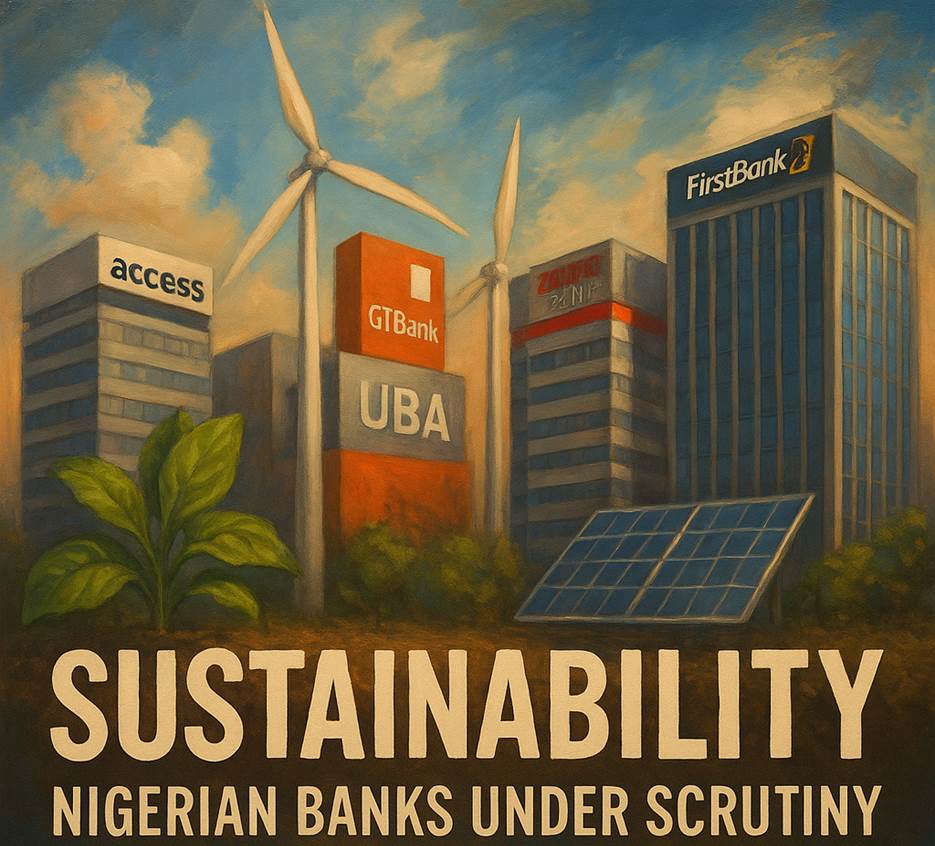
Nigeria’s biggest banks are in a hurry to look responsible. In their latest filings, Access Holdings, GTCo, UBA, Zenith Bank, and First Bank all describe themselves as champions of sustainability, committed to inclusive lending, renewable energy finance, and ethical governance.
But as global climate-disclosure rules harden, investors are asking whether these statements amount to genuine reform or just another chapter of corporate storytelling.
The 2025 half-year results mark a turning point. With the IFRS Sustainability Standards (S1 and S2) taking effect globally in 2024, sustainability has shifted from public-relations copy to a compliance requirement on par with financial reporting.
IFRS S1 sets the baseline for sustainability-related disclosures, covering how environmental, social, and governance (ESG) issues affect a company’s overall performance while IFRS S2 focuses specifically on climate-related risks, such as emissions, extreme weather, and the low-carbon transition.

“The ISSB Standards have been designed to help companies tell their sustainability story in a robust, comparable and verifiable manner,” said Emmanuel Faber, Chair of the International Sustainability Standards Board (ISSB).
These new rules, issued by the International Sustainability Standards Board (ISSB), compel banks to reveal how climate and ESG factors shape their business models, risk exposures, and profitability.
A review of Nigeria’s Tier-1 lenders shows that only Access Holdings explicitly claims to have prepared its 2023 Sustainability Report “in compliance with IFRS S1 and S2 and the Global Reporting Initiative.”
Others, such as Zenith Bank and GTCo, reference the Task Force on Climate-related Financial Disclosures (TCFD) and UN Sustainable Development Goals, while UBA and First Bank emphasise financial inclusion and ethics. Yet few have published measurable climate data or obtained external assurance of their ESG metrics.
Policies are in place but proof is elusive

For investors, that difference matters. Sustainability today isn’t about altruism, it’s about risk, capital, and credibility. Under IFRS S2, companies must disclose their Scope 1–3 emissions, a framework that captures both direct and indirect carbon output.
Scope 1 covers emissions from a company’s own operations, Scope 2 from purchased electricity, and Scope 3 from its value chain, including clients, suppliers, and financed projects.
Without those figures, it’s impossible to assess a bank’s real exposure to climate risk or its readiness for a decarbonising economy.
To their credit, all five banks have built formal governance around sustainability. ESG oversight now sits with board-level risk committees, and dedicated sustainability units exist across operations. But behind these structures, a gap remains: ambition without evidence. Access has set the benchmark, while others are still in the phase of intent over measurement.
That’s not to dismiss the momentum. Zenith Bank has begun financing renewable-energy SMEs; UBA is driving financial inclusion through digital platforms; First Bank now screens energy and infrastructure projects for environmental impact; and GTCo is expanding its social-impact lending.
Collectively, these actions signal a maturing sector. What’s missing is the quantitative backbone, the verifiable data that turns ESG promises into measurable outcomes.
The new currency of trust
Globally, the rules of engagement are shifting. Institutional investors increasingly treat sustainability data like credit risk: measurable, comparable, and priced. Banks in Europe and Asia already disclose their financed emissions, the carbon footprint of loans and investments and tie executive pay to decarbonisation targets. Nigerian lenders, by contrast, remain in the early stages of this transformation.
The Central Bank of Nigeria’s Sustainable Banking Principles were a crucial first step, requiring banks to integrate social and environmental risks into lending decisions, in line with its definition of sustainable banking as growth that is “economically viable, environmentally responsible, and socially relevant.”
But full ISSB-aligned disclosure with independent audit and third-party assurance will be the next frontier. The message is simple: sustainability reporting will soon be judged with the same rigour as audited financial statements.
And that shift is not cosmetic. For a country vulnerable to both floods and fuel shocks, climate accountability is tied directly to macroeconomic stability.
For banks, it’s a question of competitiveness: institutions that can prove their sustainability credentials attract cheaper funding from international investors and development finance institutions. Those who cannot will pay a risk premium or be screened out entirely.
“We want to make sure that NGX is one of the leading exchanges in attracting capital around sustainability,” said Temi Popoola, ceo of the Nigerian Exchange Group (NGX), at the exchange’s 2024 sustainability forum.
His remarks echo the growing shift across Nigeria’s capital markets, where sustainability has moved from rhetoric to pricing, influencing how capital is raised, benchmarked, and valued.
From promises to performance
The challenge now is to move from rhetoric to results. Nigerian lenders must quantify emissions, set reduction targets, and publish third-party-verified reports. They also need to disclose how climate risks feed into capital buffers, loan performance, and asset valuations. In other words, they must make sustainability measurable, modelable, and material.
Access Holdings has drawn the first line. Zenith and GTCo are aligning, while UBA and First Bank still rely heavily on qualitative reporting. The real test will come in 2025, when their full-year statements reveal whether these claims have evolved into verifiable data under global standards.
According to the Climate Policy Initiative, Nigeria attracted about $2.5 billion in climate-finance flows in 2022 but faces an annual $27 billion gap, underscoring why stronger sustainability disclosures by banks matter to investors seeking credible green pipelines.
For investors, the conclusion is unmistakable: Nigeria’s next investment frontier isn’t oil or FX, it’s transparency. The banks that can measure and disclose their environmental footprint will shape the next decade of credible African finance.
Because in modern markets, sustainability is no longer a slogan, it’s a score.