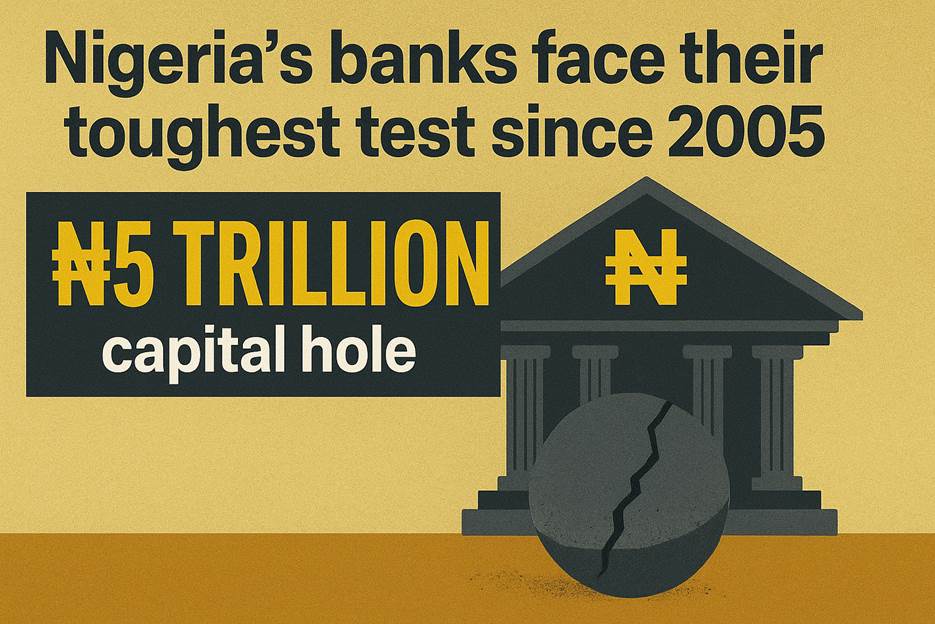
Nigeria’s banks face a capital hole of nearly N5 trillion, a shortfall bigger than the federal government’s combined education and health budgets in 2024. Two decades after Charles Soludo forced a brutal cull that left only 25 banks standing, the Central Bank of Nigeria (CBN) is again rewriting the rules of survival.
On the surface, it looks like a repeat of the 2005 playbook. But the terrain is harsher, the rules tighter, and the stakes far higher.
The Soludo template: when shock therapy worked
In July 2004, Charles Soludo, then CBN governor, stunned the industry by raising minimum bank capital from N2 billion to N25 billion, with only 18 months to comply. Nigeria had 89 banks at the time, many little more than family outfits or regional lenders with fragile balance sheets.

The deadline triggered a frenzy of mergers, rights issues, and stock exchange flotations. By December 2005, the herd had thinned to 25 banks, shareholders had raised roughly N406 billion, and the banking sector’s weight on the Nigerian Stock Exchange surged from 24 percent to nearly 50 percent.
The survivors, Zenith, Access, UBA, First Bank emerged with deeper balance sheets, stronger governance, and national reach. When the global financial crisis hit in 2008, Nigeria’s financial system avoided the worst, helped by buoyant oil prices, moderate inflation, and receptive international capital.
Cardoso’s challenge: a tougher climb
Fast forward to March 2024. Olayemi Cardoso, the CBN governor, announced new thresholds: N500 billion for international banks, N200 billion for national, and N50 billion for regional. The deadline: March 2026.
Cardoso framed the exercise as essential to Nigeria’s ambitions: “We want banks that are not only safe and sound but also capable of supporting a $1 trillion economy by 2030.”

This time, only paid-up share capital and share premiums count. As Cardoso stressed: “The new minimum capital requirement shall be applied to only the share capital and share premium. Shareholders’ funds will not be recognized for this purpose.”
The scale is daunting. Analysts estimate the system faces a N5 trillion shortfall. More than 20 banks will need to raise equity in one of the toughest funding climates in recent memory.
“Without credible foreign inflows, banks will be fishing in the same shallow pond of domestic investors,” said one Lagos-based investment banker. “The stronger players will survive, but the mid-tier names face a brutal squeeze.”
Interest rates are stuck at 27.5 percent, while the cash reserve ratio (CRR) is set at 50 percent, effectively locking up half of deposits at the central bank. That alone starves the system of lendable funds.
To make matters worse, lawmakers imposed a windfall tax of up to 70 percent on foreign-exchange revaluation gains in 2024, clawing back the one-off profits banks had hoped to recycle into new capital. Add rising operating costs and weak loan demand, and margins are being crushed just when banks must convince wary investors to commit fresh cash.
A harsher backdrop
The contrast with 2005 could not be starker. Then, Nigeria enjoyed high oil prices, a stable naira, and inflation in single digits. Today, inflation spiked to 34.8 percent in December 2024 before easing to 21.9 percent by mid-2025.
The naira has been devalued twice in two years. Real incomes are eroded, investors skittish, and global capital less forgiving.
The regulatory tone is also firmer. In June 2024, the CBN revoked Heritage Bank’s licence, citing persistent underperformance. That move reassured depositors but sent an unmistakable warning: there will be no safe landing for laggards. Either raise the capital or prepare to disappear.
Winners, losers, and the new fault lines
The race is already reshaping the industry. Fidelity Bank has launched a rights issue to shore up its balance sheet. GTCO is pursuing a secondary listing in London, hoping to tap international investors.
Access Bank and Zenith Bank have already crossed the threshold, raising over N350 billion each. Even PremiumTrust Bank, a three-year-old newcomer, announced in mid-2025 that it had surpassed ₦200 billion, becoming the ninth lender to hit the target.
For the biggest banks, recapitalisation is less a threat than an opportunity to consolidate market share. They can absorb weaker rivals, expand their dominance, and position themselves as continental players.
For mid-tier and regional banks, the options are starker: merge, downgrade licences, or risk extinction. Analysts predict at least three to five mergers before the March 2026 deadline.
“The danger is that Nigeria ends up with banks that are too big to fail, but also too risk-averse to lend,” warned a West Africa equity analyst. “That’s a recipe for stability without growth.”
Beyond the banks
This is not just a banking story. The recapitalisation will help determine whether Nigeria can meet its ambition of building a $1 trillion economy by 2030. Larger capital bases should, in theory, allow banks to extend longer-term credit for infrastructure, industry, and agriculture.
But if equity raises are completed in a climate of weak margins and punitive regulation, lenders may simply retrench: protecting their balance sheets while cutting back on real-economy lending.
For investors, the divergence is stark. The tier-1 banks, Access, Zenith, UBA, GTCO look set to emerge stronger, possibly expanding further into Africa. Their early moves signal confidence. Smaller banks, meanwhile, face existential decisions.
What happens next
Three signposts will define the run-up to the March 2026 deadline:
The pace of capital raising. If the largest banks clear their thresholds early, confidence will ripple across the sector. If smaller banks stumble, mergers and failures could accelerate.
Monetary policy relief. If inflation continues to ease and the CBN trims the CRR or policy rates, funding costs will fall and credit could expand. If tight money persists, recapitalisation becomes costlier and more painful.
Regulatory steel. After Heritage’s closure, stricter vetting of new investors and close scrutiny of capital inflows is inevitable. That will reassure depositors but leave little room for weak boards to fudge compliance.
Not 2005 all over again
The temptation is to view this recapitalisation as a replay of Soludo’s revolution: another culling of weak banks, another wave of consolidation, another chance for the big players to entrench their dominance.
But the conditions are profoundly different. Soludo’s success was underpinned by strong oil revenues, moderate inflation, and receptive capital markets. Cardoso’s challenge is being waged in an economy under stress, with higher taxes, higher rates, and far less fiscal room.
Consolidation is unavoidable. The real test is whether the new giants will power credit and growth or retreat into fortress balance sheets that leave the wider economy starved of capital.
For Nigeria, the paradox is stark: a recapitalisation that saves the banking system, but risks stifling the nation’s growth. The coming months to March 2026 will decide which way the balance tilts.