Nigeria’s 2026 Budget comes at a moment that feels both fragile and decisive. After more than two years of sweeping reforms that upended familiar but deeply flawed systems, President Bola Tinubu is presenting this budget as a turning point — a shift from pain to payoff. Framed as the “Budget of Consolidation, Renewed Resilience and Shared Prosperity,” the speech openly admits what many Nigerians already know: households and businesses have paid a steep price for reform. That honesty matters in a country showing clear signs of reform fatigue.
Still, acknowledgement on its own does not buy credibility. For citizens and investors alike, consolidation cannot become a polite way of describing extended hardship with no relief in sight. The real test of this budget is whether macroeconomic repair finally translates into everyday improvement. Unlike earlier reform budgets heavy on promises, this one is about proof — proof that Nigeria’s reworked economic framework can actually deliver outcomes people can see, feel, and trust.
Stabilisation achieved, sustainability still in question
The economic signals highlighted by the administration point to real progress. Growth is nearing four percent, inflation has retreated sharply from its peak, oil production is recovering, and external reserves are at a seven-year high. These are not cosmetic gains.

They restore a sense of predictability to an economy long battered by uncertainty. Yet the harder question is whether these gains can last. Inflation has eased partly because of tight monetary policy and better supply conditions, but food prices remain stubbornly high and vulnerable to shocks. Oil output, though improving, is still below potential and exposed to security and infrastructure risks.
Portfolio investors are returning, but long-term capital remains cautious. The task for the 2026 Budget, therefore, is not to celebrate stabilisation but to lock it in. That will require disciplined fiscal execution, credible revenue collection, and policy consistency strong enough to withstand both political pressure and global volatility.
A big budget with little room for mistakes
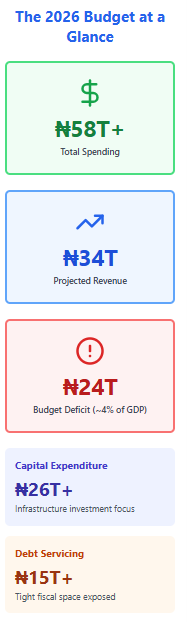
The size of the 2026 Budget is impossible to ignore. Spending plans above ₦58 trillion against revenues of roughly ₦34 trillion leave a deficit nearing ₦24 trillion, or just over four percent of GDP. This reflects a deliberate gamble: borrowing now to unlock productivity later.
Capital spending of more than ₦26 trillion signals intent to tackle long-standing infrastructure gaps, but debt servicing of over ₦15 trillion also exposes how tight Nigeria’s fiscal space has become. The risk is not the deficit itself, but what it ends up funding. If capital projects are delayed, poorly coordinated, or distorted by politics, Nigeria could end up with more debt and little to show for it.

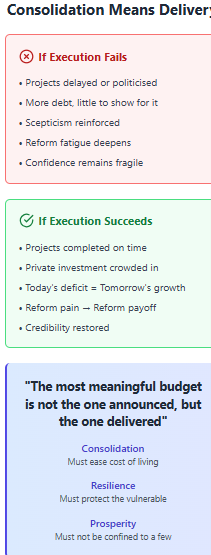
If, however, projects are completed on time and succeed in crowding in private investment, today’s deficit could become tomorrow’s growth engine. In this budget, execution matters as much as ambition.
Revenue, trust and the state’s credibility
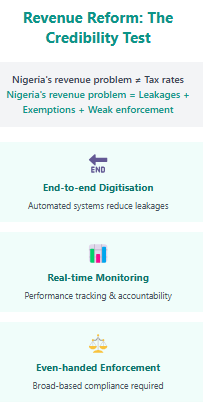
Revenue reform sits at the heart of the consolidation agenda. The government is placing a large bet on better tax administration, oil and gas reforms, and tighter oversight of government-owned enterprises. The focus on end-to-end digitisation, automated reconciliation, and real-time performance monitoring is economically sensible. Nigeria’s revenue problem has rarely been about tax rates; it has been about leakages, exemptions, and weak enforcement. But credibility will depend on fairness.
Businesses and citizens need to see that compliance is broad-based and enforcement is even-handed. Selective discipline destroys trust faster than no reform at all. Nigeria’s fiscal history is full of sound frameworks that failed because follow-through was weak.
What would set this effort apart is consistency — revenues collected transparently, remitted promptly, and clearly linked to public value. Without that connection, higher revenues risk deepening cynicism rather than rebuilding the social contract.
Security and human capital as economic foundations
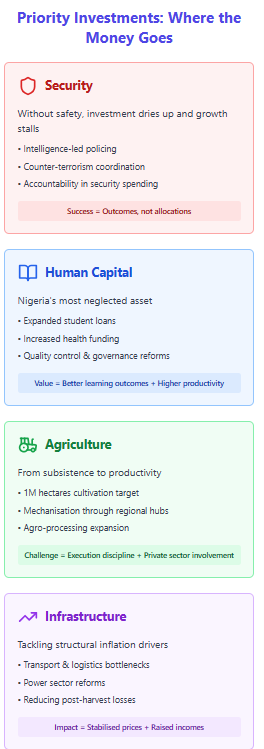
The budget’s emphasis on security reflects economic reality. Without safety, investment dries up and growth stalls. The renewed focus on intelligence-led policing, counter-terrorism coordination, and accountability in security spending is encouraging, but success must be measured by outcomes, not allocations. Education and health spending point to a recognition that human capital is Nigeria’s most neglected asset.
Expanded student loans and increased health funding are steps in the right direction, but money alone will not fix deep structural problems. Governance reforms, quality control, and workforce productivity are just as important. Human capital fuels growth only when education produces usable skills rather than certificates, and when healthcare keeps people productive rather than merely treating illness. Ultimately, the value of these investments will be judged by better learning outcomes, higher labour participation, and stronger earning potential over time.
Infrastructure, agriculture and the inclusion challenge
Infrastructure and agriculture are rightly positioned as drivers of job-rich growth. Nigeria’s inflation challenge is structural, rooted in logistics bottlenecks, energy shortages, and massive post-harvest losses.
Well-executed investments in transport, power, mechanisation, and agro-processing could stabilise prices and raise incomes. The ambition to cultivate one million hectares and expand mechanisation through regional hubs reflects the scale of effort required.
Yet agriculture has long been a graveyard of good intentions, undone by politicisation and weak coordination. What must change is execution discipline and meaningful private-sector involvement. Inclusion will not come from announcements, but from functioning markets that give smallholders predictable prices, access to finance, and reliable links to consumers. Only then can agriculture move from subsistence to productivity and become a genuine engine of shared growth.
In the end, consolidation means delivery
Perhaps the most important line in the President’s speech is the reminder that the most meaningful budget is not the one announced, but the one delivered.
That sentence captures Nigeria’s long-standing fiscal challenge. The 2026 Budget is coherent, reform-aware, and more grounded in reality than many before it. Still, Nigerians have heard strong speeches in the past. What they want now is evidence — that consolidation will ease the cost of living, that resilience will protect the most vulnerable, and that prosperity will not be confined to a few.
If execution matches intent, this budget could mark the shift from reform pain to reform payoff. If not, it risks reinforcing scepticism at a time when confidence remains fragile. The plan is clear. What matters now is the discipline to deliver.