…Gift items circulating
…Decorations in strategic places
…Parks, beaches seeing increased patronage
…Food, drink companies make a kill

…Transport companies smiling to the bank
Those who said that Nigerians are resilient people are right.
That resilience is obvious, especially this festive period as people make efforts to put smiles on their faces despite the harsh economic realities.
Uche Emeh, a rice merchant, has been urging his customers who complain of the high cost of the staple food to, “Just buy rice; full, half, quarter bag or even a derica cup. Rice is rice, just buy something to cook and eat this Christmas.”
Many Nigerians are doing exactly that this festive season, just cutting their coats according to their clothes.

Corporate organisations are further boosting the resilience spirit with the beautiful and elaborate decorations in their offices, on major streets and public places, ushering many in festive mood.
One decoration that seems to catch the most attention in Lagos is the enthralling decoration by Zenith Bank at the roundabout leading to its head office on Ajose Adeogun Street in Victoria Island.
There are many of such beautiful festive decorations that have not only lit the town, but set many in festive mood as well as encouraging them to also decorate their home even with the cheapest Christmas tree for light effect.
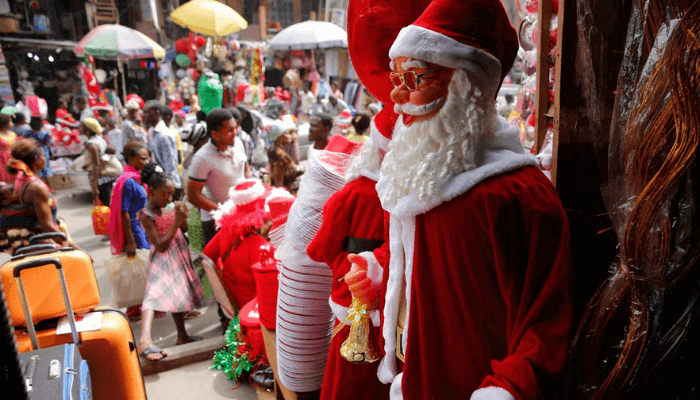
Yet, decoration companies, dealers on decoration materials, decoration designers and installers are already smiling to the bank.
Of course, this is a gifting season and the sharing is on, though in lesser magnitude.
“People are buying Christmas hampers, but not like before because of the cost. We have also reduced the quantity and quality of the content to encourage patronage,” Jide Omoniyi, a supermarket supervisor, said.
He observed that many prefer to buy gifts at the open market, which is cheaper or send money in lieu of the gifts.
“People still give gifts for the festive season, but the quality, quantity and method have changed because of the harsh economy,” Uzo Adim, a banker, said.
According to him, despite the harsh economic realities, his employer, a first-tier bank, still gave out gifts to the employees, customers, partners and associates this festive season.
Read also: Cash scarcity fuels surge in fake naira notes as Nigerians struggle for currency
“It is a corporate culture to give gifts to the employees, certain customers and partners during the festive season. The tradition will not stop, but the number of beneficiaries, quality and quantity of the gifts have reduced today because of the hardship,” Adim noted.
On a personal level, Julius Tamuno, who usually gives new phones and other electronic gadgets as Christmas gifts to some family members, now sends money to them.
“It was a culture I maintained for five years until last year. I can’t buy three phones or iPad now, they are very expensive. Instead, I send money to them because everyone is managing now,” Tamuno, a Niger Delta Development Commission staff, said.
According to the accountant, Christmas is all about sharing and people will not stop giving because of the harsh economic realities, rather the level of giving and the quality of the gifts have reduced.
For Iya Aduni, a retired government auditor and now a philanthropist, the harsh economy cannot be an excuse for those who love sharing with others, especially during this festive season.
“I usually visit some orphanage homes during Christmas and give them food items and cash. I am doing the same this year, just that I will limit my movement to orphanages within my reach and send money to some I can’t reach,” she said.
She encouraged many who usually give others gifts during the festive season to find a way around the harsh economy to continue the good gesture.
“You must not give a full bag of rice, which is over N100,000 now. Buy half or a quarter bag, buy other items, just give out something no matter how small. You can even pay someone’s transport fare, just give something to someone this season, it brings joy,” she urged.
As expected, many parks, beaches and public spaces are ready to host patrons this festive season as the owners and operators have stocked drinks, food items, souvenirs and casual staff to meet the festive rush.
“Yes, we know that the economy is not smiling, but it will not stop people from coming out to enjoy themselves this festive season.
“They will squeeze out money because it is once a year fun for many,” Yakubu Pam, a theme park operator in Abuja said.
On his part, Magnus Ibiwari, an operator at Port Harcourt beach, noted that even insecurity will not stop people from visiting the beach this festive season.
“We know there is no money, but people have been coming here and spending. More will be visiting this festive season and we will make a kill because people don’t want to die from the troubles of this country, they want to enjoy their small money as much as they can,” he noted.
Already, all the beaches in Lagos, from Elegushi, Tarkwa Bay to Badagry have started receiving visitors for the festive season, amid hike in entrance fees and the vendors are very anxious to make a kill.
“Lagosians like enjoyment, they will come in great numbers and we are waiting to excite them with many beach activities. Again, they will come because Lagos beaches are safe, no incidents year-on-year,” Saliu Gbogun, a beach operator at Elegushi, assured.
Edem Utuk, an operator at Marina, Calabar, is expecting good business this festive season as visitors are already arriving Calabar for the annual carnival, which he described as the biggest street party in Africa.
“We keep saying there is no money, but the Calabar Marina is always full every evening with people enjoying themselves, as well as many open-space restaurants in Abuja, Lagos and even Uyo.
People will come this festive season to enjoy here, we are seeing them already and more will come. Nigerians are coming to Calabar this festive season because it is safe,” Utuk said.
But what speaks more of resilience is the way many are undermining the economic hardship to travel, especially for inter-state journeys.
A visit to the Utako District in Abuja, where most inter-state transport companies are located, tells a better story.
On December 20th, the district was in lockdown due to the incredible number of passengers traveling out of Abuja to their states for the festive season.
The same is the case in Lagos’ major inter-state transport hubs of Jibowu, Mile 2, Maza Maza and Oyinbo.
While motorists are complaining of the traffic caused by the festive rush, transport companies are smiling as the passengers are gladly paying the fares that have doubled since the second week in December.
From N30,000 in the first week in December, fares to South-East routes are now going from N50,000 per passenger, South-South routes like Uyo and Calabar are even higher, from N60,000, while Abuja is from N45,000.
“Considering the steady hike, I anticipate that the fare will get to N70,000 per passenger by December 24th. It is unfair, but the passengers have no option. Flights are very expensive and night buses are cheaper, but the risk is much,” Anselm Odika, a passenger, lamented at GUO bus terminal in Jibowu.
Abasiama Ufot, a passenger at the Okota terminal of Akwa Ibom Transport Company, lamented that the fare is unbearable and that this is the time various state governments should introduce free buses to alleviate passengers’ sufferings.
“The governors keep telling us that they are working for our good. We need them to help now and not during the campaign because transporters are ripping off passengers this festive season. We need free buses to ease our sufferings in the hands of these profit-seeking transporters,” Ufot decried.
But Bruno Ezeokoye, a transporter, said that the fare hike is in response to the high demand and passengers’ rush this festive season.
“Every business has a peak season and ours is now and we have to maximise the opportunity. By January it will end and governments at all levels are collecting taxes and levies from the fares too.
“We need to maintain our buses, pay staff, especially drivers, pay and service loans used in purchasing new buses and other expenses. So, we make money this season and we also spend it,” Ezeokoye said.
While transport companies make money during the festive season, Hyacinth Idama, a driver with Agofure Motors, decried that the drivers bear the brunt.
Idama, who plies the Lagos-Benin-Warri route, said that an average bus driver is overworked during the festive season, with little to show for it.
“Passengers complain of high fares, we work, but owners make the money,” he noted.
Apart from transport companies, food and drinks companies are also making a kill this festive season as patronage soars despite the harsh economic realities.
From beer, spirits, wine, local drinks to carbonated drinks, it is incredible patronage as many undermine the hardship to celebrate for once.
Many dealers usually run out of stock as the demand outweighs supply.
“The festive spirit, starting from Ember Month until New Year, is very strong on people considering the way they drink like never before. Our stock is decreasing and that is good patronage. It means that people will even drink more this festive season no matter how lean the pocket is,” Yemi Olajide, a drinks merchant, said.
Ike Ogbonna, another drinks dealer, noted that nobody is hoarding drinks now unlike before because the price is high, but patronage is sustainable.
“We did not buy large stock to hoard ahead of the festive season because many are drinking what their money can afford now. “So, we have varieties for our customers to choose from and profit comes from across the varieties unlike before when it is mainly Nigerian Breweries and Coca-Cola products that sell most during festive season,” he explained.
While Christmas is a day that will come and go, the reality is that many want to enjoy it the best way they can, and those who cannot afford celebration, await another season.