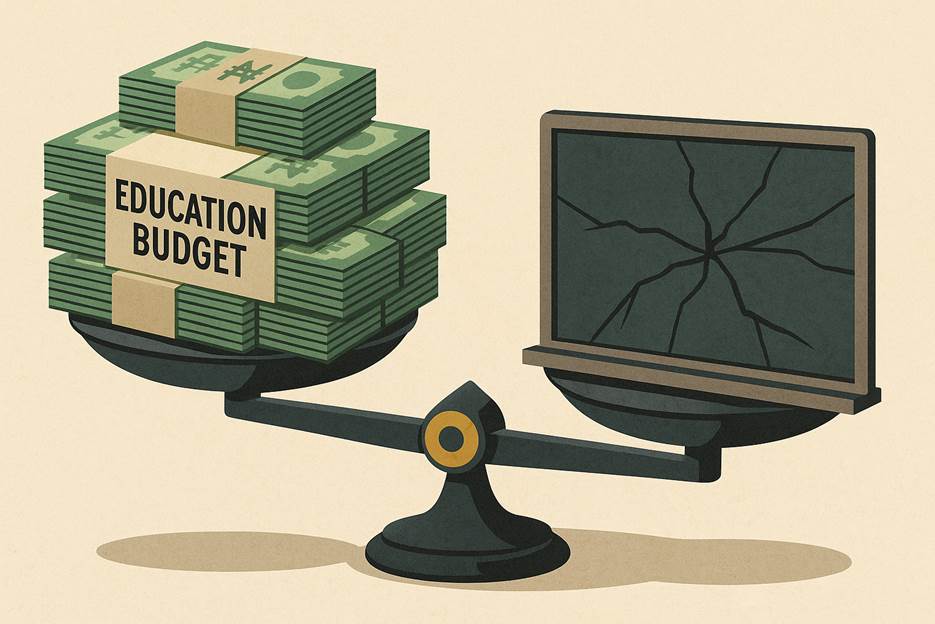
Nigeria has nearly tripled its education spending in five years, but outcomes remain flat. Budget allocations rose from N602 billion in 2019 to N1.59 trillion in 2024, yet classrooms are still overcrowded, proficiency is stagnant, and millions of children are out of school.
Analysts warn that much of the funding is absorbed by salaries and recurrent costs, leaving little for the infrastructure, teacher training, and digital tools that directly improve learning.
In 2019, Abuja allocated ₦602 bn (about $1.65 bn) to education. By 2023, the figure had nearly doubled to N1.05 tn ($2.73 bn), according to the National Bureau of Statistics. In 2024, the education budget was N1.59 tn, still well below UNESCO’s recommended 15 percent – 20 percent benchmark.
For 2025, President Bola Tinubu proposed a headline allocation of N3.52 tn out of N54.99 tn, which equates to roughly 6.4 percent of total spending far short of global standards.

“The budget tells you where a country’s heart is,” says Tunde Adeoye, a Lagos-based development economist. “And Nigeria’s heart is clearly not in education.”

Falling behind peers
The numbers underline the gap. Nigeria spends between 6 and 7 per cent of its budget on education. Egypt devotes roughly 12 per cent, South Africa 9 per cent, and Kenya 8 per cent, according to World Bank data. In absolute terms, South Africa spent $28.1bn on education in 2023, Egypt $18bn, and Kenya $6.3bn far above Nigeria’s $2.7bn outlay, despite its far larger population.
Salaries over schools

Where Nigeria does spend, most of it is absorbed by salaries and stipends. Personnel costs swallowed more than 65 per cent of the 2024 education budget, leaving just 30 per cent for capital projects such as new classrooms, laboratories and digital learning infrastructure. By contrast, Egypt channels nearly 40 per cent of its education spend into infrastructure, and Kenya about 35 per cent.
“Paying teachers is vital,” says Yusuf Oladehinde, an education consultant in Lagos, “but without investment in facilities, overcrowding, poor materials and absent technology will continue to undermine learning.”
Parents are voting with their wallets. “I would like my children to attend public secondary school, but infrastructural gaps and overcrowded classrooms discourage me,” says Akeem Ayinde, a father in Ogun State. “So, I have to work and earn money at all costs to send them to private school.”
Stagnant outcomes
Despite higher allocations, student achievement remains stubbornly weak. UNESCO data show that only 36 per cent of Nigerian primary school pupils achieved minimum proficiency in literacy and numeracy in 2022 the same as in 2019. Kenya and South Africa scored 57 and 52 per cent respectively.
Meanwhile, Nigeria’s out-of-school population is swelling. UNICEF estimates 18.5m Nigerian children were out of school by late 2024 about 15 percent of the global total.
A decade of decline
The long-term trend is stark. In 2015, education accounted for 10.75 per cent of Nigeria’s national budget. By 2025, that share had slid to 5.47 per cent. The mismatch between political rhetoric and hard budget numbers has deepened scepticism about government priorities.
The road to reform
Analysts argue that Nigeria must not only increase the size of its education budget but also reallocate spending. Capital investment should rise to at least 40 per cent of total allocations, targeting classrooms, teacher training, and digital infrastructure. Regular national assessments of literacy, numeracy and digital skills could provide a clearer measure of progress.
Accountability is just as important as money. Education budgets are often underutilised or diverted. Without stricter oversight by parliament, civil society and anti-graft agencies, even larger allocations may fail to translate into better outcomes.
Civil society groups and unions have been pushing for reform. In 2023, the Academic Staff Union of Universities launched a national campaign for higher funding and greater autonomy. Yet fiscal pressures and competing priorities have slowed progress.
At stake
For Tinubu’s government, the challenge is not how much Nigeria spends, but how it spends it. Without stronger oversight and greater capital investment, rising allocations will keep missing their mark. The danger is clear: a fast-growing youth population shut out of opportunity, and an economy unready for a knowledge-driven future.
Unless Nigeria matches money with strategy, it risks raising a generation unfit for the demands ahead.