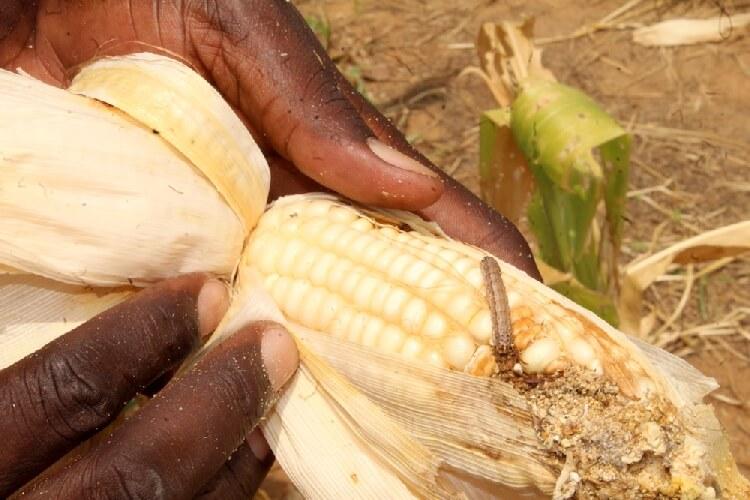
Armyworm, the destroying caterpillar that has devastated agriculture in Africa would soon be a thing of the past as Nigeria has found a chemical that can destroy the pest, the Nigeria government says.
Fall armyworm has cost African economies billions of dollars in crop losses since the pest was first spotted on the continent in 2016, prompting fears of a food shortage as hundreds of farmlands were attacked by the pest.
“We have found a solution to the armyworm invasion across Africa and the Food and Agriculture Organisation (FAO) has tested our chemicals which are purely organic and we would be launching next month on World Food Day,” Audu Ogbeh, Minister of Agriculture and Rural Development told BusinessDay on the sidelines of the just concluded Africa Green Revolution Forum (AGRF) in Kigali, Rwanda.
“It was invented by our researcher, a professor at a University in Nigeria who got the solution from neem tree and after our launch, we would be sharing with other countries,” Ogbeh said.
The minister did not give the name of the researcher nor the chemical, saying that details would only be provided when the Federal Government launches it.

The neem tree which is used to provide the solution has long been recognized for its unique properties both against insects and in improving human health. It is grown in most tropical and sub-tropical areas of the world for shade, reforestation and for the production of raw material for natural insecticides and medicines.
Armyworm, a pest, is part of the order of lepidopters and wreaks havoc on crops if left to multiply. Its name is derived from its feeding habits and it eats up the stems of crops, as well as the leaves.
Since 2016 when it was first spotted in Nigeria, a total of 22 states have been affected out of the country’s 36 states, according to Nigeria’s maize association.
The incurred losses that affected these states led to a 2016 and 2017 decline in Nigeria’s maize production, the association says.
Similarly, prices of maize in 2017 hit a record high of N180, 000 per metric, making poultry farmers, producers of feeds, flour, noodles, biscuits, brewers, confectioners among others, who uses maize as a raw material at factories to suffer as their production cost shot-up.

“We are very excited about this and waiting anxiously for the unveiling. We had suffered a lot from armyworm invasion in the past and we hope that this would totally address the problem,” Bello Abubakar Annur, national president, Maize Association of Nigeria (MAN) said in a response to questions.
Recently, the Food and Agricultural Organisation (FAO) warned that if left on checked, fall armyworm pest could push over 300 million people into hunger, and lead to an annual economic loss of about $4.8 billion from maize production alone.
The Federal Government had last year partnered with the International Institute of Tropical Agriculture (IITA) to find a lasting solution to the armyworm pest.