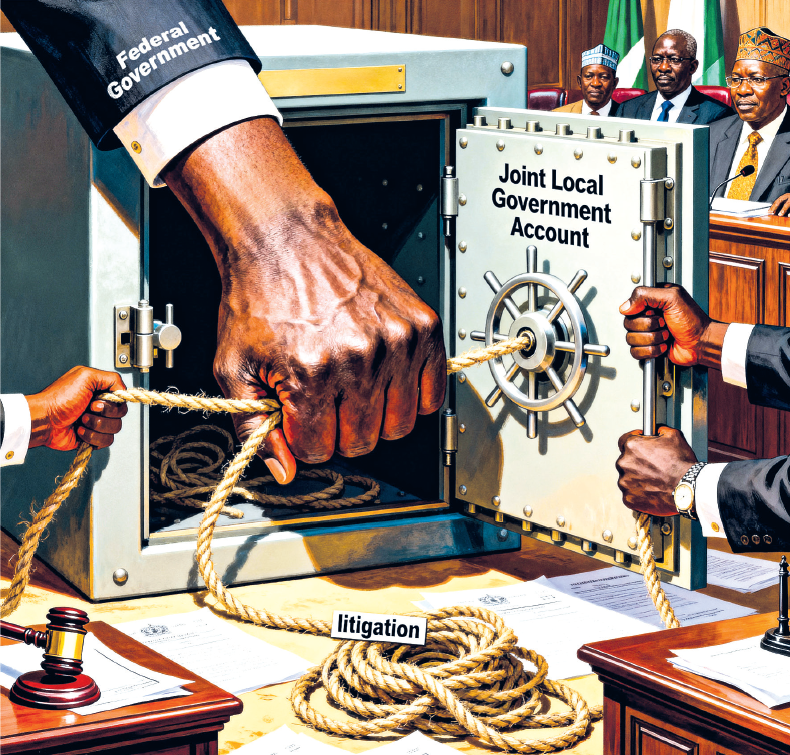
In Osun State, a political stalemate has frozen local government allocations since the early period of 2025. The Federal Government only recently released some funds amid accusations of partisan meddling. Citing constitutional requirements for democratically elected councils, it withheld allocations on the grounds that the local governments were improperly constituted. Sadly, this situation is not limited to Osun State. The delivery of public goods to the grassroots has deteriorated in Nigeria, revealing a deeper flaw in Nigeria’s federal design – a relic of military centralism that imposes a one-size-fits-all system on diverse states.
The Federal Government’s perennial fixation on the Joint Local Government Account through which states receive funds for their councils is the crux of this problem. Like a modern-day Naboth’s vineyard, the account grants governors expansive control over local affairs that Abuja finds irresistible, often motivating its frequent accusations of mismanagement. The result is a theatre of overlapping authority and endless litigation that detracts from service delivery.
The prevailing wisdom is that Nigeria’s local governments need “autonomy”. But autonomy, as currently imagined, has been reduced to a slogan, a call for unvarying independence under a uniform system. The Constitution’s 774 local governments have become a sacred number, as if divinely ordained. Yet this rigidity is the direct legacy of the 1976 Local Government Reform under military rule, which sought to standardise Nigeria’s diverse local traditions into a centralised administrative model. Later constitutions adopted it wholesale, turning a temporary experiment into doctrine and reinforcing the illusion of a “uniform autonomy” that never truly existed.
This uniformity fuels today’s contradictions. State governments, regardless of party, resist what they view as federal intrusion into their jurisdictions. President Bola Tinubu, who once defended Lagos’s creation of Local Council Development Areas (LCDAs) against federal authority, now leads a government asserting similar control over other states. It reflects Nigeria’s predictable politics – where positions change with power – leaving the federation trapped in a constant, unproductive struggle over control.

Wallace Oates’s economic logic of decentralisation holds that local administrations function most efficiently when they deliver public goods in line with local needs – waste management in cities, irrigation in rural areas, and schools and clinics in between. Central control only applies to stem negative spillover. Sadly, in Nigeria, political energy is now consumed by disputes over local council financing instead of service delivery.
There is no single universal model of local governance. In France, communes report directly to Paris. In the United States, states grant cities “home rule” charters; California’s strong mayoralties differ markedly from Texas’s limited counties. Canadian provinces control municipalities outright, while India’s panchayats adapt national mandates to local languages and cultures. Even within federations, structures vary: Germany protects a “core sphere” of local autonomy; Switzerland’s cantons defend linguistic rights; and Ethiopia and India reserve autonomous local councils for minorities. The common thread is flexibility – the ability to adjust to local histories and needs.
However, Nigeria remained frozen in a 1970s template. What the country needs is not uniform autonomy but subsidiarity-driven diversity – a structure that lets each state design its own local system. Metropolitan Lagos, dense and complex, requires a multi-tiered structure for transit, housing, and waste management. Borno, vast and rural, may thrive on simpler community councils for agrarian development. Ekiti, compact and homogenous, might even need fewer councils. The Constitution’s rigid ceiling and floor on the number of local governments should be removed; local governance should respond to reality, not stagnate on military-era diktat.
The fiscal architecture also needs rethinking. Decoupling local governments from the federation’s revenue-sharing formula would eliminate perverse incentives for political proliferation. Many of today’s LGs were created during the military era, when political patronage to sustain legitimacy was the overriding factor. Instead, fiscal adjustments should be tied to measurable indicators such as population, poverty levels, or development needs – a true fiscal equalisation policy rather than a patronage machine.
Reform should also protect minorities within states. Some Middle Belt communities could benefit from autonomous districts to correct historical imbalances in emirate systems. Likewise, resource-rich minority enclaves in the Niger Delta could receive guaranteed fiscal shares and protection through minimum self-administration provisions. Federalism, properly practised, protects difference; it does not flatten it.

Ultimately, local governments are like the roots of a tree. They are shaped according to the soil from which they draw nourishment. Some roots dig deep in deserts; others spread wide in deltas. A system that allows these roots to grow according to their soil will flourish. But when we insist on planting every tree in the same soil, no matter how fertile, we set ourselves up for failure.
The recurring conflict over the control of local governments in Nigeria reflects a deeper issue of governance and responsibility. Local governments are meant to serve as the closest tier of administration to the people, addressing community needs and fostering development, yet their roles are often hijacked.
Each level of government should recognise its distinct role: the state governments as coordinators and regulators, and the local governments as implementers of grassroots policies, while the federal government superintends constitutional guarantees against harm and undemocratic practices. Clarifying and respecting these boundaries is essential to end the constant disputes and restore local governance as a true instrument of public service rather than a tool for political domination.