In March this year, the African Union, AU, adopted the new Continental Education Strategy for Africa (CESA) 2026–2035, a framework that aspires to transform education systems across member states into engines of equity, innovation, and sustainable development. The strategy calls for bold commitment in six areas: mobilising resources and enabling environments; strengthening teachers and school leadership; investing in foundational, socio-emotional, and 21st-century skills; expanding higher education and technical training; promoting second-chance and lifelong learning; and ensuring gender equity and inclusion.
The AU has long insisted that education is non-negotiable — rather, it is the cornerstone of Agenda 2063, “The Africa We Want”.
For Nigeria, Africa’s most populous country, the new strategy is more than a continental obligation; it is a moral imperative. With over 200 million citizens, half of them under 19, Nigeria cannot afford to lag behind. Yet the uncomfortable truth is that the country is poorly positioned to deliver on this vision, unless urgent reforms and courageous investments are made.
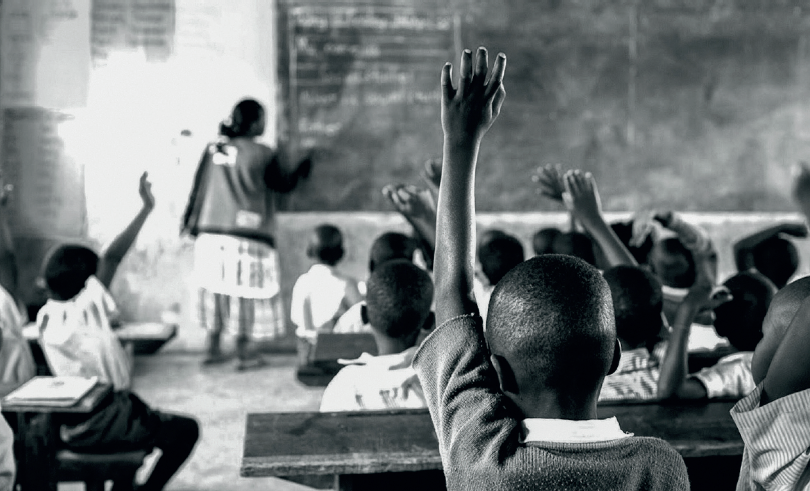
Nigeria’s education crisis sits on a tripod of exclusion — out-of-school rates, low school retention, and lack of foundational learning. Despite decades of policy pronouncements, the country remains the global epicenter of the out-of-school crisis after Afghanistan, with over 10 million children outrightly excluded from the classroom. Among those who enroll, only 63 percent of primary-school-age children attend regularly, and according to UNICEF, less than half of those who enter first grade reach Junior Secondary Grade 3. Even for those who make it into school, attendance does not guarantee acquiring the basics, as nearly 70% of ten-year-olds who have spent time in classrooms still cannot read simple text.
Teachers, who are central to learning, struggle under poor pay, weak training systems, and minimal professional support. Many classrooms remain overcrowded, dilapidated, and ill-equipped. In addition, while digital learning has expanded rhetorically, in practice uneven internet access and unreliable electricity mean technology is far from equitably deployed.

The Federal Ministry of Education’s current priorities of tackling out-of-school children, expanding Technical and Vocational Education and Training (TVET), strengthening teacher quality, and embracing digital learning mirror the AU’s six pillars. However, though alignment is evident on paper, Nigeria’s education system continues to face chronic structural weaknesses.
CESA 2026–2035 is not another AU declaration to be filed away. Rather, it is a continental framework for accountability that narrows priorities to six pillars which house 20 clear strategic objectives, covering everything from teacher professionalism and foundational learning, to lifelong education and equity.
For Nigeria, alignment with this framework could be catalytic. It offers an external benchmark against which the country’s chronically low education spending can be measured, with current allocations still under 10% of the national budget which is far below the AU/UNESCO recommended 15–20%. It reinforces the urgency of professionalising teaching, raising standards, and making the profession attractive to future generations, areas where Nigeria remains weak. It highlights the importance of scaling proven interventions such as Teaching at the Right Level (TaRL), which Nigeria has piloted but not expanded nationally. It also compels deliberate action to address entrenched inequities, ensuring that girls, rural learners, displaced children, and those left behind in conflict zones are not excluded from opportunity.
The reality, however, is sobering: Nigeria is not yet institutionally or fiscally prepared to deliver on CESA without bold corrective action. Four major constraints stand out. First is the persistent financing deficit — current allocations fall well below global and continental benchmarks, and without predictable and increased investment, reforms cannot be implemented at scale. Second is weak implementation capacity; strong policies exist on paper, but poor coordination between federal, state, and local governments consistently undermines their delivery. Third is the learning crisis, where enrolment has not translated into a grasp of basic skills, leaving millions of children in school but not truly learning. Unless foundational literacy and numeracy are prioritised, expanded access will remain hollow. Finally, deep equity gaps which are driven by poverty, conflict, and entrenched regional and gender disparities, particularly in the North-East and North-West continue to exclude millions of children from access to quality education and the opportunities it should guarantee.
To deliver on CESA, Nigeria must move decisively from promises to urgent action. This begins with committing at least 15% of the national budget to education and ensuring that funds are efficiently channelled to the classrooms and communities where they are most needed. It also requires a sustained investment in teachers, through competitive pay, structured professional development, and stronger pathways for women in school leadership, to make the profession both attractive and effective. At the same time, Nigeria must confront its learning crisis head-on by scaling evidence-based interventions such as Teaching at the Right Level nationwide, embedding socio-emotional skills, and aligning curricula with the demands of a rapidly changing 21st-century economy. None of this will be possible without stronger governance: better coordination across federal, state, and local governments, transparent data systems, and a culture of accountability that ensures every reform translates into real outcomes for Nigerian children.
Conclusion
The stakes are high but the choices are clear. With its demographic weight, Nigeria’s performance will significantly influence Africa’s collective progress on education. With nearly one in five Africans being Nigerian, success in Nigeria could set a powerful precedent, showcasing how bold reforms transform outcomes. Failure, however, would stall Africa’s momentum towards Agenda 2063 and betray a generation of young Nigerians.

The African Union has charted the course through CESA 2026–2035. Nigeria must now step up, not only for its own children, but for Africa’s future.