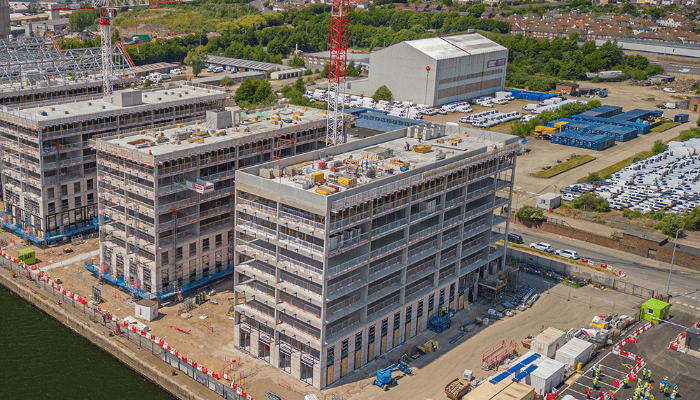
Nigeria’s data centre capacity is set to surge from roughly 70 MW today to over 400 MW by 2030. Global players are piling in. The 2Africa subsea cable now forms a 45,000 km ring around Africa with a design capacity of up to 180 terabits per second. Google’s Equiano delivers another 144 Tbps through Lagos. We have world-class pipes. We are building world-class data halls.
We are powering them with diesel. And that single fact will determine whether Nigeria becomes an AI economy or merely an AI tenant.
Here is what nobody is discussing: every data centre under construction is designed for a 20-year operational life. The diesel generators and gas turbines being installed today will still be running in 2045. If the grid improves, if carbon pricing arrives, if cleaner alternatives get cheaper, these facilities cannot easily pivot. They are locked in. First movers in Nigerian computing may become stranded assets, stuck with cost structures that later entrants will undercut.
This is the opposite of how infrastructure advantages usually work. In Nigerian AI, building first on diesel creates millstones, not moats.

The grid works exactly as incentives dictate
Nigeria’s grid collapsed four times in 2025 and about twelve times in 2024. On December 29, supply fell to 50 MW nationwide. Installed capacity is 13,600 MW; delivered capacity hovers around 5,500 MW, about 40% utilisation. But calling this “failure” misses the point.
Global investors want uptime and hard-currency returns. They build captive power and design facilities that island from the grid indefinitely. The government wants AI headlines and tolerates off-grid workarounds because every self-generated megawatt is relieved of political pressure. Utilities lose their most creditworthy customers to this exodus, leaving serving households and small businesses that cannot defect. Nigerians spend $14 billion annually on generators, according to the African Development Bank. That figure has not budged despite a decade of reforms.
“Every data centre building captive diesel is a missed opportunity to structure that capital as an anchor offtake for grid-connected renewables. The investor gets the same power and security. The surrounding industrial park gets access.”
Each actor optimises individually. Collectively, they create a trap: the more creditworthy load defect, the weaker the grid’s revenue base, the less investment it attracts, and the more rational defection becomes. Nigeria is building a tragedy of the commons in real time. The data centre boom is accelerating it.

Computing sovereignty requires energy sovereignty
The policy conversation focuses on data localisation: keeping Nigerian data on Nigerian soil. But data sovereignty without energy sovereignty is a mirage.
Nigerian self-generated power costs $0.28 to $0.33 per kilowatt-hour. Moroccan solar costs a fraction of that. When AI model training needs to scale, those multi-week, megawatt-hour runs will happen wherever electricity is cheapest. Nigeria may end up hosting inference, running models built elsewhere, while never developing the capacity to train its own. That is not sovereignty. That is tenancy with a Nigerian IP address.
Data centres are the problem and the solution
Here is the counterintuitive move our policymakers are missing. The power sector has stalled partly because it lacks creditworthy offtakers. Banks will not finance generation without guaranteed revenue. Data centres have hard-currency backing, multinational parents, and contractual uptime commitments. They are precisely the anchor customers that could make clean generation bankable.
Every data centre building captive diesel is a missed opportunity to structure that capital as an anchor offtake for grid-connected renewables. The investor gets the same power and security. The surrounding industrial park gets access. The utility gains a paying customer instead of losing one. This is not charity. It is financial engineering that treats energy, AI, and capital as one system.
Four moves to rewrite the bargain
· Make grid contribution a condition for incentives. Data centres above 5 MW receiving tax holidays should structure surplus capacity to flow to surrounding users.
· Create a first-offtaker programme for clean generation. Use climate finance to de-risk projects where data centres commit anchor contracts. The developer gets bankability. The grid gets cleaner megawatts.
· Establish a Green Compute Nigeria standard. A voluntary label tied to diesel hours, carbon intensity, and grid contribution. Link it to faster approvals. Investors increasingly care about Scope 2 emissions; give them a way to signal.
· Publish standardised templates for FX-indexed power agreements. Predictable frameworks attract capital faster than bespoke negotiations.
The bet this decade will settle
The hyperscalers building diesel-backed facilities are betting the grid never improves. That bet has been right for decades.
But if grid-connected clean power becomes viable even five years early, the diesel-first builders will be stranded with expensive, carbon-intensive assets while competitors who are structured differently take the market. The winners will be those who use data centre capital to fix the energy problem rather than escape it.
The rest will keep running on diesel, hoping the cables are enough.
Nathan Olaníyì works at the intersection of finance, strategy, and analytics, helping businesses turn complex challenges into sustainable growth. With a background in investment banking, fintech strategy, and data-driven decision-making, he has advised on M&A, capital markets, and transformation initiatives across African and U.S. markets.