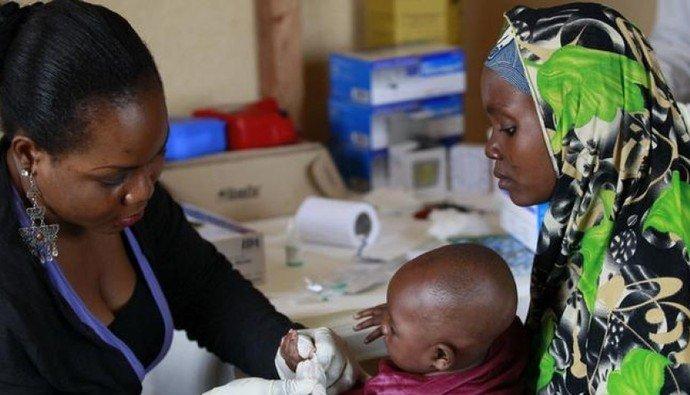
Nigeria is to benefit from Rotary International’s $8.15 million meant to fight polio in the country, as the organisation on Tuesday committed an additional $35 million in grants to support the global effort to end the menace.
This will bring the total humanitarian service rendered by Rotary’s contribution to $105 million in the year 2016 alone. The announcement follows recent reports of three new cases of wild poliovirus in Nigeria, comprising of two cases in July, and one in August.
The three cases are the first to be detected in Nigeria since July 2014, and with these cases, funding for polio eradication is particularly vital as rapid response plans are now in action in Nigeria and surrounding countries to stop the outbreak quickly and prevent its spread.
Following these recent reported cases, Rotary and its partners in the Global Polio Eradication Initiative (GPEI) are acting to immunize children in Nigeria and countries in the Lake Chad Basin, including Chad, northern Cameroon, southern Niger and the Central African Republic.

Nearly one-fourth of the $8.15 million announced by Rotary on Tuesday will support the emergency response campaigns in this at-risk region.
This is notwithstanding the fact that last month; Rotary provided $500,000 to immediately assist with the outbreak response.
In addition to supporting the response in the Lake Chad Basin region, funding has been allocated to support polio eradication efforts in Afghanistan ($5.55 million), Pakistan ($12.36 million), India ($875,000), Somalia ($1.77 million), South Sudan ($2.04 million), and the Democratic Republic of the Congo ($2 million). A final grant in the amount of $2.25 million will support key WHO staff.
While significant strides have been made against the paralyzing disease, with just 26 cases reported in 2016, polio remains a threat in hard-to-reach and underserved areas and conflict zones.
“While we are disappointed with the recent news coming out of Nigeria, this situation underscores the extreme importance of widespread immunization campaigns and strong disease surveillance in all countries of the world until polio is fully eradicated,” said Michael McGovern, chair of Rotary’s International PolioPlus Committee.

According to him, “this funding will help ensure that Rotary and our GPEI partners are doing all that we can to redouble our efforts and protect the progress in polio-free parts of the world, as well as stop transmission in Pakistan, Afghanistan, and now Nigeria.”
To sustain this progress and protect all children from polio, experts say $1.5 billion is urgently needed. However, without full funding and political commitment, this paralyzing disease could return to previously polio-free countries, putting children everywhere at risk.
Rotary has contributed more than $1.6 billion and countless volunteer hours to fight polio, and through 2018, every dollar Rotary commits to polio eradication will be matched two-to-one by the Bill & Melinda Gates Foundation up to $35 million a year.
Rotary launched its polio immunization program PolioPlus in 1985, and in 1988 became a spearheading partner in the Global Polio Eradication Initiative with the World Health Organization (WHO), UNICEF, U.S. Centers for Disease Control and Prevention (CDC), and was later joined by the Bill & Melinda Gates Foundation.
Since the initiative launched, the incidence of polio has plummeted by more than 99.9 percent, from about 350,000 cases a year to 26 confirmed to date in 2016.