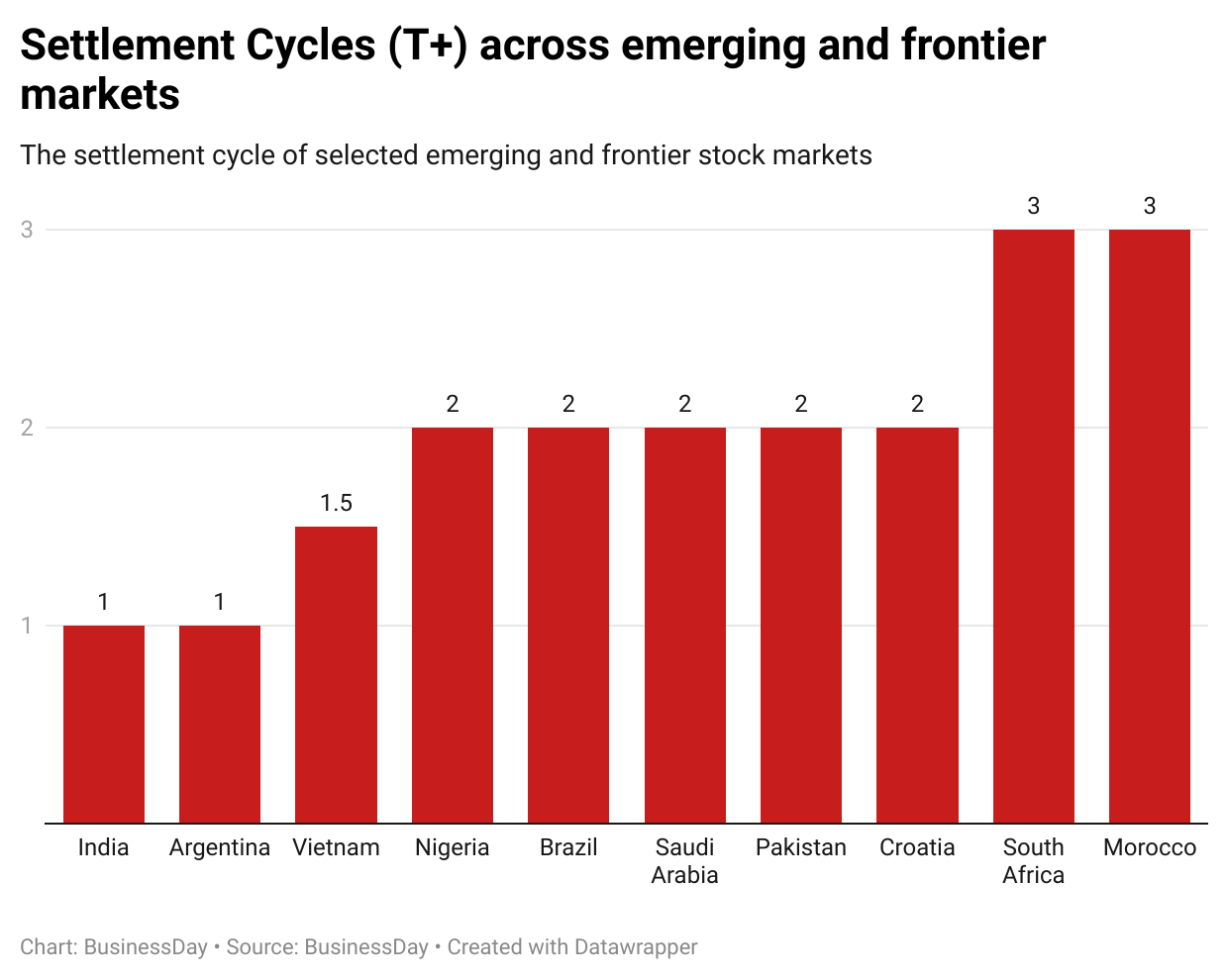
Nigeria is pushing to compress stock-trade settlement to a 24-hour cycle, a move that would align Africa’s largest economy with markets operating on a T+1 basis and potentially unlock a surge in trading activity.
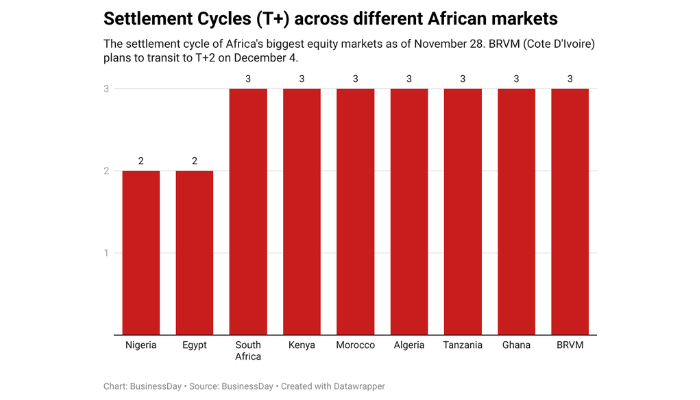
From November 28, the Central Securities Clearing System (CSCS Plc) shifted to a T+2 settlement cycle. For Nigeria’s flagship equities markets, the Nigerian Exchange (NGX) and NASD OTC, this means share transfers will now be settled after two working days.
This achievement makes Nigeria the first market in sub-Saharan Africa to reach T+2, and the second on the continent after the Egyptian Exchange, which transitioned in 2022. Despite having only just adopted the T+2 system, Haruna Jalo Waziri, managing director of CSCS Plc, confirmed that plans are already underway to move to T+1 by 2026.
Speaking at the press conference marking the launch of the T+2 settlement cycle, Haruna Jalo-Waziri noted, “T+1 is likely in May next year. Work has already started.”

Read also: Nigeria’s journey to having the fastest stock markets in Africa
With Nigeria becoming the first in the region to adopt T+2 and already preparing for T+1, the country is positioning itself to run Africa’s fastest stock market. For Temi Popoola, chairman of CSCS, the milestone reinforces that “Nigeria is committed to building a market anchored on efficiency, transparency, and global competitiveness.”
Momentum appears strong, with all parties aligned. The CSCS MD partly credited the Securities and Exchange Commission (SEC) for its support, noting that the shift from T+3 to T+2 was embedded in the SEC’s 10-year Capital Market Master Plan.
At the briefing, Bola Ajomale, SEC’s executive commissioner (operations), represented Emomotimi Agama, director-general, and offered a brief historical perspective of settlement practices in Nigeria’s equities market in the 1990s.
“When we were floor warriors, settlement was every two weeks. If you traded on a Monday, the person owing you would not pay until two Fridays after. And God help you if they gave you an up-country cheque, it would not clear for 21 days.”

Ajomale then acknowledged CSCS’ execution of the transition, saying, “I recognise the challenges, and I must commend your commitment. You have committed to a number of improvements, tighter pre-trade verification, clearer and more accurate client information, and absolute certainty about funding arrangements.”
How much did the transition cost?
Although unable to provide an exact figure, CSCS said it has spent under N1.3 billion on capital expenditure in 2025 so far. The depository attributed this relatively low outlay to years of steady infrastructure investment, which reduced the need for heavy new spending.
Jalo Waziri noted that the last major upgrade was in 2017, and the next may not be required for another five to 10 years. Overall, CSCS maintains that cumulative capital spending, averaging three percent–four percent of revenue annually over the past six to seven years, remains modest, with the real task being to avoid overspending rather than securing funds.
Technology behind the transition
Jalo-Waziri also spoke extensively about the technology powering the transition, emphasising that it was an ‘upgrade,’ not a rebuild. CSCS continues to run on TCS BaNCS, the Tata-developed core system it has used for years, while enhancing its computing backbone through an upgrade from IBM Power8 to IBM Power10 servers.
Jalo-Waziri likened the change to “increasing speed from 60km/h to 100km/h, same car, same driver, improved brakes.” The operational framework, including dispute-resolution processes, remains intact.
What has changed is timing: settlement windows are now shorter, and response teams require additional capacity to resolve issues within two days instead of three. One of the biggest technical risks, he explained, was upgrading TCS BaNCS after years of using an older version.
Read also: Here’s what T+2 settlement cycle means for stock investors
CSCS had deliberately delayed upgrades because several middleware systems were tightly coupled to the legacy architecture. A rushed overhaul, it noted, could have led to disruptions similar to those experienced by a commercial bank whose aggressive Finacle upgrade triggered system failures. To prevent this, CSCS conducted a thorough review of middleware coding to ensure that upgrades could be executed without destabilising operations.
Nigeria’s journey to becoming an attractive investment destination
CSCS frames the settlement-cycle transition as part of a broader phase in Nigeria’s capital-market evolution. With Nigeria’s recent exit from the FATF grey list, the move to a shorter settlement cycle is viewed as another confidence marker. For domestic, foreign, institutional, and retail investors, the upgrade signals that Nigeria is aligning with global standards and strengthening the infrastructure needed to support deeper market participation.
With plans already underway to move to T+1, it signals that the country’s equity markets could be in the same space as the ‘big boys.’