All roads lead to the Nigerian Economic Summit Group (NESG) annual conference in Abuja, which kicks off on Monday. Discussions will focus on strategies to enhance growth, competitiveness, and stability.
The National Bureau of Statistics (NBS) is also expected to release data on inflation and fuel prices, providing valuable insights into the current state of the economy.
Monday, 14th October
NESG summit

The Nigerian Economic Summit Group (NESG) is holding its 30th Nigerian Economic Summit in a gathering that will have global CEOs and investors in Abuja on Monday.
The summit will run from Monday the 14th to Wednesday 16th. The theme for this year is ‘Collaborative Action for Growth, Competitiveness and Stability’
Omoboyede Olusanya, chairman of the central planning committee for the 30th Nigerian Economic Summit (NES#30)/vice chairman of the Nigerian Economic Summit Group, speaking earlier, explained that the 30th Nigerian Economic Summit was a pivotal platform for discussing regulatory reforms essential for economic competitiveness.
Ayanlowo speaking further said that under the theme: ‘Collaborative Action for Growth, Competitiveness, and Stability,’ NES #30 aims to mobilise leaders towards creating shared opportunities for present and future generations.
The summit will emphasise the importance of achieving Africa’s aspirations in a new global context through bold ideas and actions, supported by strong leadership at the industry, national, regional, and global levels.

He said key events will include a meeting with CEOs from Francophone countries and sessions that will tackle topics like local pharmaceutical manufacturing and energy sector dynamics, aiming to foster collaboration among stakeholders for sustainable development.
Monday, 14th October
Has Nigeria boosted its oil production?
The answer to the question of whether Nigeria has boosted its oil production will be known when the Organisation of Petroleum Exporting Countries (OPEC) releases the monthly oil data for September on Monday.
In August, Nigeria’s output only increased slightly to 1.35 million barrels daily from 1.3 million barrels pumped daily in July 2024.
The data on Nigeria’s crude oil production provided is based on direct communication with Nigerian authorities.
Nigeria’s crude oil production probably fell by 40,000 barrels per day (bpd) in September, according to a recent report by Reuters based on a survey of OPEC’s yet-to-be-published September output.
Since the beginning of 2024, Nigeria’s crude production has remained between 1.2 million and 1.3 million bpd, falling short of both OPEC quotas and local demands, especially as the country looks to supply its struggling refineries.
Nigeria still maintains its position as Africa’s largest oil producer, with a very wide margin as Libya, its closest competitor, faced production challenges due to the shutdown of major oil fields during the month.
This ongoing shortfall hampers the revenue generation efforts of President Tinubu’s administration whose large proportion of his government’s revenue comes from oil exports.
Heineken Lokpobiri, minister of petroleum resources, says the country aims to reach a daily production of two million barrels next year, but how this will be achieved remains unclear.
Tuesday, 15th October
Inflation back on the ascent
The National Bureau of Statistics will be releasing Nigeria’s September inflation figures on Tuesday.
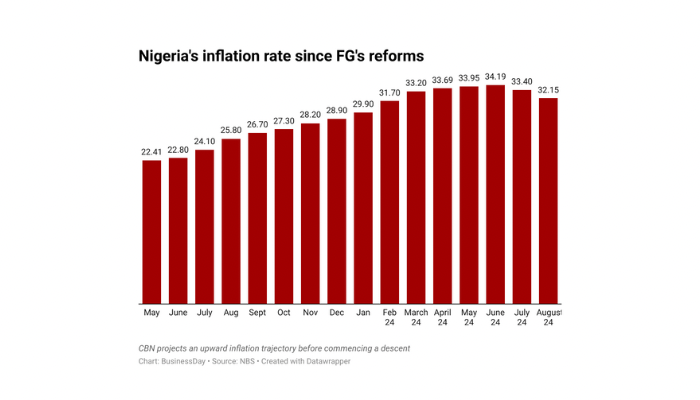
Nigeria’s annual inflation slowed for the second straight time in August to 32.15%. This was as a result of a high base effect and seasonal harvest of food.
But this deceleration did not make a strong case for a rate cut as the monetary policy committee raised interest rates by 50 basis points last month to 27.25% to further stem the potential impact of increased pump prices on consumer expenditures.
Analysts are projecting a rise in September figures as the almost 50% rise in petrol price may stoke prices, eroding the earlier gains from the high base effect.
“A potential downside to further improvements is the recent rise in prices of premium motor spirits and electricity tariffs, which adds additional inflationary pressure,” analysts at FBNQuest Capital said in a note on Friday.
Thursday, 17th October
Petrol and diesel price watch
The National Bureau of Statistics will on Thursday release the price watch for diesel and premium motor spirit (PMS).
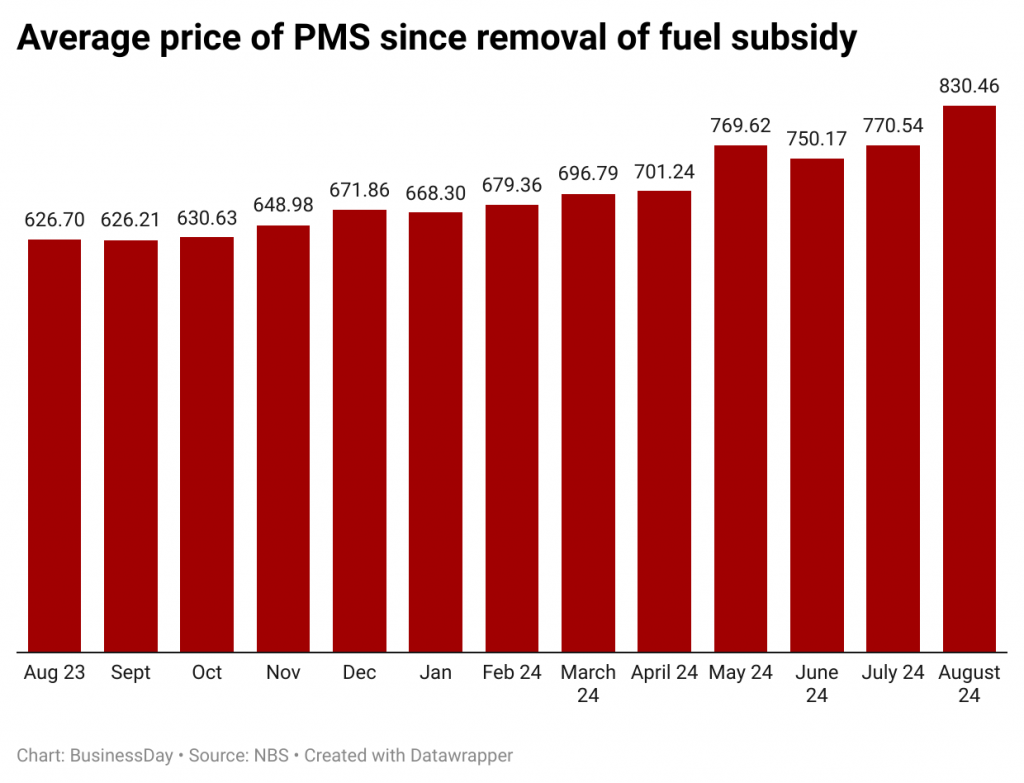
The average retail price paid by consumers for petrol for August 2024 was N830.46 indicating a 32.51% increase when compared to the value recorded in August 2023 (N626.70).
Similarly, the average retail price of Automotive Gas Oil (Diesel) paid by consumers increased by 64.58 percent on a year-on-year basis to N1,406.05 per litre in August.
It rose from cost of N854.32 per litre recorded in the corresponding month of last year (i.e., August 2023) to a higher cost of N1,406.06 per lieThe Organisation of the Petroleum Exporting Countries (OPEC) will release the monthly oil data for August on Tuesday.
Both petrol and diesel prices have been on the rise despite the operation of Dangote refinery, revealing the need for the government to ensure the four state-owned refineries have a breather.
Analysts are however projecting that with improved production from the Dangote refinery, the world’s largest single-train facility, the price of diesel is expected to crash to about N900 per litre while long queues at filling stations are tapped to end.