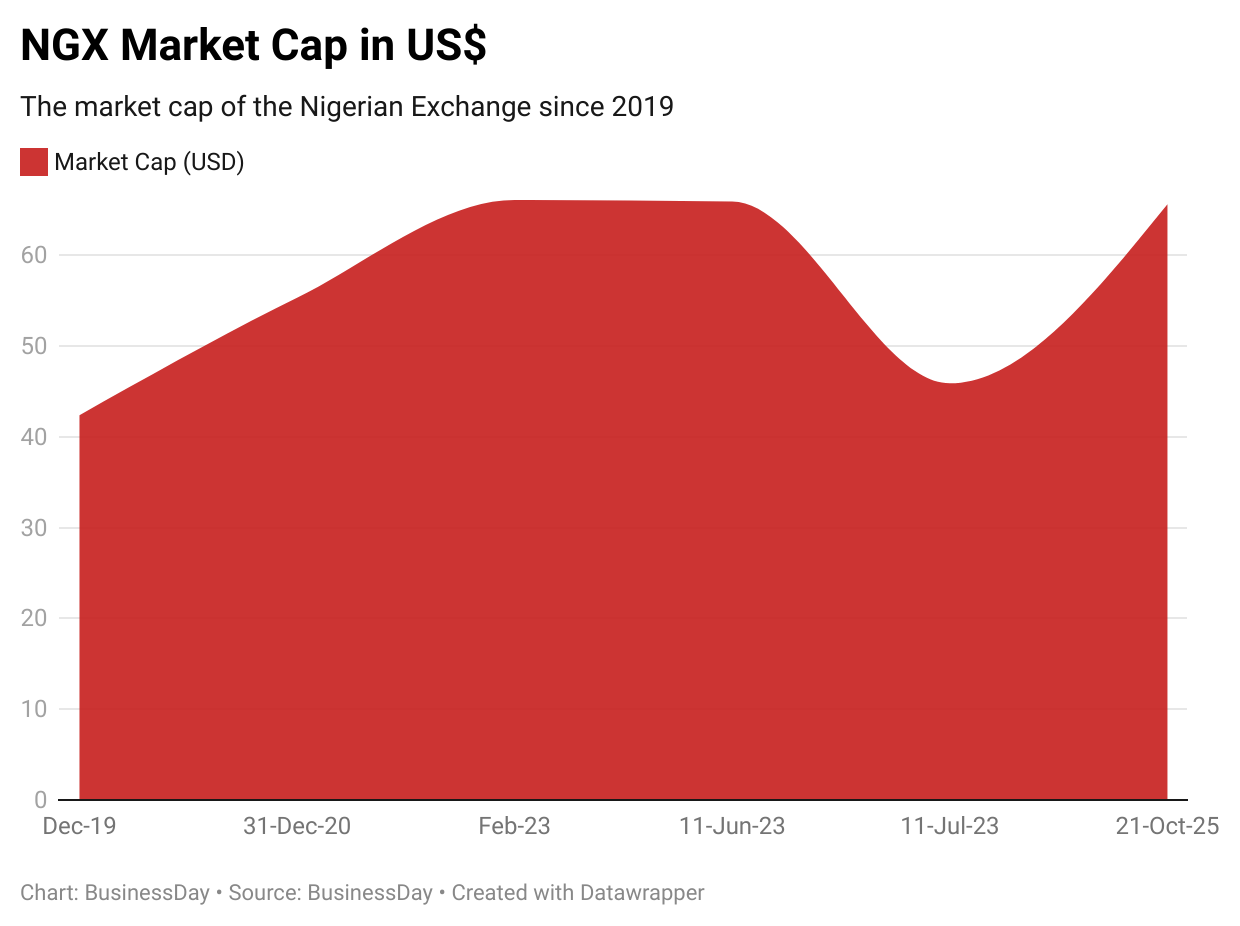
The Nigerian Exchange (NGX) ended trading on October 21 with a market capitalisation of N96.134 trillion, equivalent to $65.6 billion.
This marks its highest level since June 2023, when the Central Bank of Nigeria (CBN) introduced the floating exchange rate regime. The milestone reflects renewed investor confidence despite persistent macroeconomic headwinds.
The market has gained 47.15 percent year-to-date, outperforming its returns from previous years. In 2024, the NGX rose by 37.65 percent. A year earlier, it posted a 45.9 percent gain. The strong rally in 2025 places the NGX among Africa’s best-performing stock markets. Analysts attribute the momentum to resilient corporate earnings, attractive valuations, and growing domestic investor participation.

Since President Bola Tinubu assumed office in May 2023, the NGX has appreciated by a remarkable 172 percent. The All-Share Index (ASI) climbed from 55,738.35 points to 151,456.91 points as of October 2025. The rally has been broad-based, with banking and industrial stocks leading the way, benefiting from improved profitability and renewed policy support.
A major catalyst for this momentum has been the ongoing bank recapitalisation programme announced by the CBN in 2024. The recapitalisation exercise has seen listed banks raise around N1.8 trillion in new capital through equity raises.
When converted to U.S. dollar terms, the record highs tell a different story. Before the naira was floated on June 13, 2023, the NGX had a market capitalisation of N35.8 trillion, or about $65.9 billion. Following the 41 percent depreciation of the naira that followed, the market’s dollar value fell to $45 billion, erasing roughly $20 billion in paper wealth.
Read also: NGX-All Share Index on course for strongest gains since 2020
The naira’s weakness has persisted. Since Tinubu took office, the currency declined by 68 percent, sliding from N462/$ to around N1,465/$ at the Nigerian Autonomous Foreign Exchange Market (NAFEM). Despite this, the equities market gained enough in naira terms to offset a significant portion of the currency losses.

Rise in billion-dollar companies
One of the most notable shifts has been the increase in billion-dollar companies on the NGX. Before the float, there were ten firms valued above $1 billion. The number dropped to eight after the initial devaluation in mid-2023. Today, that figure has more than doubled. As of October 2025, the exchange lists 19 companies worth over $1 billion each.
BUA Foods now tops the list with a market capitalisation of $8.3 billion, followed by Dangote Cement and Airtel Africa. This expansion underscores how Nigerian corporates have managed to grow in value despite inflation, rising costs, and currency volatility.
The market’s performance has also exceeded analysts’ expectations. At the start of 2025, Afrinvest Research projected a 24.3 percent year-to-date return in its base case and 38.1 percent in the best case. CardinalStone expected a 40.4 percent full-year return. The NGX has already surpassed these forecasts, recording a 47.15 percent return despite seeing only one new listing this year.
Read also: NGX-ASI up 0.29% as stock pickers favour E-Tranzact, others
The rally highlights how Nigerian equities have become a defensive play against inflation and naira depreciation. Investors are betting on strong fundamentals rather than macroeconomic stability. Still, uncertainty remains.