…Calls for govt., CSOs collaboration to end tragic pattern of killings
The President of the Nigerian Guild of Editors (NGE), Eze Anaba has urged media organisations in Nigeria to do more in amplifying the plight of the Nigerian child caught in the line of fire amidst growing cases of violence, abductions, and killings in the country.
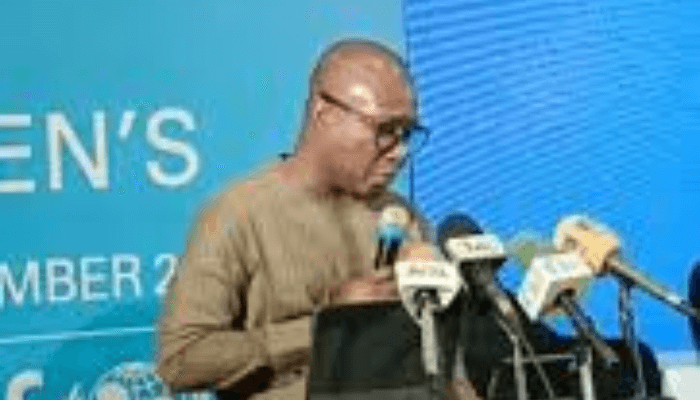
Speaking during an event jointly organized by UNICEF Nigeria, the Nigerian Guild of Editors (NGE), and the Diamond Awards for Media Excellence (DAME) on Tuesday, November 25, 2025, Anaba called on media professionals in the country to confront some painful truths to deliver their constitutional obligation.
“Millions of Nigerian children are out of school—the highest number in the world. Girls are disproportionately affected due to poverty, conflict, cultural norms, and lack of basic infrastructure.

“Millions of children under age one are not vaccinated, placing them at risk of preventable diseases,” Anaba stated.
According to him, children across Nigeria endure violence, abuse, child labour, and early marriage; while some are forced into becoming combatants, with their innocence and futures stolen.
“These are not mere statistics. They are the lived experiences of children whose dreams—and our country’s future—are being derailed,” he said.
The NGE president also said that the media, civil society, UNICEF, and the government must work in lockstep to reverse the tragic trajectory.
“The government’s declaration of the highest level of security alert only underscores the reality that these are not normal times,” he stated.

In his call for action, Anaba challenged the government, the media, civil society organisations, and development partners to work collaboratively to end violence against children.
“Collectively, our actions can rewrite the narrative for millions of Nigerian children.
“Colleagues, when we leave this symposium, I challenge each of us—media professionals, civil society actors, government representatives, and our partners at UNICEF—to commit to at least one actionable step.”
Anaba also urged media professionals to use their platforms and influence to advocate for policies that place every Nigerian child at the centre of national development.
“As custodians of information—and as citizens—we must be the conscience of our nation,” he stated.
The event held under the theme, ‘Reinforcing the Role of Media in Mainstreaming Child Rights’ brought together editors, journalists, UNICEF Champions, development partners, civil society, government and private sector representatives to explore how storytelling, accountability journalism, and public dialogue can shape a better future for Nigeria’s children.
The workshop followed the release of the “Nigerian Child 2025 Report”, which shows that two out of every three children in Nigeria live in multidimensional poverty, lacking access to education, healthcare, nutrition, and safety. The report also reveals that over half of all children experience some form of violence before age 18, and that one in three girls is married before reaching adulthood.
UNICEF Nigeria Representative, Wafaa Saeed, who presented the key findings of the report, urged the media to be a driving force for change.
According to her, “The data tells us that millions of children are being left behind, but it also shows where progress is possible. The media can change how we see these children, from statistics to stories of strength and hope. Every time a journalist gives voice to a child, the nation takes a step forward.”
In his remarks, Lanre Idowu, chairman of DAME, reminded participants that powerful journalism can transform children’s lives.
“Good journalism does not just inform, it saves lives. When the press asks why a child is out of school or why a health centre is closed, it triggers solutions. Today is a call to all of us in the media to be the steady voice that speaks for those who cannot yet speak for themselves,” he said.
A high point of the event was a panel of discussants moderated by Chinonso Egemba, popularly known as Aproko Doctor, on the topic ‘Equipping the Nigerian Child for the Future: How Prepared Are We?’