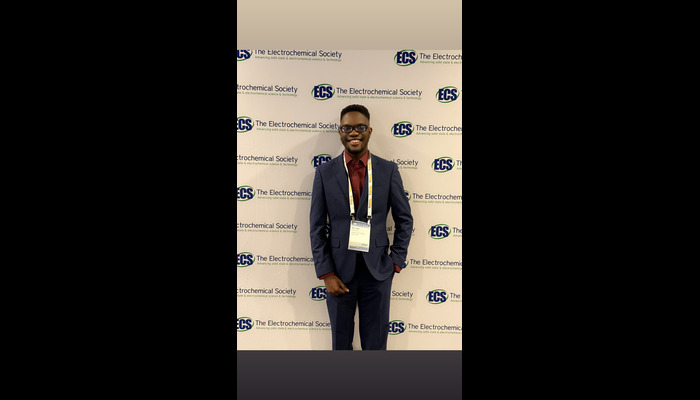
A Michigan State University researcher, Michael Adesanya, has urged businesses to be cautious in responding to emerging claims around a new class of dye-sensitised solar cells (DSSCs), despite growing excitement following fresh data presented at the 248th Electrochemical Society (ECS) meeting held in Chicago in October 2025.
Speaking with BusinessDay, Adesanya stressed that while the innovation—a “single-component” DSSC—marks a meaningful scientific step, it remains firmly in the early research stage.
The single-component concept, introduced by Michigan State University researchers at the ECS meeting, departs from the traditional DSSC structure that relies on separate molecules for light absorption and charge transport.
By allowing one molecule to perform both tasks, the design aims to simplify device architecture and reduce the number of materials used. But Adesanya cautioned that promise alone is not enough. “We’ve shown in the lab that a single-component DSSC can work,” he said, “but the slow step is getting electrons into the semiconductor fast enough.”

According to him, the next critical phase is scientific groundwork that builds reliability into the concept.
“Our next steps are to map out which additives help or hurt, quantify how far we can push performance on real films, and document the full procedure so another lab can follow it and test it independently,” he explained.
He emphasised that breakthroughs must be measurable and repeatable before anyone considers commercial prospects.
Adesanya outlined three clear indicators that would signal real progress over the next six to twelve months, beginning with independent confirmation of his team’s findings. “First, an independent lab should replicate our method and see the same drop in charge loss. If it only works on bench, it doesn’t really count,” he said.
The second sign, he noted, is improved electron entry into semiconductor films without reducing charge transport elsewhere in the device. The third, he insisted, is durability: “The behaviour should hold up under basic heat and humidity testing in a clearly stated packaging.”

Despite the early stage of the research and the absence of a commercial product, Adesanya believes businesses should pay attention now—not to adopt the technology, but to develop the right expectations when approached with “novel solar” pitches. “My work is not saying, ‘Buy this new cell,’” he noted. “What it does is spell out what real evidence should look like if, in a few years, somebody walks into their office with a ‘novel solar’ pitch.”
If forthcoming signals are positive, Adesanya said the most responsible next step is limited experimentation rather than market rollout. He suggested that any trial should involve “one partner, a small number of very low-power indoor devices,” run quietly under normal building light. “No big announcement, no purchase order,” he added. “If it doesn’t hold up, we call it what it is and go back to the lab. If it does, it just earns more questions and more testing.”
Should the technology eventually mature, its impact would be felt in operations rather than corporate public relations, Adesanya predicts. He pointed to departments that maintain networks of sensors, access tags, electronic labels and small displays. “If, in the future, the science holds, some of those devices could lean on ambient light,” he said. “The value is straightforward: fewer routine visits, fewer dead devices at awkward moments, and fewer small failures to log and fix.”
To build trust in the results, Adesanya promised openness and replicability. “We’ll put the full method on paper—thin-film recipe, additive levels and measurement steps—and share raw data with the analysis scripts so the numbers can be checked independently,” he said. He added that durability tests would be documented with the exact packaging and light conditions, stressing: “We actively want another lab to repeat the work and publish what they see.”
The research is funded by the U.S. Department of Energy with no corporate sponsor attached, a structure Adesanya says protects the independence of the findings. “There’s no exclusivity or product-linked deliverables,” he explained. “That means data, good or bad, can be published openly and the methods shared.”
Looking ahead, he urged both the scientific community and the business world to stay “optimistic but disciplined.” He concluded: “When a ‘novel solar’ claim appears, ask three questions: Can an independent group repeat it on the films? Do measurements show faster electron hand-off without hurting transport? And does it survive basic heat and humidity checks? If those answers are unclear, save your time. If they’re clear and documented, then it deserves real attention.”