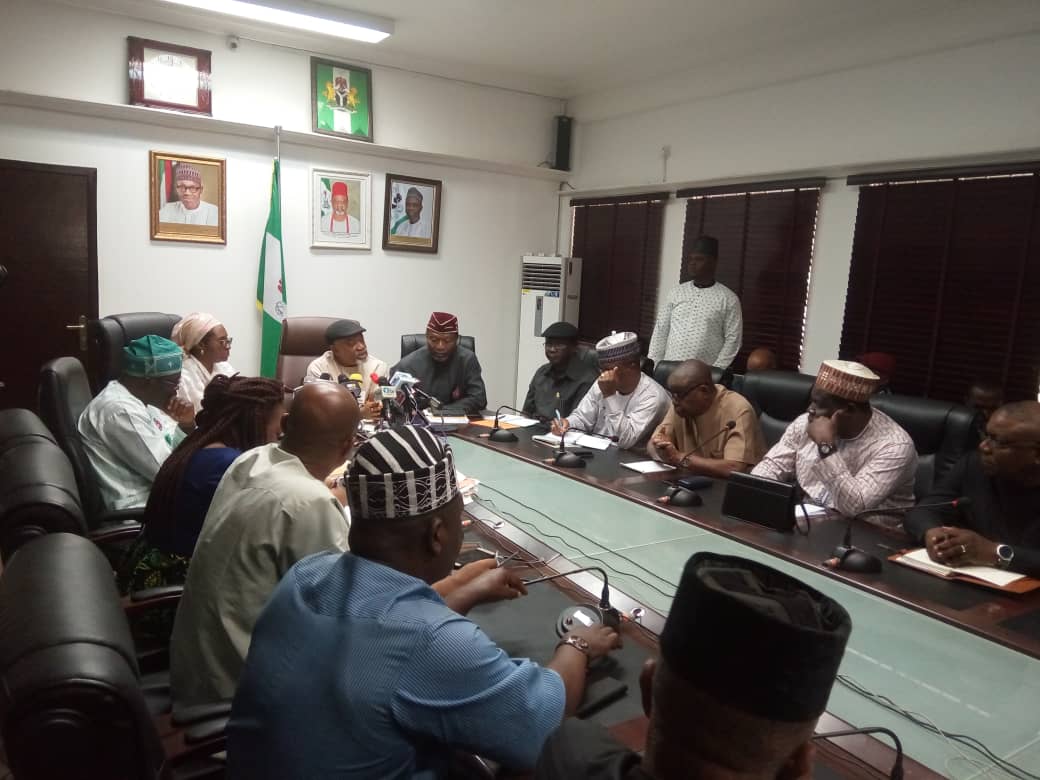
With the assent given to the new national minimum wage law by President Muhammadu Buhari on April 18, it should be expected that Nigerian workers will soon begin to savour improved pay packages.
Workers are hopeful that employers of labour in both the public and private sectors of the economy currently paying below the new benchmark will, in response to the new law, adjust their employees’ salaries and allowances to reflect the N30,000 national minimum wage, as required by the law.
Already, in matching action with their expectation, there is an overwhelming demand by labour, as encapsulated in the various speeches delivered by labour leaders during the 2019 May Day, when Nigerian workers joined their counterparts in other parts of the world to celebrate. From Abuja, the nation’s political capital, to Lagos, the economic hub, and across the 36 states, the demand was the same- immediate implementation of the new minimum wage.
Repeatedly, organised labour has explained why the wage increase is not only necessary but compellingly so. According to labour unions, although there has been a marginal drop in official inflation figures from 11.44 percent in December 2018 to about 11.25 percent in March 2019, the economic realities, as they affect an average Nigerian, still leaves much to be desired, and requires urgent intervention.

Justifying the need for the immediate implementation of the new wage, at the May Day rally in Abuja, Ayuba Wabba, president of the Nigeria Labour Congress (NLC), said: “In reality, life has become increasingly excruciating today for the average worker and citizens.”
According to Wabba, the phenomenal hike in the price of Premium Motor Spirit (PMS) otherwise known as petrol in 2016, the devaluation of the naira in the same year and increase in the cost of electricity in the past five years have sustained high inflationary rates. He further argued that the persistence of double-digit inflation and stagnant remuneration for workers has wiped off the purchasing power of Nigerian workers.
He believed that the impact of the prevailing hyper-inflation on pensioners and workers is, to say the least, traumatic, as working families are unable to meet up with basic costs of living, especially feeding and decent accommodation, thus plummeting living standards to an all-time low.
“The worse is that most Nigerians are not even enjoying utility services such as public power supply, potable water, public education and healthcare despite very high user access charges. In the absence of cushioning palliatives, it appears that workers have become the sacrificial lamb on the slab of all that is not working in Nigeria. This is indeed very unfortunate.”
Wabba’s assertion runs concurrent with Joe Ajaero’s, president of United Labour Congress (ULC).

Ajaero, while speaking on the May Day, in Lagos, said there was an anxiety in the economy and this stems from the feeling of despair, frustration and hunger. According to him, an average family of four can no longer afford a balanced diet.
“The welfare of the citizenry is mainly a function of the health of a nation’s economy but unfortunately, the nation’s economy has become parasitic on the citizenry.
“It is so because our economy is tending backwards with all the major macro-economic indices heading in the negative direction. All core Human Development indices (HDI) are not returning favourable figures and the nation is placed among the worst in the world. The misery index leaves us almost at the bottom while poverty has decided to make its headquarters in Nigeria,” he said.
With these, Ajaero argued there was a compelling need for the government and private sector employers of labour to hasten the implementation of the new national minimum wage, as it will not only benefit paid workers, but will also have multiplier effect on the overall economy due to higher purchasing power.
Abdrafiu Adeniji, chairman, Trade Union Side (TUS) of the Joint National Public Service Negotiating Council (JNPSNC), and Alade Lawal, the general secretary, are no less concerned.
The duo have asked the Federal Government to kick-start negotiation with the joint council towards the consequential adjustments arising from the new national minimum wage.
The labour leaders said millions of workers, especially civil servants, expected the implementation would commence immediately after the N30,000 monthly minimum wage law was signed by Mr. President.
“This is the more reason why we urge the Federal Government to immediately meet with the Trade Union Side of the Joint Council to work out the consequential adjustments and produce a fresh salary structure in line with the new national minimum wage.”
Both leaders noted that the normal practice was that once a new minimum wage is fixed, a fresh salary table is generated so that employees in all salary grade levels will benefit from the new emoluments.
“This is the standard practice all over the world and Nigeria should not be an exception,” they stressed, even as they noted that the generation of a fresh salary table in line with the new minimum wage would also prevent distortion and overlapping.
“The TUS recalled that after the 2011 National Minimum Wage was fixed, the consequential adjustment was not properly handled. Instead, the government decided to award N900 across board for all the other grade levels in the civil service thereby distorting the salary chart. This led to a lot of crisis, a scenario that should not be allowed to repeat itself this time around.
“The government should not continue to generate avoidable crisis in the civil service and this is why we are now urging it to do the needful by urgently inviting the joint council with a view to commencing negotiation on a new salary table that will meet the aspirations of workers.”
They posited that once a new salary table was generated, it would help to maintain the current relativity among all grades in the civil service, adding that “the new table will also go a long way to assisting the state governments to have a seamless implementation of the new minimum wage and where negotiation will be required at all, it will be a minor exercise.”
However, as the agitation for the immediate implementation of the new benchmark rages, there are concerns about the ability of government especially at state level to pay and to sustain the payment, especially given the fact that majority of them have been unable to pay N18,000 or managed to pay in distorted forms.
Although some governors, including those of Akwa Ibom, Bayelsa, Kano, Edo, Enugu, Ogun, Oyo, among others have indicated they would pay the N30,000 minimum wage, there is the thinking in some quarters that their statements might be political, as the Nigerian Governors’ Forum (NGF) had before now denounced the N30,000 and opted for N22,500.
“Governors have collectively made it abundantly clear that they would have been happy to pay workers the N30,000 but times are hard and because of financial constraints and other limitations, many states cannot afford it, for now,” Abdulrazaque Bello-Barkindo, head, media and public affairs of the NGF said in an earlier statement issued on behalf of the governors.
Some pundits are of the view that many of the Nigerian 36 states can, however, afford to pay the new wage if the governors prioritise their spending. In 2018, the Federal Government, 36 states and the 774 local government councils reportedly shared a total of N8 trillion from the Federation Account; out of which the state and councils were said to have earned a total sum of N4.5 trillion. To some of the analysts, developments in the various states of the federation do not reflect the humongous sums, which mean that the monies are not properly channeled.
According to Adetokunbo Mumuni, executive director, Socio-Economic Rights and Accountability Project (SERAP), state governments have been unable to set their priorities right.
“Let me say straight away that at any level in the Nigerian polity, if priorities are ordered right, if we put our focus where it should be, there is no basis for any government not to be able to pay the new minimum wage.
“Look at what they pay their political hangers-on. You cannot say any of those governors do not pay more than N30,000 to political hangers-on. So, I believe that it is a question of cutting our coat according to our cloth; ordering our priorities right and everything will be okay,” Mumuni said.
Indeed, if pronouncements by the workers and their umbrella organisations- NLC, TUC and ULC, are anything to go by, labour is not prepared to take excuses from the state governors.
“Any state governor that cannot pay the minimum wage is not ready for governance, and therefore, should resign,” Bobboi Kaigama, president of the Trade Union Congress of Nigeria (TUC), said.
It would seem that the organised labour is battle-ready, as it is already calling for vigilance from members.
“We want to appreciate all Nigerian workers for their doggedness in the struggle against the forces that wanted to deny us a new national minimum wage. Collectively, at every stage of the way, together we engaged them at the barricades and on the streets until the committee’s report became an executive bill which was expeditiously passed by the National Assembly and later given assent to by the President.
“We doff our hats for the National Assembly for demonstrating good faith in their dealings with Nigerian workers. They stood by us and fulfilled their promises to us as the legislative processes wound its way through both chambers. They provided the required moral leadership by refusing to be cowed by the intimidation of some groups that were bent on truncating the N30,000 minimum wage.
“But we call on all Nigerian workers and masses to be vigilant as we go through this critical phase of getting this law implemented. We are happy that many governors have indicated willingness to comply but it is important that others come on board or face our collective wrath. We also warn private sector employers to immediately comply to avoid unsavory consequences.
“All Nigerian workers must remember that we did not get to this level by charity but by struggle. We can only conclude it favourably by being ready at all times to defeat the forces of wickedness that would not want Nigerian workers to earn decent wages,” said Ajaero, president of ULC.
JOSHUA BASSEY