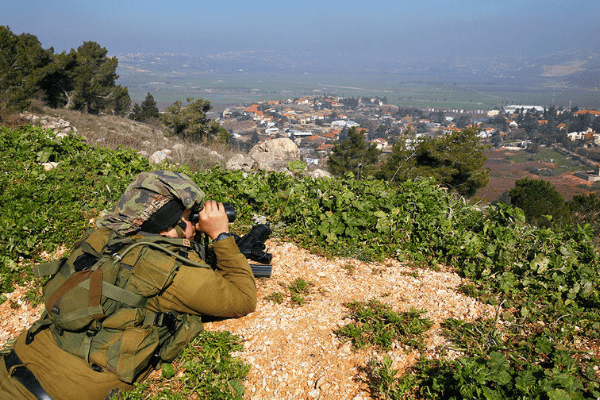
AN EXPLOSION AND subsequent fire in the early hours of August 25th in Beirut’s Dahiye neighbourhood led to fevered speculation. Were they caused by two quadcopter drones, one of which was captured in a shaky video moments before? Were the drones Israeli or Iranian? Was the intended target a media office of Hizbullah, as the Lebanese militia suggested? Or was the target Iranian-supplied equipment to improve the guidance systems of Hizbullah missiles, as anonymous “intelligence services” claimed? One thing seems sure: the episode is part of a broadening of the battlefields between Israel and Iran.
Lebanon was one of the earliest frontlines. Iran helped found Hizbullah there in 1985 to fight the Israeli army, which had invaded its northern neighbour. More recently the conflict has expanded to Iraq. A series of explosions there has been ascribed to Israel. “Iran doesn’t have immunity anywhere,” said Binyamin Netanyahu, Israel’s prime minister, neither confirming nor denying responsibility. Israel accuses Iran of spreading missile and attack-drone technology. The sites targeted in Iraq are bases of Iranian-backed militias which may have been storing Iranian missiles.
The explosion in Beirut came just hours after an Israeli air strike near Damascus, where a team of Iranian
and Hizbullah operatives were said to have been preparing to launch drones against Israel, apparently in retaliation for the attacks in Iraq. This time Mr Netanyahu was quick to acknowledge responsibility. (Lebanon’s state media claimed that Israel also struck the base of a Palestinian organisation aligned with Iran and Hizbullah near the Lebanon-syria border on August 26th.)

The world’s attention, meanwhile, was on diplomacy. France’s president, Emmanuel Macron, engineered a surprise visit by Iran’s foreign minister, Muhammad Javad Zarif, to the G7 summit in Biarritz. Mr Macron has been trying to salvage the nuclear deal signed by Iran and six world powers in 2015. The agreement limits Iran’s nuclear programme in exchange for the partial lifting of sanctions. President Donald Trump withdrew from it last year and embarked on a policy of “maximum pressure” to cripple Iran’s economy.
Mr Macron dangled the prospect of a summit between Mr Trump and his Iranian counterpart, Hassan Rouhani. Mr Trump seemed tempted by the idea. So did Mr Rouhani, at first. “If I know that by meeting someone, the problem of my country will be solved, I will not hesitate,” he said in a speech. But, under pressure from hardliners, he later backed away, saying that there can be no meeting unless America first lifts its sanctions on Iran.
Israel is keen for America to maintain pressure on Iran. It worries about the strategy of regional expansion championed by Iran’s Revolutionary Guard Corps and supported by the country’s supreme leader, Ali Khamenei. In recent weeks Israeli officials have warned that this strategy now includes a full rapprochement with Hamas, the Palestinian Islamist movement in Gaza. Ties between them were cut off in the early years of the Syrian uprising when Iran backed Bashar al-assad’s regime, which was butchering Hamas’s Sunni coreligionists. With the war in Syria all but over, normal service has been resumed. Iranian support for Hamas is reckoned to be as much as $100m a year.
But the Iranian network may have become overextended and easier for rival espionage agencies to penetrate. Israel has carried out hundreds of air strikes on Iranian targets in Syria. Senior Israeli officers claim they have succeeded in preventing Iran from establishing missile bases there.
Until recently Israel maintained a policy of “opaqueness” regarding its strikes against Iranian targets. Mr Netanyahu, however, has taken to extolling Israel’s intelligence-gathering and operational successes in surprising detail, as well as openly saying it carried out the latest air strike in Syria. Some of his critics in Israel’s security and political establishments are uncomfortable with this.