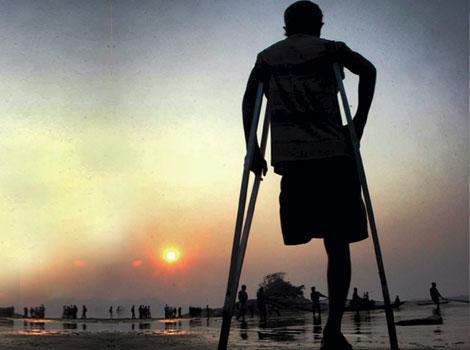
It is disheartening that discrimination against the physically challenged is prevalent in Nigeria. Here, the reality of being physically-challenged affects not only the physicality of a person but also how others judge them culturally, spiritually, financially and emotionally.
It is registered in the mind of an average Nigerian that once a person has one deformity or the other, such a person has nothing to offer the society again. This is notwithstanding the rare feats performed by some physically challenged persons over the years in various areas of human endeavour including sports, the academia, art, music, business and even philanthropy.
As it is, most persons with physical challenges remain materially and socially poor without access to transport, which is needed for business, visitation to friends and relatives, going to school and vocational training centres, markets and finding and keeping jobs, where they are found. Most offices, shopping malls, banks and other public buildings are erected with little or no consideration for mobility impaired members of the society. Automated Teller Machines in banks are built in such a way that those on wheelchairs cannot access them.
It was to ameliorate the pain of people with disabilities and give them a new lease of life that the Lagos State government created the Office for Disability Affairs (LASODA) which coordinates the education, social development, welfare and inclusion in of People Living with Disability in governance. It is in furtherance of the need to strengthen the activities of LASODA that the current administration established the Special People’s Fund. The Fund was created to provide the right environment for People Living with Disability to live life more meaningfully.
The creation of the Fund reflects the state government’s interpretation of social environment and devotion to social responsibility as well as a major shift from charity as the mode of addressing disability. It is in this context that LASODA made clarification on the recently approved N500 million fund that it was not meant for distribution but rather to provide infrastructure that would enhance welfare of People Living with Disability.
More cheering was Governor Ambode’s pronouncement, at the last Quarterly Town Hall held in Badagry, that his administration would decentralize LASODA and absorb 200 physically challenged persons to manage their affairs in all the LGAs and LCDAs in the state.
To further boost this renewed effort towards making life more meaningful for People Living with Disability, the state government has urged corporate organizations to collaborate with government by contributing their modest quota. Delivering a goodwill message recently at the opening of a three-day international conference on disabilities with the theme “Creating an Inclusive Society for All” at the Civic Centre, Lagos, Ambode said that People Living with Disabilities should be recognized as an integral part of the society. He, therefore, canvassed that they should be provided with the enabling environment to realize their full potentials in all spheres of human endeavour.
To further reinforce its commitment towards the physically challenged, Bus Rapid Transit and LAGBUS operators have been mandated to offer them free ride across all routes. Hitherto, they used to wait endlessly on the benevolence of good-hearted compatriots to get into the bus. Similarly, the newly introduced BRT buses have facility for the physically challenged.
The Lagos example has, indeed, given hope to the physically challenged in the society. What people with physical challenges need is enabling environment and not discrimination.
On the same page with the state government on the new deal for the physically challenged is the First Lady, Bolanle Ambode, who has urged children without limbs and other physically challenged persons not to allow their situation to deter them for aiming high in life. She gave the charge at the presentation of cheques of N1.5 million each to five pupils of different nursery, primary and secondary schools, as part of Stanbic IBTC’s “Out for a Limb” corporate social project, to fix the limbs of some children amputees and those with congenital limb defects. This, coming from the First Lady, is a morale boost that when complemented by others would yield a significant change in life and perception of people with physical challenges.
The point here is that we ought to learn from what a nation like America has achieved with its Americans with Disabilities Act (ADA). Thanks to the Act, in the USA transportation, public facilities and many services are more accessible to all. Thanks to ADA, for example, many city buses and trains have lifts or ramps for wheelchairs, priority seating signs, handrails, slip-resistant flooring, and information stamped in Braille. Emergency call centres are equipped with telecommunications devices for the deaf (TDDs), and federally-funded public service announcements have closed captioning. Most importantly, ADA prohibits discrimination against people with disabilities in job recruitment, hiring, promotions, training or pay. ADA’s provisions have enabled many people to live independently, despite any physical or mental disability, and have helped protect their rights.
For now, the law and the office created to give a new deal to the physically challenged in Lagos State as well as the Special People Fund are stepping stones towards achieving what exists in decent nations. Overall, emphasis should be on fuller “inclusion” within the community. On the national scale, it is imperative that we put in place a National Disability Rights Commission with innovative deal and commitment to enable and not disable people with deformity to attain their God-given potentials. With that in place, physically challenged people will walk through life with hope.
Rasak Musbau