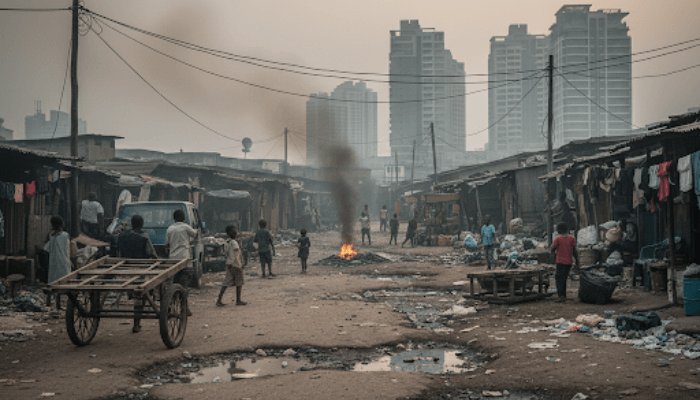
The harsh economic condition in Nigeria highlights the need for immediate and sustained actions.
In a finding contained in the General Household Survey-Panel Wave 5 (2023/2024), supported by the World Bank, last year the National Bureau of Statistics disclosed that 20.8 percent of Nigerian households resorted to borrowing food or seeking help from friends and relatives to survive over a period of 30 days.
According to the report, 65.8 percent of households were unable to afford healthy, nutritious, or preferred meals due to financial difficulties, while 63.8 percent relied on a limited variety of foods. 62.4 percent of households admitted to being anxious about running out of food, with 60.5 percent saying they ate less than they should.
Sadly, 12.3 percent reported that at least one member of their household went an entire day without food.

Looking back, about 25 million adults in many Nigerian households did not eat for an entire day in 2020, as the World Bank estimated the number to be less than 10 million in 2019 and about 13 million in 2018.
The issues the World Bank highlighted then are still very viable options to work with if taken seriously. The short-term priority for the Nigerian economy should be to reduce inflation and protect the poor, the World Bank said then.
With the economic growth rate below the rate of population growth, per capita income will continue to decline, the World Bank’s ‘Resilience Through Reform’, a Nigeria Development Update (NDU), reported.
With the high cost of living in Nigeria and a declining per capita income that has been trending downwards since 2015, Nigerians are three times more miserable than they were some five years ago. In 2024, Nigeria’s misery index, a measure of economic hardship calculated by adding unemployment and inflation rates, saw a rise, reaching 36.9 percent in quarter one (Q1) and 38.3 percent in Q2. This indicates a cost-of-living crisis and weak purchasing power for many Nigerians.
While one in every three Nigerians is unemployed, those that have been able to get a job spend about 65 percent of their income on food, the main driver of the country’s inflation rate. Nigeria’s inflation rate has been accelerating since September 2019, 30.09 percent as of today (February 2025). It slowed in April to 18.12 percent after accelerating to a four-year high of 18.17 percent in March 2021.

A high unemployment rate in a country like Nigeria, whose economy is described as one that is stagflated (a blend of high inflation rate and slow economic growth), means poor Nigerians will become poorer in real terms, and the middle class will get thinned out.
To reduce inflation while protecting the poor and supporting economic recovery, the World Bank suggested then that Nigeria should pay urgent attention to the following six policy areas:
Exchange rate management: Nigeria should communicate an exchange rate management strategy that makes the NAFEX rate more flexible, as it would boost Nigeria’s competitiveness while helping to reduce inflation.
MSMEs and job creation: Identify criteria for enabling MSMEs to access appropriate forms of equity financing and launch a scoping exercise to enrol and screen eligible MSMEs, develop parameters for debt restructuring, and create performance indicators for viable delinquent MSMEs.
Social protection: Nigeria should provide targeted cash transfer support to poor households using the National Social Safety Nets Programme (NASSP I and II) while expanding the Rapid Response Register of vulnerable beneficiaries in urban and peri-urban areas.
Monetary policy: Signal a commitment for price stability as the primary monetary policy objective, the World Bank said, adding that Nigeria should consider resuming naira-denominated open-market operation (OMO) with a clear schedule for issuing securities. “Reduced CBN lending to medium and large corporates under its subsidised schemes. Phase out the reliance on the cash reserve ratio (CRR) as a liquidity tax on financial savings,” it said.
Fiscal policy: Nigeria should establish mechanisms to monitor the Federal Government’s stock of Central Bank of Nigeria (CBN) overdrafts (i.e., the historical stock of accumulated ways and means), the flow of the overdrafts facility (i.e., its monthly use), and its servicing cost (i.e., internal payments).
Trade: Nigeria should fully reopen its land borders to trade and should also facilitate imports of staple foods and medicine by removing them from the list of foreign exchange restrictions.
In addition to the World Bank’s advice, we believe sustaining reform momentum is critical to ensuring a robust recovery now and beyond the immediate needs of Nigerians. Above all, the government should intentionally intervene in pricing mechanisms, as we see a deliberate exploitation of the consumers by Nigerian manufacturers. This is clear from the various full-year dividend declarations of companies’ financials across sectors.