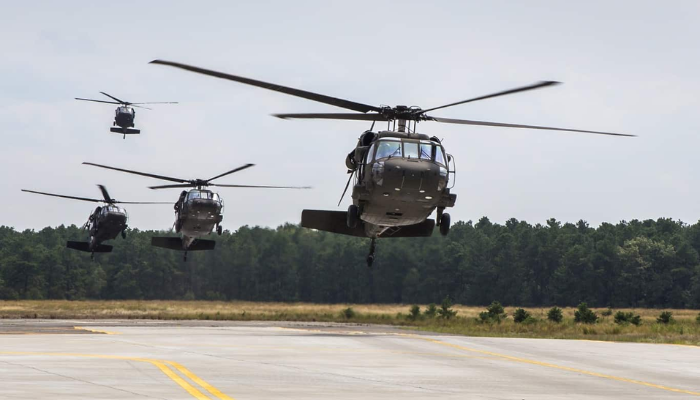
The Nigerian Airspace Management Agency (NAMA) has issued a stern ultimatum to oil and gas operators across the country, demanding full compliance with the statutory payment of helicopter landing levies for air navigation services rendered within Nigerian airspace.
The agency has given the operators a seven-day deadline to communicate their proposed payment plans or face enforcement actions, including denial of flight clearances.
In a statement signed by the Management of NAMA, the agency emphasized that the levies apply to helicopter operations at Oil Fields, Terminals, Platforms, Rigs, Floating Production Storage and Offloading (FPSO) units, Helipads, Airstrips, and Aerodromes.
The $300 helicopter landing levy which raised a lot of controversy was suspended by Festus Keyamo, Minister of Aviation and Aerospace Development in May 2024 pending a review, but the government has now lifted the suspension and directed strict compliance.

The directive is grounded in the Nigerian Airspace Management Agency Act, 2022, which mandates NAMA as the sole authority to provide and manage air navigation services within the nation’s airspace.
The statement disclosed that since 2022, NAMA, in collaboration with its revenue consultant, Naebi Dynamic Concepts Ltd, has engaged stakeholders in the oil and gas sector through multiple written communications to ensure awareness and compliance. However, the agency lamented the lack of adherence from operators, attributing the challenge to the actions of certain individuals undermining regulatory enforcement.
Read also: Despite FG’s directive, NAMA stops helicopters from taking off over $300 landing charge
NAMA underscored that the implementation of helicopter landing levies aligns with global best practices and is standard among member states of the International Civil Aviation Organization (ICAO).
According to NAMA, The levies are crucial for funding the maintenance, upgrade, and acquisition of critical air navigation infrastructure, particularly in light of the increasing operations of helicopters, drones, and fixed-wing aircraft in Nigeria’s airspace.

The agency reiterated that under Sections 8 and 9 of the NAMA Act, only NAMA is authorized to provide air navigation services within Nigerian territory. It warned that any individual or organization found providing such services independently is in breach of the law and national security protocols.
Sanctions against defaulters may include the withholding of flight clearances.
“Sanctions will be applied to defaulting operators, including denying or withholding flight clearances to any operator until outstanding charges have been paid by the operator or a security or guarantee has been given to the satisfaction of the Agency for the payment of the charges or fees.
“In instances where operators persist in unauthorized usage of Nigerian airspace, particularly through private helipads or platforms operating without requisite NAMA clearance and in breach of national security protocols, the Agency shall seek the approval of the Honourable Minister of Aviation and Aerospace Development to shut down an relocate such facilities utilized in connection with unauthorized navigational operations within Nigerian airspace in line with Section 8(3) of the Act.
“As responsible and law-abiding international corporate entities, the Nigerian Airspace Management Agency (NAMA) hereby calls on all affected oil companies to, within seven (7) days from the date of this publication, formally communicate to Naebi Dynamic Concepts Ltd their proposed payment plans and modalities for applicable air navigation levies.
“Failure to comply within the stipulated time frame will trigger appropriate enforcement measures, including the denial of flight clearances for helicopter operations to Oil Fields, Terminals, Platforms, Rigs, Floating Production Storage and Offloading (FPSO) units, Helipads, Airstrips, and Aerodromes,” the statement reads
NAMA urged all affected oil companies to reach out to Naebi Dynamic Concepts Ltd within seven days to formalize their payment modalities, warning that failure to comply will trigger immediate enforcement steps.
“This action is undertaken not merely to enforce regulatory compliance, but to safeguard national security, enhance aviation safety, promote operational sustainability, and ensure the continued efficiency of Nigeria’s aviation ecosystem, all in alignment with international obligations and globally accepted best practices,”