The naira closed flat across the foreign exchange (FX) markets on Monday as weekly inflows fell by 15.7 per cent, reflecting weaker foreign exchange supply conditions and mild pressure on the local currency.
Data released by the Central Bank of Nigeria (CBN) showed that the naira depreciated slightly by 72 kobo, with the dollar quoted at ₦1,437.29 on Monday compared with ₦1,436.57 recorded on Friday at the Nigerian Foreign Exchange Market (NFEM).
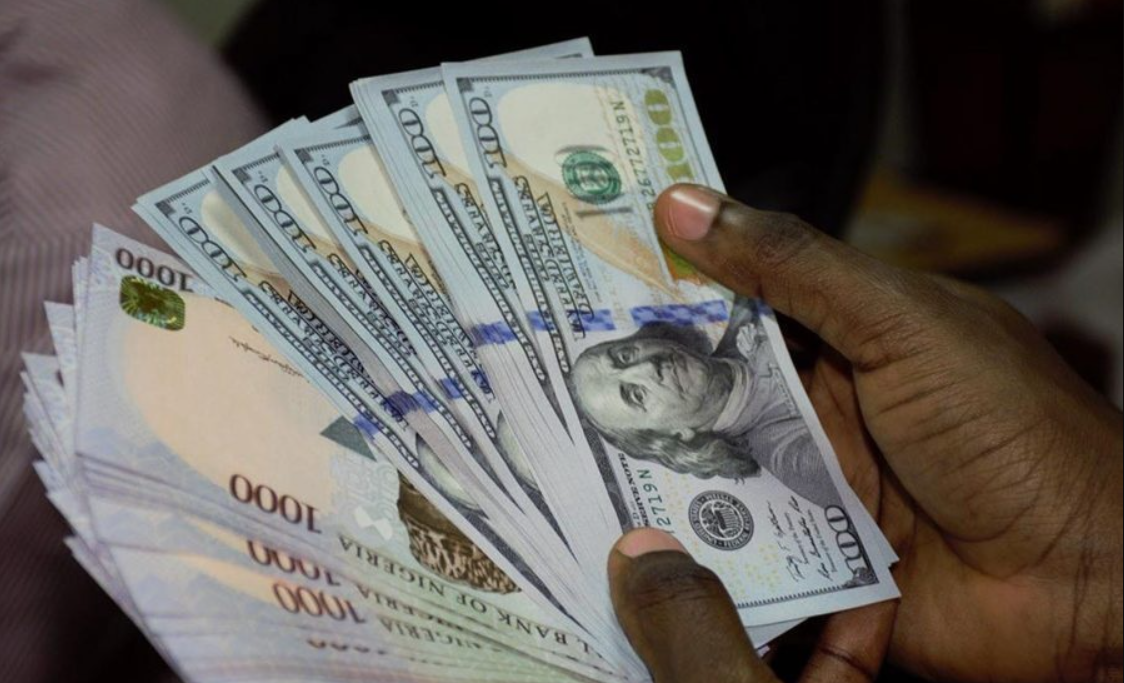
In the parallel market, also known as the black market, the naira weakened against the dollar, closing at ₦1,460 per dollar on Monday — a loss of ₦5 from ₦1,455 on Friday. Traders attributed the decline to a drop in market liquidity as inflows slowed.
According to a report by the research department of Coronation Merchant Bank, foreign exchange inflows through the NFEM fell to $899.20 million, representing a 15.7 per cent decline compared with $1.04 billion recorded the previous week. The report noted that the moderation in inflows was mainly due to reduced participation from foreign investors and corporates.

Read Also: Nigeria sees biggest jump in FX access ranking on reforms
Foreign Portfolio Investors (FPIs) remained the dominant source of inflows, contributing 60.13 per cent (about $540.70 million) of total market liquidity. They were followed by non-bank corporates, which accounted for 13.99 per cent, individuals (12.75 per cent), and exporters (12.56 per cent), while other sources made up the remaining 0.56 per cent.
The report stated that weaker inflows coincided with the naira snapping its two-week appreciation streak. The official exchange rate depreciated by 1.03 per cent week-on-week to close at ₦1,436.58 per dollar. Similarly, the parallel market rate weakened by 1.71 per cent week-on-week, settling at ₦1,465 per dollar. Consequently, the premium between the official and parallel market rates widened to ₦28.42 per dollar, up from ₦18.27 per dollar in the previous week.
On the reserves front, Nigeria’s gross external reserves rose marginally by 0.29 per cent week-on-week — equivalent to an increase of $127.10 million — to close at $43.32 billion as of 6 October 2025. The modest gain was supported by recorded inflows of $899.20 million and relatively lower outflows of $822.60 million during the review period.
Analysts at Coronation Merchant Bank expressed cautious optimism about the near-term outlook for the local currency. “In the near term, the naira is expected to remain below the ₦1,500 per dollar mark, supported by steady foreign portfolio inflows into the fixed-income market and improved market liquidity,” they said.

However, they warned that sustaining stability in the FX market would depend on continued reforms by the CBN, active investor participation, and consistent efforts to build external reserves amid global economic headwinds.
Market participants also noted that the moderation in inflows could be temporary, as upcoming Eurobond proceeds and seasonal remittances may strengthen liquidity in the coming weeks.
Despite the naira’s flat close, analysts said the current dynamics underscore the sensitivity of Nigeria’s FX market to foreign investment trends, global risk sentiment, and local policy outcomes. With foreign portfolio investors maintaining a strong presence, market watchers expect exchange rate movements to remain largely influenced by the pace of external inflows and central bank interventions in the weeks ahead.