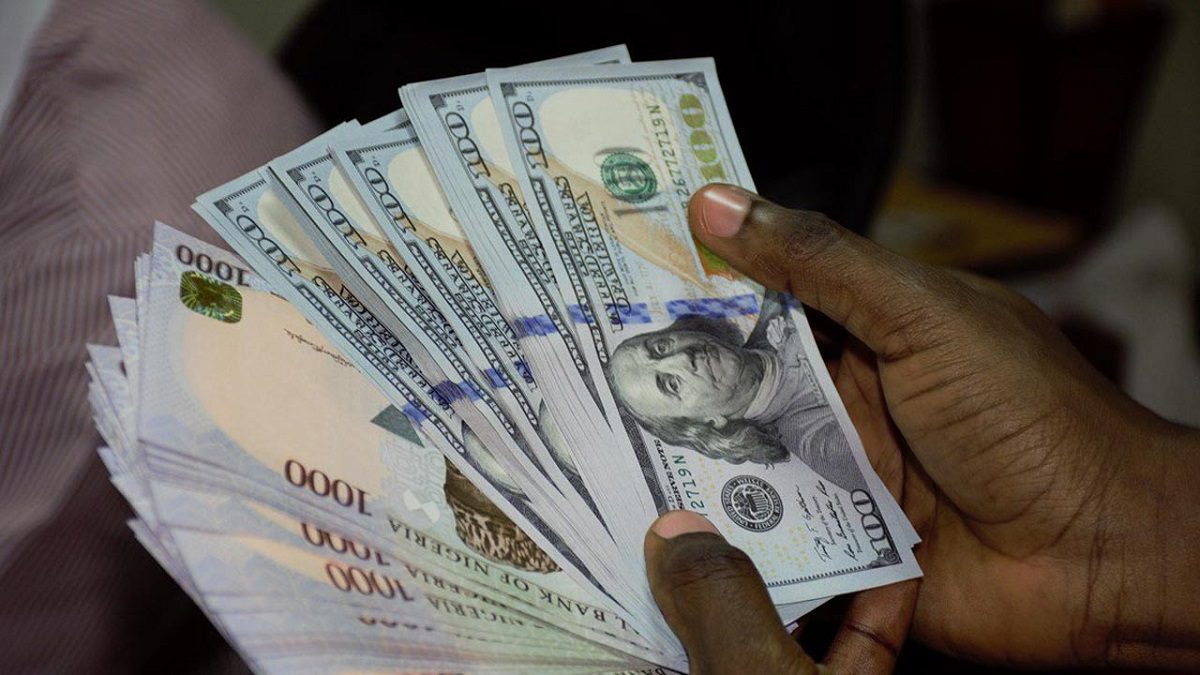
The naira has weakened against the dollar on the back of Donald Trump’s tariff turmoil that has triggered uncertainty among holders of local currency assets.
However, analysts are still betting on the naira, saying that the depreciation remains within expected bounds for economies with similar profiles, anticipating stabilisation in the near term.
Data from the Central Bank of Nigeria (CBN) showed the naira depreciated by N35.77 on the official market between last Wednesday and Friday, settling at N1,567.02 per dollar (from N1,531.25 on April 2).
Read also: Naira’s 3.6% fall against USD ‘reasonable’ compared to peers —JP Morgan

“I think small depreciation of the naira is in line with other currencies of similar economies. If we were falling beyond where other markets have, then maybe a concern would exist,” Zeal Akaraiwe, CEO at Graeme Blaque Advisory, said.
According to Reuters, the Nigerian and Ghanaian currencies are expected to be broadly stable from this week to Thursday, thanks to the support of the central banks of both nations. However, the Ugandan and Zambian currencies could fall, traders said.
Reuters said that Nigeria’s naira is seen holding steady as the Central Bank of Nigeria (CBN)’s dollar sales counteract pressure from foreign investors trying to pull their money to safe havens because of Trump’s changing tariff policies.
In response to renewed pressure linked to US tariffs and oil price drops, the CBN injected approximately $550 million into the official market last week.
This prompted JP Morgan to reverse its positive stance on Nigerian open market operations (OMO) bills last week. The firm now forecasts that a sustained decline in oil prices below $60 could push the USD/NGN rate above N1700/$, leading to greater losses on its March 3, 2025 OMO bill trade than what is exiting now at a less favourable N1590/$.

However, JP Morgan admitted that when compared to its peers as well as more liquid markets, the naira’s 3.6 percent move against the dollar over the past week has been reasonable.
Fitch Ratings upgraded Nigeria’s credit rating to B last week, citing improved policy credibility and reduced near-term risks to macroeconomic stability.
Read also: Naira blip temporary as analysts bet on rebound
Trump recently imposed 10 percent or more tariffs to US trading partners, citing imbalance in trade and payment. Though he subsequently put a 90-day pause on the tariffs, he imposed a 145 percent levy on Chinese goods. China, in retaliation, imposed a 125 percent tariff on US goods.
For Nigeria’s peers, the uncertainty stemming from Trump’s tariffs is expected to impact several African currencies. In Uganda, the shilling (UGX) is predicted to slip, with commercial banks quoting it at 3,680/3,690/$ on Friday, weaker than last Thursday’s 3,647/3,657/$ close.
The shilling is forecast to fluctuate between 3,660/$ and 3,720/$ in the coming week. Zambia’s kwacha (ZMW) is also anticipated to face downward pressure, trading at 28.39/$, up from 27.98/$ a week prior, largely due to a decline in copper prices attributed to the trade tensions.
Meanwhile, the outlook for the Kenyan shilling (KES), which stood at 129.30/80/$ compared to last Thursday’s 129.00/50/$, is less clear. Traders indicate its performance in the upcoming week will heavily depend on any further tariff announcements from Trump.
Akaraiwe said that the Nigerian market has demonstrated that there’s liquidity, and for foreign portfolio investors (FPIs) willing to exit, they can do so at the prevailing price, just as JP Morgan did.
“Their price sensitivity is very low because if you consider those that came in a year ago when it was around N1600/$, they earned a 25 percent yield and their breakeven would be $/N2,000,” he said.
“Paying N50 premium to exit is a no-brainer for them, especially coming fresh from the last few years. That’s why the parallel market didn’t react quickly as the demand has no access to that.”
Ike Ibeabuchi, an emerging markets analyst, noted that “the naira will rebound as the global market cools over Trump’s tariff pause and the economy benefits from recent reforms.”
“The fact that the Nigerian economy is not importing petrol at the moment will help, to some extent, to serve as a bulwark against external risks like Trump’s tariffs. It is not enough, but it will help in combination with other reforms However, oil price decreases could be a bigger risk.”
Read also: Trump’s tariffs threaten FMCG recovery as naira takes hit
Last week, the CBN announced that the country recorded a balance of payments (BOP) surplus of $6.83 billion for the 2024 financial year, from a deficit of $3.34 billion in 2023 and $3.32 billion in 2022.
JP Morgan remains confident of the Nigerian economy in the medium term.
“As we wrote last week, before the tariff carnage, we believe Nigeria will stay the course on its reform journey, especially after implementing the more politically difficult measures of eliminating fuel subsidies and allowing the exchange rate depreciate as well as become more flexible over the last 18 months,” it noted.
“We think the changes at the state oil company, NNPC, would bear fruit in the medium term, as oil proceeds should now flow more freely into the fiscal accounts, via the central bank.”