Nigeria’s power sector is feeling the squeeze as unpaid electricity debts from neighboring West African nations mount, deepening financial pressures on the cash-strapped industry.
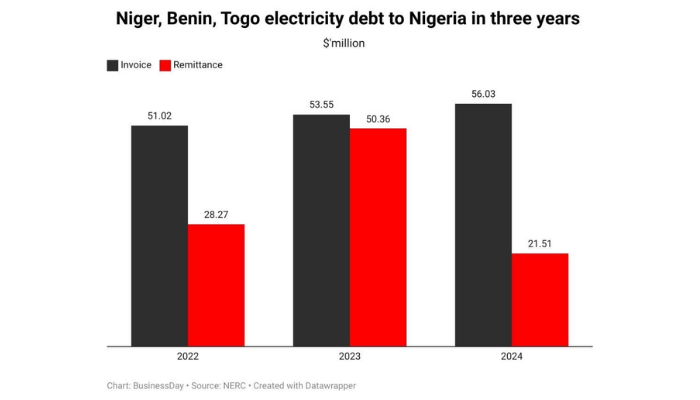
Data from the Nigerian Electricity Regulatory Commission (NERC) revealed Niger, Benin, and Togo owe Nigeria a combined $35 million (N55 billion) for power supplied in 2024.
A breakdown of the debts showed that Togo topped with $15.61 million, Benin followed with $15.48 million and Niger with $3.42 million in 2024.
Read also: Power sector advocacy: A pause and a review

For years, Nigeria has supplied power to its regional counterparts under the West African Power Pool (WAPP) and bilateral agreements, fostering economic cooperation. But the failure of some recipient countries to meet payment obligations is weighing on the country’s already fragile electricity market.
Experts say the growing debts threaten the financial health of local power generators and gas suppliers, which rely on payments to cover operating costs, invest in infrastructure, and settle their own obligations.
With cash flows squeezed, companies are struggling to procure spare parts, maintain facilities, and pay staff.
“Many GenCos sell power to these countries because our transmission infrastructure can only handle an average of 4,000 to 5,000 megawatts. On the face of it, it makes commercial sense but the pile of unpaid debt has thrown a spanner in the works,” said Chinenye Ajayi, team lead of the Power and Infrastructure Practice at Olaniwun Ajayi LP.
Nigeria’s international electricity customers include Paras-SBEE, Transcorp-SBEE, and Transcorp-SBEE (Afam 3) in Benin; Paras-CEET and Odukpani-CEET in Togo; and Mainstream-NIGELEC in Niger. These companies recorded lower debts in 2023, with outstanding payments dropping to $3.19 million from $28.27 million a year earlier.

“Some argue that exporting electricity brings in foreign exchange; the lack of assurance in payment raises concerns,” Ajayi said. “It’s one thing to sell power for forex; it’s another to ensure payments are made. There should be mechanisms in place, such as bank guarantees, letters of credit, or even sovereign guarantees, to secure these transactions.”
Read also: NERC inaugurates grid review panel to boost power sector operations
An analysis of the latest data from the Nigerian Electricity Regulatory Commission (NERC) shows that six international bilateral customers collectively paid $5.21 million of a total $14.05 million invoice issued for the fourth quarter of 2024—a remittance rate of 37.08%.
Among them, Paras-SBEE remitted $2.65 million, while Paras-CEET settled $1.64 million. Transcorp-SBEE (Ughelli) paid $1.71 million of its $3.59 million invoice, while Transcorp-SBEE (Afam 3) cleared $0.90 million of $1.2 million. Odukpani-CEET still owes $2.37 million. The only exception was Mainstream-NIGELEC, which fully settled its $2.60 million obligation.
Domestically, bilateral customers paid N1.25 million out of the N1.98 million invoiced, reflecting a remittance rate of 63.36%.
Nigeria should review its electricity export contracts to curb prolonged debt accumulation, said Tunde Akinbobola, an energy analyst at a Tier 1 bank. “It might be useful to review the contracts between Nigeria and these countries and understand why such a huge amount is being owed with little enforcement. The sector is already facing liquidity issues, making it unattractive to investors, and this worsens the situation.”
Delayed payments are also slowing Nigeria’s ability to upgrade power infrastructure, analysts say. The country’s energy sector is already grappling with aging facilities, inadequate transmission and distribution networks, and a growing domestic supply gap.
“The funds that are owed by neighboring countries could be crucial for financing these critical investments, which are essential for improving the reliability and efficiency of Nigeria’s energy supply, both domestically and regionally,” said Chinedu Uzordike, an energy analyst at Sofidam Capital.
The financial strain from unpaid debts could also force Nigerian companies to scale back or suspend exports altogether to manage cash flow pressures, according to industry experts.
Read also: Navigating Nigeria’s power sector liquidity crisis beyond the missed PCAF deadline
Beyond financial risks, the issue carries broader economic implications. Analysts stress the need for more robust and enforceable payment agreements with neighboring countries. “These agreements should include clear payment terms, robust enforcement mechanisms, and penalties for non-compliance,” Uzordike said.
Diplomatic intervention may be necessary to resolve the issue, experts added. “Bilateral discussions and regional forums like the Economic Community of West African States (ECOWAS) can provide platforms for finding amicable solutions and ensuring that payment obligations are met,” said a senior NERC executive who requested anonymity.