The Federal Government has kicked off a series of town hall meetings with a first edition at the City Hall in Nigeria’s commercial capital, Lagos.
The meeting featured ministers – Lai Mohammed (Minister of Information and Culture), Babatunde Fashola (Minister of Power, Works and Housing), Chibuike Rotimi Amechi (Minister of Transportation), Ibe Kachikwu (Minister of State for Petroleum), Geoffrey Onyeama (Minister of Foreign Affairs), and Okechukwu Enelamah (Minister of Industry, Trade and Investment).
Fashola says N2 trillion is required by the Federal Government to complete about 226 ongoing road projects across the country.
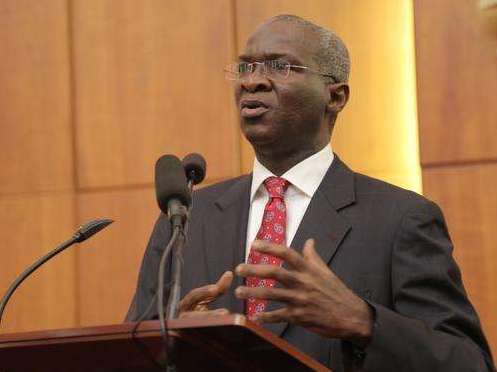
Fashola, who spoke in Lagos at a town hall meeting to brief the public on the activities of the Federal Government in the last 11 months, said the total amount allocated to all the sectors under his ministry in the 2016 budget was less than N500 billion, and stressed that the government did not have enough resources to complete all the projects at present.

According to Fashola, the focus of the government therefore, is to complete some of the projects and not to undertake new ones.
“The Ministry of Power, Works and Housing proposed N423 billion at the Federal Executive Council and the information reaching us is that we are not going to get all that.
“Ongoing road projects alone awarded by the government before we came – about 266 roads awarded in the various states – the liability to complete them is about N2 trillion.
“So, when you look at N400 billion, you know that that is not enough, but when you compare what this administration is going to do with the N400billion, with what the last administration did, you will know it is much progress.
“What the last administration did was to budget N18billion for all the roads in the country, knowing the liability was in excess of N2 trillion. For the three sectors, that is Works, Housing and Power, the total budget by the last administration was N24.5 billion. So, this administration decided to move away from that and that is why we have a figure that may not be enough, but substantial for the sectors,” he said.

In the power sector, the minister said though there were many challenges facing the sector, the government would do everything possible to fulfil its promise to revamp it.
He said the 5,000megawatts the country was generating was inadequate and explained that the government was completing some ongoing power projects and taking other steps to boost generation.
On electricity metering, Fashola said his ministry was engaging the distribution companies to ensure that they distribute metres to households.
He said it was through metering that consumers could be appropriately charged and that power companies themselves could block revenue leakages.
The minister said government was designing a housing model for the country that would not only take care of the problem of affordability but also take into consideration cultural suitability in every part of the nation.
Okechukwu Enelamah took the opportunity to buttress the benefits of the President’s recent trip to China one of which was that “China is also willing to give technical assistance to Nigerians on business.”
He noted the mismatch between available jobs and skills of Nigerian youths and announced that the ministry would embark on retraining.
Rotimi Amechi, who also disclosed that most of the rail lines would be standard gauge, announced the commencement of work on the Lagos-Kano rail line. For the Lagos-Kano rail, it will run through Lagos-Ibadan-Ilorin-Marina-Abuja-Kaduna-Kano. He pleaded with Nigerians to cooperate with the authorities if they are required to move their properties for the project.
Ibe Kachikwu informed the audience that ministry of petroleum was working on ideas that “will make everybody comfortable to bring in products.
“Over 30 percent of the fuels we supply in Nigeria are diverted outside Nigeria. Nigerians need to report these crimes. We need to begin to direct our energy towards solving problems that we can.”
He noted that for the first time in seven years, Warri and Port Harcourt refineries were working while Kaduna was expected to start production in a few days.
“One way to removing need for subsidy is to focus on ensuring refineries are functioning. We are doing that already,” said Kachikwu.