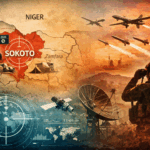
Terrorist groups operating in northern Nigeria will face further military action following Thursday night’s joint operation by Nigeria and the United States in Sokoto State, officials of both countries have confirmed.
Security sources said the strikes, which targeted suspected Islamic State (ISIS) enclaves, are ongoing, describing the initial operation as a “test run.”
The New York Times quoted a US military official as saying that about a dozen Tomahawk missiles were deployed in the strike, which hit areas close to the Niger Republic border where Islamic State-Sahel fighters have been attacking government forces and civilians. Nigeria’s Minister of Information, Mohammed Idris, later put the number at 16.
In a detailed statement, Idris said debris from the missiles caused explosions reported on Thursday night in Offa, Kwara State, and Jabo in Tambuwal Local Government Area of Sokoto State, triggering panic among residents.

The Tomahawk is a long-range, all-weather, subsonic cruise missile used by the US Navy and its allies for deep land-attack missions, capable of flying at low altitudes to evade radar and striking targets more than 1,600 kilometres away with precision-guided warheads.
A video released by the Pentagon showed at least one projectile being launched from a warship, while a US defence official said the strikes targeted multiple militants at known ISIS camps. The US Africa Command said its initial assessment indicated that “multiple” ISIS fighters were killed.
Chairman of Tangaza Local Government Area, Isa Saleh Bashir, said he could not confirm casualty figures but noted that the militants were hit. “They are certainly injured,” he said, adding that Niger Republic security forces on patrol reported seeing suspected Lakurawa fighters fleeing the area.
An area struck by one of the missiles in Tangaza LGA was still emitting smoke as of Friday afternoon.
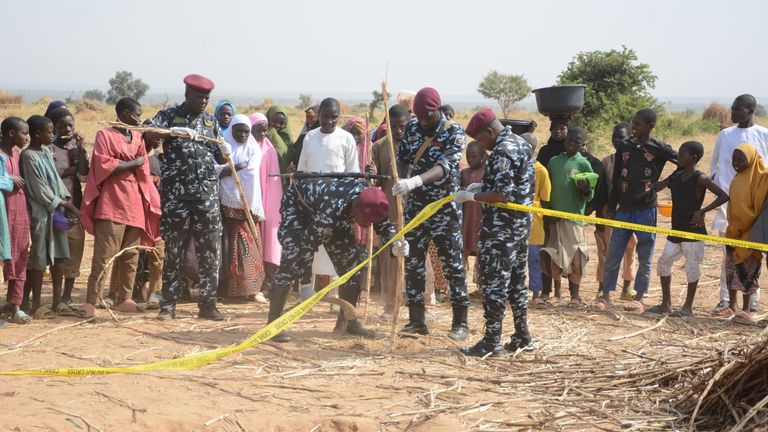
Residents of Tambuwal and Tangaza LGAs recounted scenes of fear and confusion as the operation unfolded. They said the skies first turned red, followed by deafening explosions. A team of police bomb disposal experts later cordoned off the affected areas in Jabo, Tambuwal LGA.

Shortly after the strikes, US Defence Secretary Pete Hegseth wrote on social media: “The @DeptofWar is always ready, so ISIS found out tonight — on Christmas. More to come…” He added: “Grateful for Nigerian government support and cooperation.”
Commander of US Africa Command, General Dagvin Anderson, also acknowledged Nigeria’s role, saying: “US Africa Command is working with our Nigerian and regional partners to increase counter-terrorism cooperation efforts related to ongoing violence and threats against innocent lives.”
Idris said the Bauni forest axis of Tangaza LGA was the primary target of the operation. According to him, Nigeria, in close coordination with the US, “successfully conducted precision strike operations against two major Islamic State (ISIS) terrorist enclaves” in the area.
“Intelligence confirmed that these locations were being used as assembly and staging grounds by foreign ISIS elements infiltrating Nigeria from the Sahel region, in collaboration with local affiliates, to plan and execute large-scale terrorist attacks within Nigerian territory,” he said.
The minister added that the strikes were carried out between 12:12 a.m. and 1:30 a.m. on Friday, December 26, 2025, following approval by President Bola Tinubu. He said the operation involved the Armed Forces of Nigeria and was supervised by the ministers of defence and foreign affairs, as well as the chief of defence staff.
“The strikes were launched from maritime platforms domiciled in the Gulf of Guinea after extensive intelligence gathering, operational planning and reconnaissance,” Idris said, noting that 16 GPS-guided precision munitions deployed via MQ-9 Reaper drones neutralised the targeted ISIS elements.
He confirmed that debris fell in Jabo, Tambuwal LGA, and Offa, Kwara State, but said no civilian casualties were recorded and security agencies promptly secured the areas.
“The Federal Government of Nigeria reiterates its unwavering resolve to confront, degrade and eliminate terrorist threats, particularly those posed by transnational extremist networks seeking to undermine Nigeria’s sovereignty and security,” Idris said, urging citizens to remain calm and vigilant.
Foreign Affairs Minister Yusuf Tuggar said the operation reflected long-standing calls for deeper security collaboration with the US. “It was Nigeria that provided intelligence for the US strike in Nigeria,” he said, disclosing that he spoke with US Secretary of State Marco Rubio before the operation and secured presidential approval.
Tuggar stressed that the action was a joint operation and not targeted at any religion. “We are a multi-religious country, and we are working with partners like the US to fight terrorism and safeguard the lives and properties of Nigerians,” he said.
In a separate statement, the Ministry of Foreign Affairs said Nigeria remains engaged in structured security cooperation with international partners, including the US, to address terrorism and violent extremism, adding that all actions are guided by the need to protect civilians and uphold national unity.
The Defence Headquarters also confirmed the strikes, saying the Armed Forces of Nigeria, in conjunction with the US, carried out precision operations against foreign ISIS-linked elements in parts of north-west Nigeria. Major General Samaila Uba, director of defence information, said the strikes followed “credible intelligence and careful operational planning” aimed at minimising collateral damage.
Meanwhile, Tangaza LGA chairman Isa Salihu told journalists that the missiles hit a known terrorist hideout used as a major route from Niger Republic. “We cannot yet confirm if targets were killed. We are awaiting detailed security reports,” he said.
The BBC reported that a separate strike hit a field in Jabo, south of Sokoto, with no casualties recorded. Traditional ruler of the town, Alhaji Abubakar Jabo, cautioned residents against picking metal fragments from the site.
In Offa, residents said fragments damaged buildings in parts of the town. “When fragments started falling, we thought a plane had broken apart. We thank God it did not claim any life,” said Biodun Alabi, a resident.
Sokoto State Government welcomed the operation, describing it as a positive step in curbing terrorism and cross-border crimes. Abubakar Bawa, director-general of media and publicity at Government House, Sokoto, said while no civilian life was lost, the full impact of the strike was still being assessed.