…Credit to government rises by 8% as private sector’s declines
Money supply (M3), a broad measure of the total amount of money in an economy, recorded a three-month low of N110.3 trillion in February, following liquidity mop-ups by the Central Bank of Nigeria (CBN), aimed at controlling inflationary pressure.
Money and credit data from the CBN revealed that money supply declined slightly by 0.6 percent month-on-month to N110.32 trillion in February 2025, marking a N622.9 billion drop compared to N110.94 trillion in January of the same year.
The last time money supply declined was in October 2024, when it dropped to N107.99 trillion from N109.41 trillion in September 2024.

Read also: How CBN policy is stabilising naira, boosting FX reserves
“This reflects the impact of the various monetary tools to moderate the volume of funds in circulation as part of the initiatives to curtail inflation,” said Ayokunle Olubunmi, head of financial institution ratings at Agusto & Co.
He said if the decline is sustained, it could further moderate the inflationary pressures.
Ayodele Akinwunmi, senior relationship manager at FSDH Merchant Bank, said the decline in money supply shows that the measure put in place by the CBN to curtail inflation, which includes mopping up of excess liquidity, is working. On the impact on the economy, he said, “It will have a moderating impact on inflation.”
On a year-on-year basis, the money supply increased by 15.5 percent from N95.55 trillion recorded in the corresponding period of February 2024, the CBN’s data indicated.

The Open Market Operation (OMO), which is one of the tools used by the CBN to mop-up excess liquidity in the system, surged 18 times in one year.
Data from the CBN revealed that the apex bank sold N11.8 trillion OMO to banks and investors in 2024, rising by 1,773.7 percent compared to N627.2 billion auctioned in 2023.
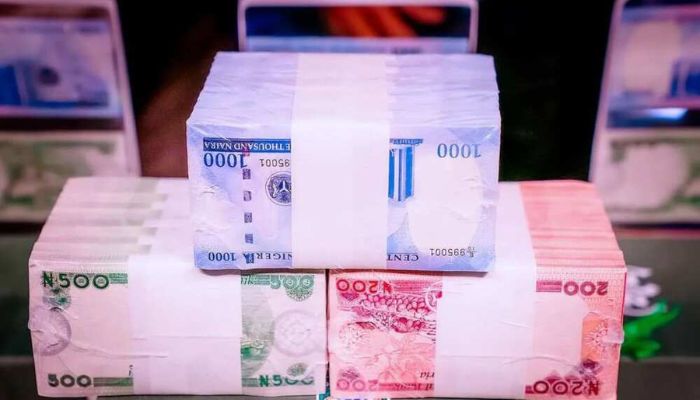
Currency in circulation hit a 13-month decline to N5.04 trillion in February 2025, representing a 3.6 percent month-on-month decline compared to N5.23 trillion recorded in January 2025.
However, on a year-on-year basis, currency in circulation declined by N1.35 trillion from N3.69 trillion in February 2024.
The federal government last year took a decision to halt the use of Ways and Means advances, a practice previously employed to finance budget deficits through borrowing from the CBN.
Read also: Senate confirms Nwakuche as CG NCos, Ayogu as CBN board member
Olayemi Cardoso, governor of the CBN, in November 2024, highlighted deliberate policy changes, emphasising fiscal discipline and monetary stability. In his words, “Under my leadership, we have taken decisive steps to move away from these practices. We have ended years of fiscal deficits financed through CBN’s Ways and Means advances, reinforcing our commitment to price stability and promoting fiscal discipline.”