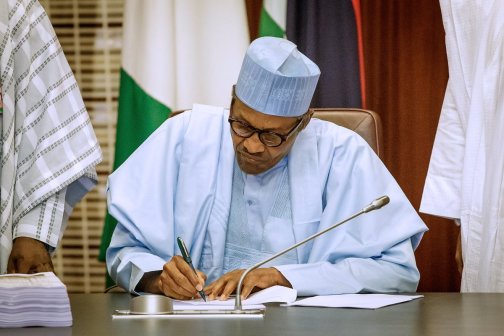
Eventually, the long-awaited ministerial list was sent to the Senate yesterday by President Muhammadu Buhari, following what appeared a subtle threat that should it failed to reach the National Assembly before Thursday this week, it would have to wait till after the legislators’ recess.
Close to two months after his inauguration, President Buhari had kept Nigerians in suspense over the list, a delay that had allowed varied speculations to fester.
Many Nigerians had begun to think that history was on play back; that the President may want to re-enact the six-month delay that featured in his first term. Recently, the President had said he was under pressure to announce the list, adding that unlike in his first term when strange people were forced on him, he had determined to select only those he knew. He has indeed, selected those he “knows”.
The list that was released yesterday looked very strange to many Nigerians. Many observers say there is nothing exciting looking at the constituents of the list. It is also their belief that nothing fantastic should be expected from a cabinet that will be constituted by those on the list.

The major criticism against the Buhari administration has been the perceived absence of vibrant economic team, which has also impacted the country negatively. It is left to be seen how the names on the list would eventually move the nation forward, economy wise.
An observer said, “Expect no surprises. In fact, there will not be anything striking. It is a lack-lustre list and anti-climax.”
It appears that what Nigerians are going to have this time around are angry ministers, who are going to approach their duties on the basis of “I will show them. They thought I would not get there, but here I am now.”
Some of the nominees contested for governorship, senatorial and other positions during the last election but lost. Some of them are still having their cases at the election tribunals. They are seething with anger and bitterness over their losses. If anything, they would be more interested in flaunting their ego and recouping the money they spent during their ill-fated electoral outing, than in pursuing the duty of their offices. Although they are to represent their states, to be the eye of the President in their individual states, but because they are not in the same party with their state governors (in some cases), they are likely going to work at cross purposes with such governors, albeit to the overall detriment of their states. They are likely going to build a parallel government within a state government to show their importance. They would establish their own power base and indigenes of their states are likely going to see a serious rivalry between state governors and ministers on a scale that has never been seen before.
The thinking in some quarters is that a number of the returnees had no basis making the list, if the target was great performance and development of the Nigerian nation. Some of them came back on the basis of their perceived contributions to the President’s re-election.

A cursory look at the activities of some of the returnees in the first stanza shows that their utterances did a terrible damage to the corporate existence of Nigeria. The question now is, is it what Nigerians are going to see again at a time they are hoping to see men whose words are seasoned with grace, and people with the balm that can soothe the too many wounds already being inflicted on the people?
A look at the list, at the face value, does not show names that are capable of taking the country to the ‘Next Level’, economy wise. There may be a few on the list who have been successful in their individual line of businesses, but they are largely unknown when it comes to playing at a level that can breathe life into the nation’s ailing economy.
For the nominees to make the needed impact and record appreciable success in their endeavours, they have to be weaned off animosity that has enslaved many politicians, and making it difficult for them to see the larger picture. If they are to make the desired mark, they should shun the rhetoric that had killed the spirit of brotherhood in Nigeria, by looking at their service, not just to the members of their party, but to all Nigerians, irrespective of party affiliation.
Again, despite the promise of giving the youth more opportunity this time around, it appears there are no youths there, in the real sense of the word. The list is, at best, a compendium of the geriatric. Where then is the justification for the much-vaunted #NotTooYoungToRun (lead/serve) law that came into being in June 2018?
Zebulon Agomuo