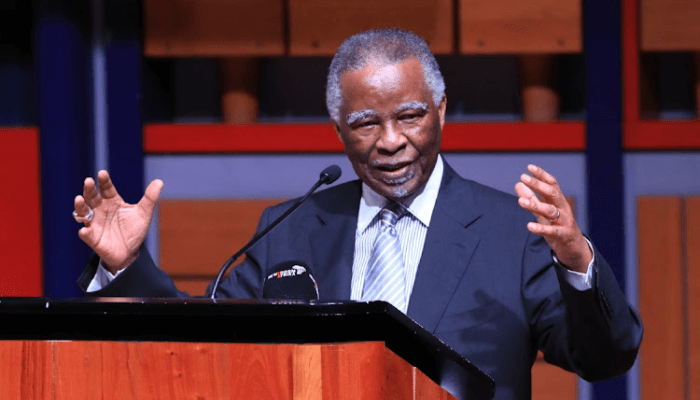
A South African-hosted dialogue on the Democratic Republic of the Congo (DRC), spearheaded by Thabo Mbeki, the former president of South Africa, has triggered fierce opposition from a prominent Congolese civil society movement, which accuses him of undermining existing peace efforts and misrepresenting the country’s history.
The Congolese Solidarity Campaign (CSC), a diaspora-based rights organisation, denounced what it called “Sun City II” – a reference to the 2002 talks in South Africa that produced a power-sharing deal but left deep divisions in Congolese politics. The new meeting, organised by the Mbeki Foundation at a Johannesburg hotel, has brought together Congolese political figures, including former president Joseph Kabila.
Read also:Alarm bells ring as Ebola surfaces in Congo, 15 dead
Kabila, who ruled the DRC for 18 years, is facing treason charges in absentia over alleged ties to the M23 rebellion, a group rooted in earlier Rwandan-backed insurgencies. His inclusion in the talks, the CSC argues, is provocative at a time when negotiations are already under way in Washington and Doha between Kinshasa, Rwanda and M23.
“By staging this conference, Mbeki is interfering in processes already in motion and threatening fragile progress,” said Shomari Mukandjwa, CSC spokesperson.

The CSC’s criticism goes beyond politics. The group accuses Mbeki of distorting history in his recent remarks about the Banyamulenge, a Congolese community of Rwandan Tutsi origin whose identity has long been a flashpoint in the east of the country.
Read also: Nigeria, Congo to expand trade, peace, cultural cooperation
Mbeki has suggested that discrimination against Banyarwanda-speaking communities lies at the root of recurring conflict. The CSC disputes this, pointing out that prominent Banyamulenge politicians – such as Azarias Ruberwa, Bizimana Karaha and Alexis Gisaro – have held senior government roles over decades. That history, they argue, undermines claims of systematic exclusion.
The group also challenges Mbeki’s suggestion that the Mai-Mai militias were created to persecute the Banyamulenge. Instead, they trace the movement’s origins to Lumumbist fighters of the 1960s, later absorbed into local self-defence structures that resisted Mobutu Sese Seko’s rule.
Read also: Congolese group condemns DRC-Rwanda deal, calls it “treason in disguise”

Underlying the tension is Mbeki’s longstanding friendship with Rwandan president Paul Kagame. Rwanda has been repeatedly accused by Kinshasa and the United Nations of supporting armed groups in eastern Congo while exploiting its mineral wealth.
The CSC suggests Mbeki’s narrative aligns too closely with Kigali’s, fuelling fears that external actors seek to legitimise Banyamulenge claims as part of a broader strategy to divide the DRC – a prospect often referred to in Congolese debates as “balkanisation.”
The Congolese government has refused to participate in the Johannesburg meeting, citing concerns about Mbeki’s impartiality. Civil society organisations were not invited either, deepening suspicion about the process.
Read also: Congolese solidarity campaign backs Swaziland struggle against absolute monarchy
In a strongly worded statement, CSC leaders accused Mbeki of repeating the mistakes of Sun City I, which they argue legitimised warlords and weakened state sovereignty. They urged him to focus on unresolved challenges in South Africa rather than “meddling” in Congolese affairs.
“Our people have suffered enough,” the statement read. “We do not need another Sun City that legitimises criminals at the expense of citizens.”
Despite their rejection of Mbeki’s role, the group said peace remains possible if Congolese themselves lead the process. “The Congolese are capable of finding their own solutions without guidance from those who hold prejudiced views of our nation,” it said.