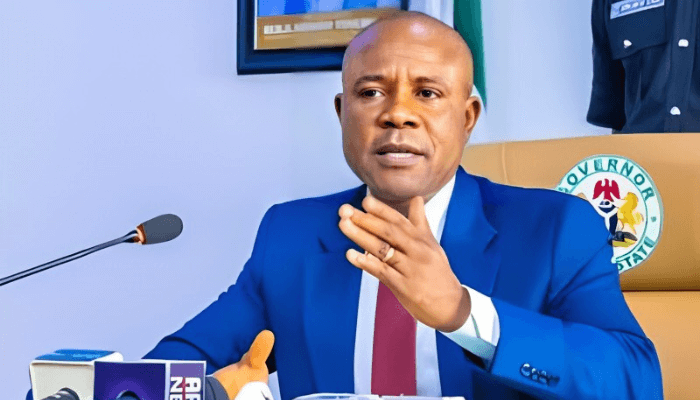
Peter Ndubuisi Mbah, the governor of Enugu State, has revealed plans to expand the State’s economy by nearly seven folds, emphasising his resolve to transform the state into a premier investment destination while slashing poverty to zero percent.
At the 2025 Nigerian-British Chamber of Commerce (NBCC) “Meet the Governor” series held on Thursday, Mbah laid out a multi-sector strategy spanning trade, agriculture, tourism, infrastructure, and technology, urging collaboration from the private sector.
“During our campaign for office, we set out a blueprint for Enugu. And it’s based on three critical factors. One is to grow the economy exponentially, growing from $4.4 billion to $30 billion in eight years.
“And of course, we also expressed ambition to achieve a 0% headcount rate in our poverty limits. Our ambition is to make Enugu State a premier destination for investment, policy, business, and income. These objectives are interconnected.

“We want secure neighborhoods, roads and transport networks that connect markets, schools that prepare young people for new industries, agro-industrial hubs, tourism sites, and full value extraction from all assets, above and below ground”, he said.
Mbah emphasised that government alone cannot drive this growth, highlighting the need for private-sector engagement. He also highlighted proactive measures to tackle security, a longstanding investor concern, and outlined Enugu’s expanding infrastructure footprint, now covering 70% of city roads.
On tourism, the governor signaled a push for mass tourism, citing natural sites and the state’s highest point at 585 meters as untapped attractions. Agriculture and value chains were highlighted as critical areas for both domestic growth and export potential.
Supporting Mbah’s vision, John Baxter, British Deputy High Commissioner, reaffirmed the UK’s commitment to Nigeria, describing the bilateral trade relationship as “dynamic, long-standing, and multi-dimensional,” currently valued at £7.9 billion—the highest ever—and growing annually.
“Nigeria is the United Kingdom’s second-largest trading partner in Africa and its largest export market. We are proud to be the biggest investor in Nigeria, accounting for 65% of all foreign direct investment flows into the country,” Baxter said.

He pointed to the Enhanced Trade Investment Partnership (ETIP), launched in February 2024, as a mechanism to remove barriers, strengthen public-private collaboration, and unlock growth across clean energy, education, health, creative industries, agriculture, finance, and legal services.
Baxter also emphasised regulatory support and the Developing Countries Trading Scheme, which allows Nigerian goods to enter the UK duty-free, noting that aligning local standards with international benchmarks would open broader markets and increase product value. Highlighting London’s role as a gateway for African firms, he said, “The London Stock Exchange hosts 117 African companies; New York hosts seven.”
Abimbola Olashore, NBCC President and Chairman, framed the event as a “living bridge between government and the private sector,” designed to turn dialogue into concrete investments. “The conversations that begin in this room can translate into bold investments, into new jobs, into stronger institutions, and into opportunities that extend well beyond the boundaries of Enugu State,” he said.
Mbah’s ambitious blueprint, combined with the UK’s endorsement through ETIP, could position Enugu as a focal point for both domestic and international capital. By prioritizing infrastructure, security, agriculture, and education, the state aligns with broader regional efforts to diversify economies away from oil dependence.
As Enugu accelerates reforms, the twin signals of domestic policy and external validation are likely to attract both capital and expertise, potentially establishing the state as a hub for trade, technology, and tourism in South-East Nigeria.