Workers’ welfare in Nigeria must go beyond ceremonial speeches every May Day. As the world marks Labour Day, Nigerian workers once again voice familiar grievances—low wages, rising costs, and poor working conditions. The 2024 strike, barely a month after last year’s celebration, brought the nation to a halt. Labour demanded N615,000; the government countered with N48,000. After public outcry and presidential intervention, a N70,000 deal was struck.
Yet, this annual cycle of protest and compromise is unsustainable. In a country grappling with inflation, informal employment, and job insecurity, fair wages and decent work must become everyday concerns—not yearly debates.
Beyond pay, Nigerian workers deserve access to healthcare, job security, dignity, and upward mobility. The conversation must shift from survival to sustained progress.
From pay to purpose

The expectations of Nigeria’s workforce are shifting—and fast. According to the National Bureau of Statistics (NBS), just 26.3% of workers had access to pension and health insurance in 2023. The National Health Insurance Scheme (NHIS) puts coverage at under 5%, with over 70% of Nigerians still paying out-of-pocket for healthcare.
These are not just data points. They are everyday realities. Behind each percentage is a worker skipping a doctor’s appointment because of cost, a family dealing with job loss without a safety net, or a young graduate taking whatever job comes first—not because it fits their skills, but because it pays something.
And yet, there is hope. Workers across sectors—from teachers in Ogun to tech developers in Lagos—are increasingly vocal about what they value: stability, respect, health, growth. These aren’t frivolous demands. They’re the foundation of a productive workforce.
Global trends, local realities
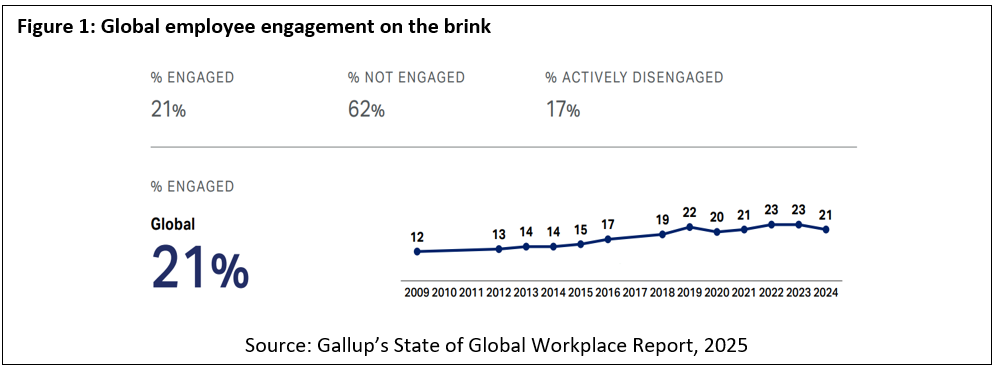
Gallup’s 2025 State of the Global Workplace report shows that only 21% of employees worldwide are engaged at work. Beyond pay, workers increasingly value respect, emotional support, growth opportunities, and mental health care. Engagement is closely tied to well-being—50% of engaged workers say they’re thriving in life, compared to just one-third of disengaged peers. Yet 40% of global employees report daily stress, with Sub-Saharan Africa among the highest.

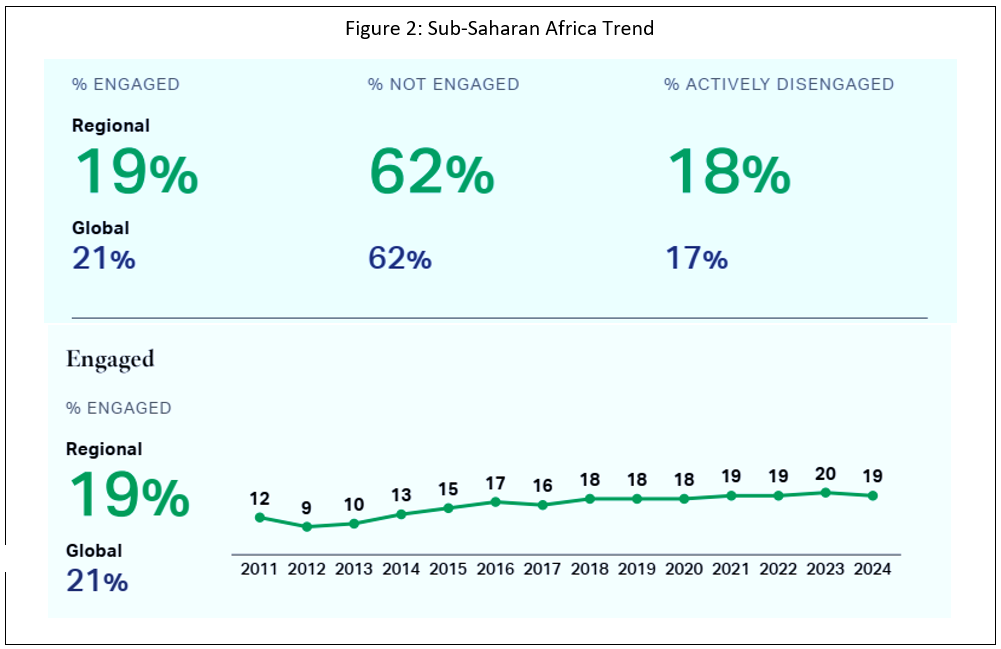
Similarly, the level of worker’s engagement in sub-Saharan Africa dropped by 1 percentage point from the 2024 figure of 20% and falling below global average. The image shows that only 19% of workers in Sub-Saharan Africa are engaged, compared to the global average of 21%. A striking 62% are not engaged, and 18% are actively disengaged. Regional engagement has plateaued since 2019, highlighting a persistent challenge in workplace motivation and employee well-being across the region.
Closer home, the NBS Labour Force Surveys from 2024 tell a more nuanced story. While the unemployment rate stands at 4.3%, underemployment—people working in jobs that don’t match their skills or provide adequate income—remains at 9.2%. This isn’t just about getting a job. It’s about getting the right job.
Nearly 15% of Nigerian youth are neither in education, employment, nor training. Meanwhile, 27% of the workforce has no formal education at all. When opportunities are this uneven, ambition becomes a privilege. That needs to change.
The data also shows a steady transition from rural to urban employment—57.7% of Nigeria’s workforce is now urban. This urbanisation is reshaping preferences. Workers are moving toward sectors offering better pay, structure, and prospects. Agriculture and retail remain dominant, but the real story is in the silent migration—toward a better life.
According to the World Economic Forum’s Future of Jobs Report 2025, 96% of Nigeria’s core job skills are expected to change by 2030—higher than the global average. This tells us two things: disruption is inevitable, and the ability to adapt will define who thrives.
The good news? Employers are catching on.
About 40% of Nigerian workers are projected to be reskilled within their current roles, and 22% retrained for new ones. Some of the most forward-thinking companies in Nigeria are already treating jobs as platforms for evolution, not fixed roles. They’re investing in people—not out of generosity, but necessity.
Seventy-three percent of Nigerian employers now support public funding for skills development. Eighty-three percent have active diversity, equity, and inclusion strategies. And in an era where attracting and retaining talent is a battle, well-being is no longer a soft idea—it’s a core business strategy.
A new social contract is emerging
What’s unfolding in Nigeria’s labour market is more than a policy debate—it’s a reset of expectations. The future of work in Nigeria isn’t just about better salaries; it’s about building workplaces where people feel safe, heard, and empowered.
There’s a growing understanding that job satisfaction is multidimensional. It includes fair compensation, yes. But also mental health support, career development, psychological safety, and a sense of purpose.
And this is not some imported idealism. Nigerian workers are making it clear—through union demands, quiet quitting, migration patterns, and workplace activism—that they want more. Not more in naira alone, but more in meaning.
This is a pivotal moment for both government and private sector leaders. As inflation bites harder, digital transformation accelerates, and young Nigerians continue to flood the labour market, the question is no longer “what can workers do for companies?” It’s “what can companies do to keep their workers?”
A resilient workforce isn’t built on slogans. It’s built on systems—health insurance, upskilling programs, affordable childcare, flexible work policies, and retirement plans. These aren’t perks anymore. They’re essentials.
Because what Nigerian workers want in 2025 isn’t just a monthly alert from payroll.They want to be seen. They want to grow. They want dignity.
And if we get that right, the dividends will be shared—by workers, by businesses, and by the nation at large.